By Prof Chris Kwaja
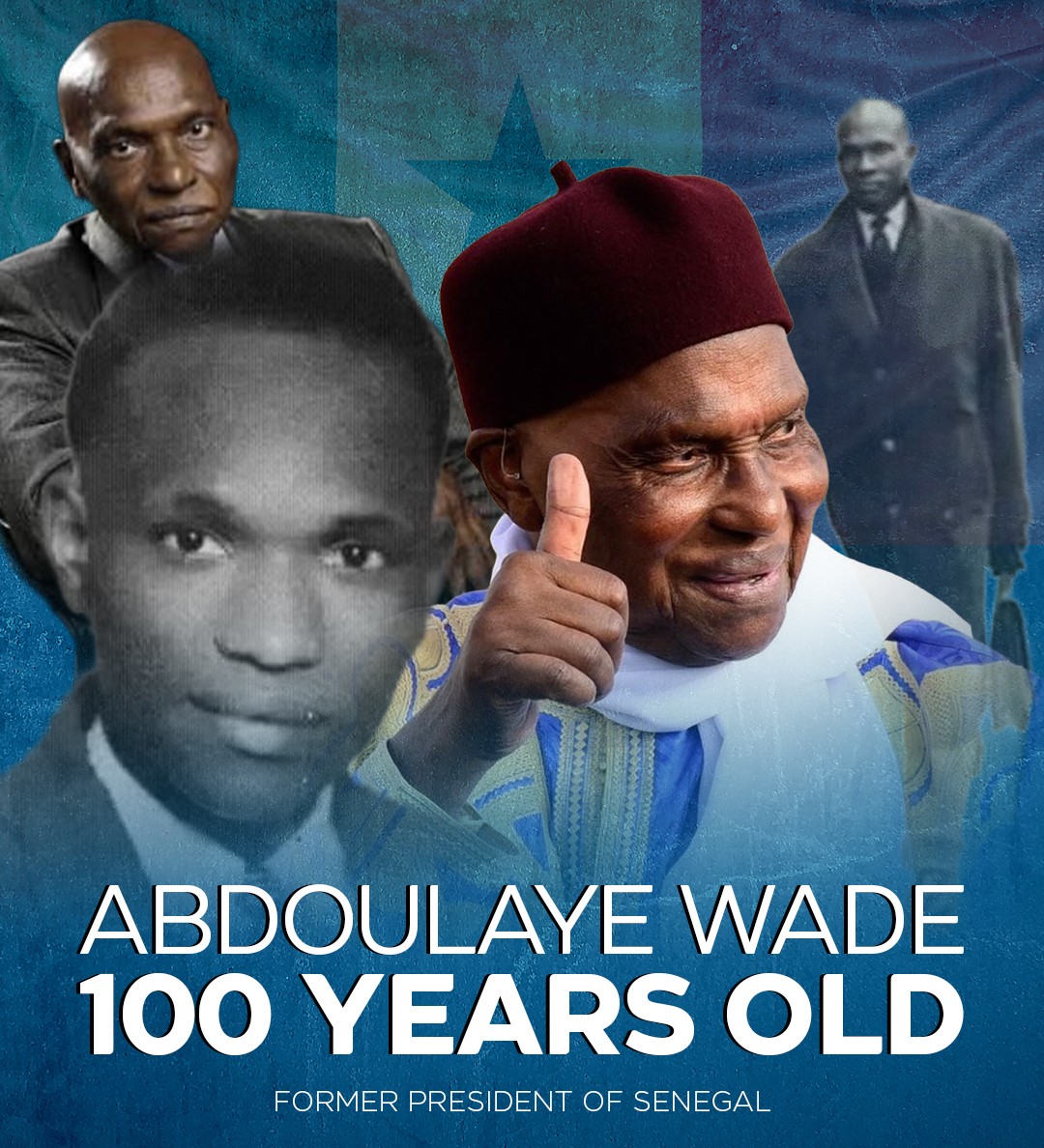
Indeed, God has been gracious to Abdoulaye Wade, former president of Senegal. He clocks 100 years.
Beyond his role as President of Senegal, he was a staunch pan-Africanist and a key visionary behind the co-founding of the New Partnership for Africa’s Development (NEPAD), aimed at boosting African economic autonomy. He can best be described as one of the founding fathers of the modern African Union.
Before becoming president, Wade spent nearly three decades as the leader of the opposition. Despite being jailed multiple times by the ruling regime, he never turned to violence or armed rebellion. He fought strictly through the legal system and the ballot box, earning immense respect as a champion of peaceful democratic struggle.
Wade holds doctorates in both law and economics from France. He was a highly respected university professor and dean of law in Dakar. People respected his immense intellect, sharp legal mind, and eloquent speaking skills. This level of intellect and experience accounted for the thought leadership he deployed to governance as a pan-Africanist.
Abdoulaye Wade reshaped Pan-Africanism by pivoting it away from purely ideological anti-colonial rhetoric and transforming it into a pragmatic, economy-first development model. As the movement transitions into a modern era—marked by a rising youth demographic and a shift toward “Neo-Pan-Africanism”—Wade’s intellectual blueprints continue to heavily influence how Africa envisions its economic sovereignty and its relationship with the global diaspora.
Historically, Pan-Africanism under founding fathers like Kwame Nkrumah focused heavily on immediate, total political unification. Wade, an economist by training, shifted the approach toward institutional and infrastructural integration.
Wade formulated the “Omega Plan,” focusing on regional infrastructure, education, and health. This plan directly merged with Thabo Mbeki, Obasanjo and others’ initiatives to birth the New Partnership for Africa’s Development (NEPAD), which established a formal framework for economic self-reliance across the African Union (AU). The “United States of Africa” Agenda: Alongside Libya’s Muammar Gaddafi, Wade was one of the loudest 21st-century champions advocating for a highly unified, borderless continent. He envisioned an Africa using its massive natural and human resources to manufacture wealth rather than remaining dependent on Western aid.
Wade also spearheaded the formal AU initiative to recognize the global African diaspora as the “Sixth Region” of the continent. Following the tragic 2010 Haiti earthquake, he famously offered land and automatic repatriation to any Haitians wishing to return to their ancestral homeland.
As Wade reaches his centenary milestone, the mantle of Pan-Africanism should be picked up by a new generation. This future iteration of the movement must take distinct structural shapes: eliminate destructive economic competition between African states and build internal supply chains; shared digital spaces, transnational pop culture, and cross-border civil activism; achieving global justice, and demanding the restitution of colonial-era stolen artifacts, and leveraging the diaspora for direct institutional investment rather than philanthropic aid.
Happy Birthday, “Maître Wade”.
The author is a Nigerian scholar cum politician