By Y. Z Ya’u
Dear compatriots, friends, colleagues and comrades, on behalf of the Planning Committee for this Symposium and the entirety of the Osoba for Eternality Platform, I welcome you to this symposium, the second in a series that aims at honoring our departed comrade, Dr. Segun Osoba. The Osoba for Eternity platform is an open space, consisting of members from the Osoba family, members of the Bala Usman Institute, Zaria, members of ASUU, comrades, friends, ex-students, mentees of Osoba, and others who share the ideas and passion of Dr. Osoba for the social transformation of Nigeria.
Dr. Osoba lived and struggled, both through the body of his ideas and work as well as his involvement in movement politics, for the emancipation of the poor, the enthronement of social justice and economic transformation of the country. The symbolism in the name we have given ourselves, that is Osoba for Eternity, is that unlike the human body which merges back with the earth, ideas are eternal and will continue to resonate with society when they speak to the realities of that society. Osoba is (and I use ‘is’ rather consciously) is an embodiment of ideas that should be treasured and made widely to the wider public.
The Osoba for Eternity commits to the preservation and amplification of Osoba’s ideas. It hopes to do this through the convening of forums like this, among others, the celebration of the good scholarship he has left behind by instituting annual Osoba prizes in some of our universities, and the efforts to build both a foundation in his name as well as a broader institute for the preservation and promotion of left ideas and struggles in the country. The outcomes of this symposium as well as the earlier one, will be part of a broader book of tributes that will be published in the coming weeks. Such a distillation of the array of idea by eminent speakers today, will serve to illuminate the Nigerian condition, continuing the task that Osoba set for himself and which he discharged with such brilliance and condone. It is his endearing deployment of knowledge in the bid to make sense of the challenges and to contemplate of the making of a radical rapture of the colonial state in Nigeria, that has made many us here and many more outside this hall to embrace him as a mentor and teacher.
This symposium is the second in the series, coming barely a month after a similar one was held in Ijebu-Ode, a day after his funeral rites. Through this, we want the people beyond academia and the movement to know and appreciate his ideas, which have continued to remain relevant in the discourse and struggle for a better Nigeria.
You will recall that in 1977, along with his compatriot, Dr. Bala Usman, Dr Segun Osoba articulated a body of ideas that came to be referred to as the minority report submitted for the consideration of Nigeria but which was rejected by the military junta in favour of the one produced by the coterie of 47 others. That document, which we are sharing this morning courtesy of the Bala Usman Institute, represented the view and aspirations of the majority of Nigerians, and as Prof Ibrahim Abdallah of the University of Sierra Leone and member of this platform, insists, it should be regarded and referred to as the majority report rather since what the military opted for was the constellation of the views of the tiny ruling class.
That today, both outside and within our national assembly, we are passionately debating our constitutional order, underlines the fact that the submissions they made remain relevant and that the ideas that the military opted for have continued to show that they do not provide for the true aspirations of Nigerians. At this stage, I would like, on behalf of the Platform, to invite the members of the National Assembly to read and digest this document, and we will provide them with copies for this purpose.
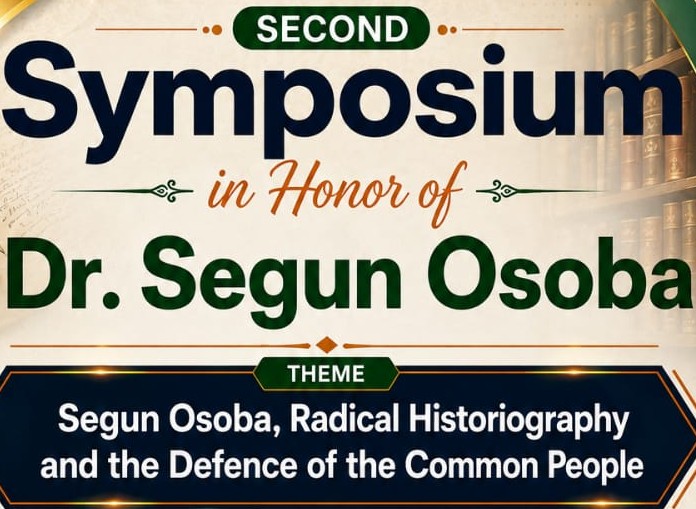
The symposium today with the theme Segun Osoba, Radical Historiography and the Defence of the Common People, provides an opportunity for scholars, activists, labour leaders, gender activists, etc, to reconnect with the ideals, scholarship and struggles of Dr. Osoba in the light of the current reality, not only in the country, but also globally. We do this not just for the sake of intellectual self-satisfaction but because we believe that in doing so, we will find a way and compass to direct the struggle for a just constitutional order that will provide the foundation for the building of a just Nigeria where justice and development would free us from the mass poverty and misery that have enveloped the country.
I invite you to engage rigorously with the issues because that is how we can only honor Dr. Osoba, who himself was a rigorous scholar, who looked at any idea or issue deeply. Dr. Osoba taught and lived in Ife but was a constant reference in trade union Circles, student movement, gender justice struggles, and, in fact, in all shades of struggle for justice in the country. Pan Nigerianism came to him logically as he saw the struggle in Nigeria not in ethnic or religious prisms but one that fitted the oppressed against the oppressors wherever they are. He was a principled, brilliant scholar who forsook titles for rigor and who sacrificed personal comfort for the development of a body of ideas that could transform the country, free the poor from the bandage that the neocolonial superstructure has imposed on us as a people and country.
We hope that this engagement, like the previous one before it and the subsequent ones to come, will help to define our mission as patriots who are committed to the remaking of this country. We do not take ideas as ornamental pieces to decorate our speech. We take them as tools for action, and we invite you to do so. We thank the Osoba family for giving us Comrade Osoba and allowing us to appropriate him as a compass for national development. By this, we have all become members of that large family that Osoba himself had nurtured over the years. That pan-Nigeria family will continue to grow and become an influential force in the transformation of Nigeria. Osoba has died but his idea will continue to live. As I take my sear, let me thank all those who have contributed one way of the other in making this symposium possible. May we have a productive and fruitful meeting that add values to the struggle for a better Nigeria.
Thank you very much.
Text of Welcome Remarks On Behalf of the Planning Committee