By Hassan A. Saliu
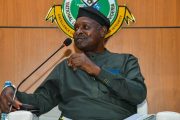
This piece is aimed at formally introducing Prof Ibrahim Agboola Gambari as the Board Chairman of the reborn Nigerian Society of International Affairs (NSIA). It is also to welcome Prof Gambari to the Board of the NSIA. Writing to introduce his kind of personality poses its own peculiar challenges. Each time his name is mentioned, people instantly remember his service to the UN and, invariably, other parts of the world. Putting his life together into a single piece can be challenging indeed. What this author has done is to avoid reproducing, as much as possible, what I had said about him in two previous attempts, and to concentrate on the new layers or developments.
Prof. Gambari has served both in Nigeria and abroad with remarkable impact. He joined the league of Nigerians who have served the UN creditably, beginning in January 1990 as Ambassador and later rising in the UN hierarchy. He followed in the footsteps of Simeon Adebo, who had the honour of contributing to the early announcement of Nigeria’s arrival on the world stage. Adebo consequently raised the bar by rising to the enviable position of one of the Assistant Secretaries-General of the UN.
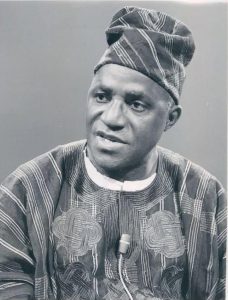
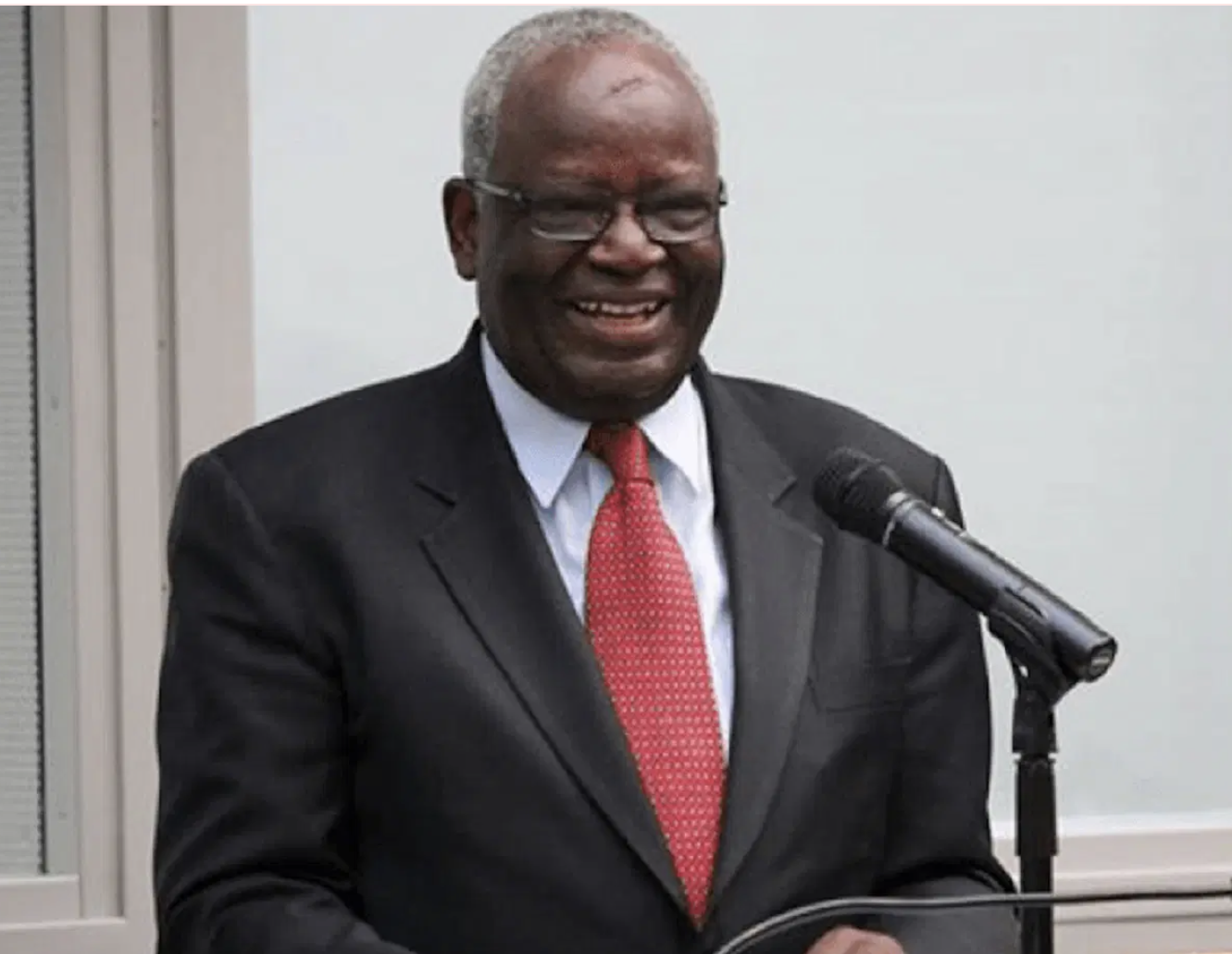
The younger Chief Adebo in a Facebook pix
Politically, we have had Nigerians who have headed the General Assembly and the Security Council. Both General Joseph Garba and Prof. Tijjani Bande were, at one time or another, Nigeria’s able Ambassadors in New York who headed the General Assembly. Other distinguished Nigerian Ambassadors to the UN who have made Nigeria proud include: Maitama Sule, Arthur Mbanefo, Aminu Wali, and others. Amina Mohammed is currently serving as Deputy Secretary-General of the UN, thereby raising the profile of Nigeria at the UN.
The subject of this tribute did not serve as President of the General Assembly but has had the opportunity to head the Political Affairs Directorate, the Peacekeeping Committee, and other administrative committees of the organisation. He has also served the organisation in critical assignments across the world, to the extent that he is more known in the UN hierarchy than in some sectors in Nigeria. He served in the UN for about 22 years before developments in the Nigerian sector led to his departure from his UN post around 2012.
Prof. Gambari was born in Ilorin in 1944 into a royal bloodline. He belongs to the Abdulsalami royal line. His grandfather and three of his uncles have served as Emirs of Ilorin. He himself holds the traditional title of Wambai of Ilorin. He attended three major schools in Nigeria before moving out of the country for further studies. He started with a primary school in Malete, a rustic rural area, before its gradual transformation into an urban centre, enabled by the siting of a university in the town in 2009. He later went to the Ilorin Provincial School, Ilorin, now known as the Government Secondary School, Ilorin. He moved from there to King’s College, Lagos, for his A-level subjects.
The next port of call for the Professor in his search for knowledge was the London School of Economics and Political Science, where he bagged a degree in Economics in 1968. His master’s degree and PhD were obtained in the USA, with his last degree specifically from Columbia University in 1974. He taught briefly in the United States before returning to Nigeria to join the services of Ahmadu Bello University, Zaria, in 1977.
At Zaria, he tried to put his degree in International Relations to good use by starting the International Studies programme that has gained some prominence in the country: Political Science and International Relations programmes are running pari passu in the Department and the university up to the moment.
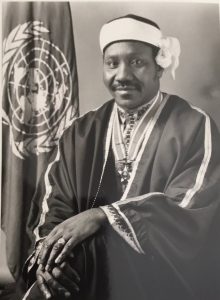
Gen Joe Garba, another Nigerian diplomatic show stopper at the UN
Enough of university engagement. He spent time as the Chairman of the Kwara State Polytechnic, Ilorin, in the 1980s. He later got noticed by the Shagari civilian government, which appointed him as the Director-General of the Nigerian Institute of International Affairs (NIIA), Lagos in 1983. He had hardly gone through all the files at the Institute before he was beckoned on to serve as the External Affairs Minister of Nigeria by the Buhari military regime in 1984. A change of government that brought about the Babangida regime made him vacate office as minister less than two years after. The events of the coup created their own dynamics that may have prevented him from engaging early with the new military regime. Five years later, he was named Nigeria’s Ambassador to the UN in January 1990. In my reckoning, this was a breakthrough appointment for Prof. Gambari: the appointment literally opened him to the world.
It has been one engagement or the other for him ever since. While on the UN beat, which lasted for more than two decades cumulatively, his period of service could be viewed in two phases: the period of ambassadorial posting and the period of his service as a UN staff. Evidently, he was instrumental in bringing about some positive and remarkable developments. One, he was instrumental to the resumption of peacekeeping efforts in Somalia. Two, he campaigned vigorously for a Nigerian to be UN Secretary-General in 1991 and later for an African, which found expression in the appointment of Boutros Boutros-Ghali and later Kofi Annan. Three, he raised his voice loudly against the genocide that took place in Rwanda. On this occasion, Prof. Gambari placed the blame where it should be: on the UN and the Western powers. The peace missions that he undertook for the UN were too extensive for all to be captured in this tribute. In a few words: Prof. Gambari contributed greatly to resolving conflict situations to which he was deployed.
As a kind of golden fish, he has been honoured at home and abroad for the quality services he has rendered to humanity. He holds national honours in Nigeria, Rwanda, Angola, South Africa, and other countries. The list of universities that have awarded him honorary doctorate degrees is ever increasing, and he is a visiting professor to some universities, including those in South East Asia. His book on Politics and Nigeria’s Foreign Policy under the First Republic was a must-read book for students of Nigeria’s foreign policy during our students’ days. He has followed up on this with another book sharing his experiences as Nigeria’s External Affairs Minister.
As a minister, he made some noteworthy achievements. His subscription to the thesis of concentric circles injected some theoretical clarity into Nigeria’s foreign policy. In a recent intervention on Nigeria’s foreign policy, I had alluded to the fact that a careful reading of the concentric circles would reveal that the concerns of the new thrust are well embedded in the concentric circles thesis as espoused by Prof. Gambari. It is noted that while foreign policy thrusts are mobilisational in a way, this can hardly be achieved when they are not properly conceptualised and marketed.
Prof. Gambari is a Nigerian scholar-diplomat who has served at the state and federal levels. For instance, he was the first Chancellor of Kwara State University, Malete. At the federal level, he was a member of the last constitutional conference held in Nigeria. The reader can see why Prof. Gambari is eminently qualified to chair the Board of the NSIA. His theoretical grounding, extensive networks, and practical experience are relevant to the mission of NSIA.
Prof Hassan A. Saliu, the author of this piece as well as the immediate past president of the Nigerian Political Science Association (NPSA) is the Interim President, Nigerian Society of International Affairs (NSIA)