By Adagbo Onoja
“If I win the presidential election, I will restore the subsidy. And anyone who stole Nigeria’s subsidy funds must return the money.” – Atiku Abubakar
There’s a sense in which this single sentence captures what Alhaji Atiku Abubakar of the African Democratic Congress (ADC) is saying on fuel subsidy should he win the coming presidential election. It is the one sentence which has framed Nigerian politics into those for return of subsidy and those against the returning of subsidy. And this frame game is coming at a time when citizens have understood subsidy removal as another grammar for aggravated suffering and mass misery, thanks to their experience of life since May 29th, 2023.
So, with just one sentence, so to say, Atiku has moved himself from a hated figure in many ideological circles which have fought the withdrawal of subsidy, positioning himself as a potential nodal point for routing neoliberalism in Nigeria at last. That is because fuel subsidy passes for the core of neoliberal logic in Nigeria, having been the spark for explosive contestation of state power since 1986 especially by students and labour.
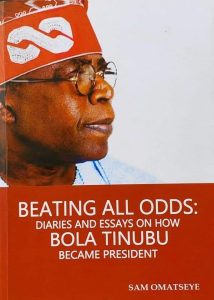
Confronting subsidy backlash in 2nd term bid!
However, the big question remains. Nigeria, the self-understood giant of Africa, has not been lucky to have a dreamer, a crusader, an angry ideologue, whether of the right or of the Left, as president since 1999. At every turn, someone poorer in vision has turned up after all said and done. Each time it happened, the threshold drops much, much lower. So much so that many are, for instance, not prepared to be part of any struggle for change anymore. Each time they have fought for a change, someone worse would be thrown up.
Is it then the case that, this time, fuel subsidy has provoked the antagonism between those for it and those against as to resolve the impasse of Nigeria’s entrapment in deceptive, apologetic agents of neoliberalism? And is Atiku Abubakar the resolution? This is the big question.
Atiku Abubakar may sound the unlikely hero in emerging as such a nodal point for a prolonged and hurting struggle against fuel subsidy but the dynamics are working out in such an ironic manner that only those who may be suffering from the ‘Thales of Miletus syndrome’ may still have difficulty in coming to terms with the heroism he is fast acquiring as a result of his stand on the matter. The classical tale used to illustrate the problem of thinkers, the men and women of ideas, thinkers of big pictures or radicals who could still be looking at the sky to ascertain astronomical indicators of an impending rain when the rain is already falling. So, they get beaten by the rain. That is, anyone who can’t see a very messy but radical development unfolding with his pronouncement is replicating the ‘Thales of Miletus’ in contemporary times.
So, the big question comes with a theoretical cum ideological significance for critical observers in what is unfolding. Even if Atiku doesn’t go farther than this pronouncement, he has already shocked those whose ideological breeding has assigned change to pre-determined agency of the working class or radicals. Atiku, the ‘speaking subject’ in this anti-fuel subsidy pronouncement belongs to neither the category of the working class nor radical middle class activists. But he can transform into a change agent, depending on how the leaders of the working class (which, according to Femi Falana, is currently missing in action) and the radical activists move from class essentialism to discursive contestation of space through hegemonic articulation of Atiku’s position which has coincided with its. The theoretical take-away is that no object, no individual, no phenomenon, language or entity has a final, authoritative and universal meaning. Meaning keeps changing because the social world itself is a discursive world, discourses which are themselves inherently vulnerable to rupture, now and then.
Of course, Nigerian activists will be particularly justified to raise the question of how far Atiku can be trusted to be faithful to his pronouncement should he get into power. They will not be missing the point in asking such question, not after what happened in 2012 when, as it were, they were used against President Goodluck Jonathan over fuel subsidy. However, Atiku and his promise of reinstating the subsidy is not about whether he will keep that promise or not but about one member of the establishment who has broken ranks to offer a contrary and, as it is now, a popular position at a time when the everyone is exhausted in fighting the neoliberal menace. The challenge may thus lie more in what Prof Peter Ozo-Eson, then NLC Chief Economist, pointed out in an interview granted originally in 2006 where he said:, “I am convinced that majority of Nigerians identify with Chapter Two of the Nigerian Constitution. So, I hope this majority will be able to organize, have a minimum programme and reposition to lead the nationalist fervor to control power and reverse these neo-liberal policies”.
That is, the meaning of Atiku’s pronouncement does not depend permanently on the Atiku persona. Rather, the bigger point about Atiku’s pronouncement is its potential to exceed itself into an epitaph for neoliberalism in Nigeria, depending on how a wider coalition buys into its materialisation. It is in doing that they invest in the pronouncement the potential to make it difficult for any other administration or group of players to produce a convincing argument in favour of neoliberalism after Atiku Abubakar’s attack on fuel subsidy. This is achievable by a campaign that leverages on:
Atiku and his types within the elite crust, a collective standing which those who disagree with cannot say, who the hell are they?
The second is how in that way, the coalition will also be shattering the idea of an anemic, slavish domestic ruling class which will sit on ice if ordered to do by their colonial patrons. This is as no one else in that class may want to reverse that image and acquire the shameful image of a lackey.
Flashback to the anti-SAP days
The third is generating further awareness of how fuel subsidy is what has defined leadership and power since 1986: IBB maneuvering through a debate on SAP which he lost, finding himself introducing SAP through the backdoor only to invite on his administration the explosive students and civil society rebellions in June 1986, 1989 and 1991 through to 1999, ending in his stepping aside; The late Chief Ernest Shonekan provided the fuel that consumed him by raising the price of fuel during his short stay; General Abacha amending neoliberalism to what Prof Aluko called ‘Guided deregulation’ either due to the powerful ideological presence of Prof Aluko and/or his own residual nationalism. By that, he meant the Nigerian State retained the last words on economic management of Nigeria, not some PhD holders working in IMF and the World Bank who may not even be able to locate Nigeria on the world map dictating terms; Gen Abdulsalami Abubakar’s administration was too short to remember what he did on neoliberalism but, certainly, neither he as the Head of State nor any ministers, formal and informal advisers, was out there challenging the neoliberal can’t; Chief Olusegun Obasanjo shifting from the case for ‘SAP with human face’ to a full blown privatizer with the help of 12 disciples whom Prof Peter Ozo-Eson also described in the 2006 interview with The Nation newspaper already mentioned as some of the people whose socialization has prepared them as intellectual vanguards of the privileged class and to whom the type of policies that will promote the interests of that class comes naturally. NITEL, ALSCON, Ajaokuta, Nigeria Airways and so on were either sold or so bruised that some, like the mega mix called Ajaokuta Steel Complex neither survived nor died. It has become a quandary for the country’; President Goodluck Jonathan selling more, especially NEPA.
Still on this point is the leverage from its automatic referencing of the very sharp statement by former ASUU president and ABU, Zaria historian, Mahmud Modibbo Tukur in his Minority Report to the Study Group on Public Utilities (Problems of Commercialization, Profitability, Efficiency) the Buhari administration set up in 1984. Part of the statement reads “This being so, the proposal that these enterprises should be “privatized” has two very dangerous implications. These are: (i) Either, in spite of their being vital to the country economically, militarily and politically, the FGN should sell them into private hands where, among other possibilities, they could collapse, or (ii) that even while handing them, dirty cheap, to private profit-seekers, the FGN should hold itself ready to salvage them with the infusion of public money in the very probable event of their being poorly managed to the point of having to liquidate”. He must also be aware of how, under Buhari, the first move to sell off the remaining national patrimony failed when the National Assembly bulked. Surprisingly, two of the most vibrant voices against that move are all today for removal of subsidy. One of them is Senator George Akume while the other is Senator Shehu Sani aka Comrade. Akume spoke very brilliantly, details of which can be confirmed from NASS documentation. Lastly, how fuel subsidy removal on the scale President Tinubu had done is now the spectre for his second term bid. Atiku who has shifted position now from pro- to anti-subsidy has watched all these.
The last point which is connected with the first is how less vulnerable Nigeria’s next president would be to ministers and advisers who are IMF/World Bank scholars, apologists and believers who may somehow find their way into the engine room of power.
Already, it is difficult to recall any other single pronouncement which has reverberated far and near, in most cases improving Atiku’s image in otherwise hostile quarters, especially those hostile to him on the ground of his previous pro-neoliberalism stances such as when he said at the 22nd Kaduna Trade Fair in February 2001 that privatisation was the “the ultimate solution to fuel scarcity” and that there was no going back on FG’s resolve to deregulate the Petroleum sector. This was before he said in 2019 that he would privatise everything left even if it will lead to his death. It was one statement that alienated him the more.
But now, Atiku has brought about a dislocation: the moment in any discursive order such as the fuel subsidy agenda when the language of the discourse can no longer capture the reality on the ground. When the Catholic bishops went to President Tinubu and told him that the country is bleeding, they were, in one word, announcing the dislocation. Theirs then became a masterclass in articulatory practice. In most cases, an articulatory practice doesn’t just produce an outcome, it create changes in the elements involved. In this case, the bishops as a collectivity enhanced their standing in the society as the group that could invade the Villa and tell the landlord what obsequious others could not. It also changed the regime, fetching it a lower rating in public perception if Facebook instances of such are anything to go by.
As is usual with dislocations in local or global politics, the struggle to fix the system always follows the break. In Atiku’s pronouncement, we find one frontier: those who think that reinstating fuel subsidy and, by implication, destabilising the neoliberal pack, is the way forward. Of course, the government and a few others are there arguing that reinstating the subsidy regime will amount to reversing the gains of reform. By that, we entered into a fierce struggle over meaning between the two frontiers.
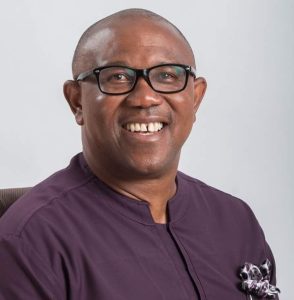
Anything can happen!
Peter Obi doesn’t belong to any of the two yet. He articulates a pro-subsidy argument which, however, hangs on a different logic from that of the government in power. He is talking of probity guaranteeing the benefits of removing the subsidy. Whether he will be able to convince a society which has endured bleeding for four years that his probity language game will counter balance the iniquities of a subsidy/neoliberalism order is what remains to be seen. For sure, there are certainly Nigerians who wish to see someone who studied Philosophy as Peter Obi become the president. There is no knowing yet if such people are many enough to have any electoral advantage. So also are those who wish to see Obi, a former Nigerian governor who has never been invited by the EFCC, become president. His slogan of “From consumption to production” is equally apt, especially if its arteries are broken down clearly.
Can he win? Yes, he could win because there are no serious reasons why he cannot win. The idealism that worked for Abiola in 1993 could work for Obi too. There is certainly idealism in seeing a new face in power across Nigeria. It is debatable if he has the equivalent of the Abubakar Rimis and his team who made Abiola to prevail in Kano as against Tofa, a ‘shon of the soil’ in the June 1993 presidential poll. But Dr Rabiu Musa Kwankwaso is expected to take care of that although there is not the kind of unifying narrative of politics in Kano of today as was the case in 1993.
There are sentiments and fears about what Obi would do on the Biafra consciousness and the Obidients, generally regarded as unruly and abusive. But these are things that his campaign should be able to handle. The main issue now is if Obi can outflank Atiku if he (Obi) continues talking about fuel subsidy the way he is doing now without sounding obscure.
Unlike Tinubu, Obi doesn’t have the advantage an incumbent in Africa has. Across the continent, incumbents have large room for manoeuvre in terms of resources, control or leverage over ideological and repressive instruments of the state. President Tinubu, in particular, has shown everyone that he has a layer of power to guarantee his re-election: the governors. That looks like a sure banker except if the argument of late Talban Bauchi overrides this strategy. In an interview published in The Nation around July 2006, Dr. Ibrahim Tahir argued that every president who made governors central plank of sustaining power never made it anywhere. He named General Gowon as one president who over relied on military governors but only to find himself out of power before he knew it. He said the same applied to General Babangida and he explained the collapse of Obasanjo’s Third Term gambit partially in relation to what he saw as Obasanjo’s over reliance on governors. In the case of Obasanjo, he said he asked Obasanjo to name any state(s) of the of federation where governors would say yes and the people would not say no. His thesis at the time was that the governors were so unpopular because they were not carrying the people along and that Obasanjo was taking a risk by doing everything of his through the governors instead of through distinctive federal presence in each state as the NPN was doing in the Second Republic through Shagari’s then controversial Presidential Liaison Officers. Between 2006 and 2026 is a long time. It is possible the governors are popular now and, in which case, Tinubu’s strategists might have a concrete fallback.
Should the governors fail, then incumbency advantage might be at risk of self-reproduction. Two recent statements warrant this. Engineer Lawal Babachir, a former Tinubu insider and ex-SGF, mentioned in an interview recently that the election results might have already been written. He located the warrant for the statement in his familiarity with how ‘they’ used to do it. Archbishop Emeritus of Abuja, Cardinal Onaiyekan also said almost at the same time that the president is determined to win the election. Statements of these nature have the performative potential of making contenders ready their anti-rigging machineries just in case the regime may be tempted to rig.
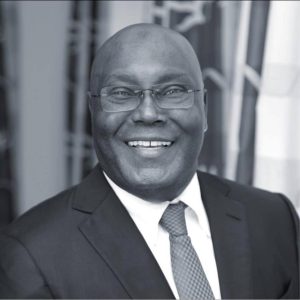
Is he the one to come or shall we look for another?
The plausible outcome is better imagined than mentioned when an Atiku Abubakar, in particular is, beyond the fuel subsidy pronouncement, clearly on an electoral offensive. It is there for all to see. He is taking on the incumbent, dominating the agenda setting dimension of the struggle for power as well as exposing governance deficits here and there, all the time.
They all boil down to the big question of why he has been struggling to be president. And if he can win the prize this time. The second question is easier to answer. Any of the three leading candidates can win. Atiku has won before and there are no reasons why he cannot win again. Clearly, his campaign is that of someone who sees himself as a good fit and winning candidate.
When the question is thus asked, it is the same as who and what can stop him, at what point and how? It doesn’t seem the incumbent can stop him. If he could, he would have done that since. Chief Olusegun Obasanjo, Atiku’s boss, could not stop him from contesting in 2007. Dr. Goodluck Jonathan could not in 2011 nor could Buhari in 2019. In fact, what people say is that if the Atiku/Obi pair had been sustained, it would have been impossible to rig Atiku out in 2019.
There is a Facebook stuff in which General Abdulsalami Abubakar is supposed to be wondering how Atiku could be struggling to be president at his age. If the material is not an AI fabrication, then it is a major minus for Atiku because, in that case, almost none of the members of the Super 5 is with him, starting with General Abubakar.
IBB is unlikely to be for him. This would be easy to understand by those who remember Atiku defeating IBB in 2011 when the North wanted a regional consensus candidate against Dr Goodluck Jonathan. Of course, the two of Atiku and IBB could have quietly met and sorted themselves out. That doesn’t seem to have happened, although Intervention stands to be corrected on that. Former governor of Cross Rivers State and PRP presidential candidate, Donald Duke, has been widely reported recently as attributing to Babangida an advisory to Obasanjo on how untrustworthy Atiku could be, years back. The timing of the disclosure suggests a well-aimed shot at Atiku even as Duke is close to Atiku as well as Obasanjo. It is unlikely that General Yakubu Danjuma or General Aliyu Gusau are together with Atiku, not to talk of the Baba himself, Chief Olusegun Obasanjo.
Obasanjo-Atiku relations has been so explosive as to always attract the question of what really went wrong and at what point. Obasanjo has done everything to paint Atiku as the devil incarnate, including some of the kinds of comments he allowed himself to document about Atiku in his Under My Watch. But how is it that the former first two citizens of a country with so much catch-up to do, developmentally, are lost in an irreconcilable feud, without any local or foreign conflict parties interested in reconciling them? And by which frame of reference might the Obasanjo-Atiku conflict be best understood, in the first case? Is it just Obasanjo’s commandist complex or something dangerous about Atiku?
There is a hint that it is the former. In fact, Intervention’s guess is that there is no way Obasanjo and Atiku would have have remained the best of friends beyond 2003. Before what Obasanjo interpreted as Atiku’s haste and manoeuvres to succeed him as president in 2003, the tensions were there. This is a thesis which might need no more than contextualising two self-interpretation for evidence.
In a ThisDay interview sometimes in 2000, Atiku told the story of how Obasanjo picked him as Vice-presidential candidate. According to Atiku, Obasanjo called him to ask if he would always be loyal or obey him or words to that effect. Atiku replied in the positive, adding how doing so is what Gen Shehu Yar’Adua instructed all of them in his camp: to defer to Obasanjo in his absence. This was followed by Obasanjo asking Atiku to go and tell the late Chief Solomon Lar that he (Atiku) is the Vice-presidential candidate.
What this manner of picking a Vice-president reveals is that Obasanjo dispensed with the filtering process of the PDP in favour of his own filtering process. Given his long years in the military, that filtering process could not but be commandist in orientation. Hence, his sense of Atiku’s manoeuvres as disloyalty, dismissing the fact that Atiku had contested before and nearly made it.
It is precisely the commandist orientation most PDP operatives of yore cite behind Obasanjo’s back to say that Atiku wasn’t Obasanjo’s mistake but one fundamental demonstration of Obasanjo’s unsuitability for the office of the president in 1999. By unsuitability, they mean his difficulty in transforming into a civilian. The late Dr Stanley Macebuh did a couple of columns elaborating on this. His argument throughout is that IBB is the only successful case of civilianisation among the military elements who ventured into politics. That thesis remains to be tested but Dr Macebuh had wide interaction with military elements at the very top level. His inference is not very different from what equally late Prof Isawa Elaigwu was used to saying about Obasanjo suffering from a messianic complex and residual militarism.
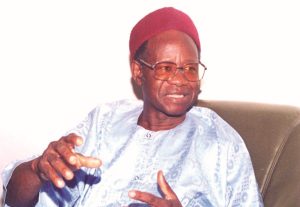
The late Chief Sunday Awoniyi
In further explication of the commandist explanatory schema, some PDP activists argue that the way Obasanjo selected a Vee-pee is the moment the Fourth Republic was undermined even before it had been born, all because of Chief Obasanjo search for absolute loyalty. The question Obasanjo’s critics keep asking is how a candidate of a party could even contemplate choosing his deputy all by himself. It is beyond him. That’s something only the party could decide. In 1999, the PDP basically had a Vice-presidential candidate in mind in Mohammed Abubakar Rimi. As Chairperson of the party’s Finance Committee, he was expected to transit into the second in command. While it is true that some more willy elements in the PDP feared that Rimi would be uncontrollable, the expectation was that the party would sort that out when the time came. The time never came before Obasanjo made his move in favour of Atiku.
Reference is made to how, much earlier than Atiku’s selection, Obasanjo had, on his own, offered Dr Alex Ekwueme president of the Senate right there at the Jos convention of the PDP. It was Dr Ekwueme who rejected it. If Ekwueme had accepted it, that would have been the starting point of imposing candidates since there was already a fellow who had won party nomination for that seat.
Although General Danjuma was not a PDP member in that sense, this was also part of the conflict between him and Obasanjo. Those who can still recall his interview in The Guardian in February 2008 would not have forgotten his articulation of that disappointment about Obasanjo. He sees it as Obasanjo’s betrayal of a country which brought him out of jail and made him president without any debriefing but only for Obasanjo to disallow the democratic process.
Others cite Obasanjo’s demolition of the PDP’s Board of Trustees (BoT) while in office. The BoT was the mechanism designed by the party mandarins against any temptation by a sitting president to corrupt party processes. Only people who could not be bribed with money or appointment were supposed to be there. The grudge against Obasanjo is that, instead of him contributing to advance the process, he devalued it by peopling it with pupil and pretentious acolytes. It was that committee which inserted the provision that made a former president the qualification for Chairmanship of the BoT at a time, resulting in the fight for primacy between Obasanjo and the late Tony Anenih.
Like the first self-interpretation, the second is what is also there in the public domain, not in the form of an interview but what Chief Awoniyi told a huge gathering of journalists, law makers and civil society at Shehu YarÁdua Centre. This reporter has no idea of when exactly but the event in question held shortly after Chief Awoniyi wrote a lengthy open letter to Obasanjo. It should be early in 2006 or so.
The self-interpretation goes like this: After the take-off of the Obasanjo regime in 1999, Obasanjo asked Chief Sunday Awoniyi what he would consider an adequate compensation for his contributions to the return of Obasanjo to power. It was Obasanjo’s recall of Chief Awoniyi’s sessions around the country that “the IRA wing of the PDP” (to use IBB’s language) had put their foot down that it had to be Obasanjo, not Dr Alex Ekwueme who was the emergent party’s initial choice for the presidency. Although a section of the PDP led by Adamu Ciroma and other NPN elements in the PDP rebelled against this, they were crushed at the Jos Convention. But Awoniyi carried out this task after an encounter with Obasanjo. Oba (his name for Chief Obasanjo), you will not be president because as far as I know you, you are not it. Then, Obasanjo replied him to the effect that, in the aftermath of his imprisonment under Abacha, he was now a new person, different from the Obasanjo he (Awoniyi) knew as military Head of State. He assured Awoniyi he was now a changed person. Then Awoniyi went on the mission of convincing the chiefs, emirs and others that there had been a shift from Ekwueme to Obasanjo. It was for this Obasanjo was figuring out what Awoniyi would consider as ‘compensation’. The late chief indicated party chairmanship as Chief Solomon Lar was only an interim leader of the PDP and soon to leave after presiding over the party’s victory.
Somehow, Chief Awoniyi began to hear that Atiku was opposed to his ambition. To clear the supposed Atiku opposition to his candidature, he went to see the Vice-president but only to discover that Atiku had not even heard that Awoniyi aspired to take over from Chief Lar. The ‘junior Sardauna’ smelt something fishy from Baba’s side. At the end of the day, Engineer Barnabas Gemade, not Awoniyi, got the job. The point about this recall is to show that there are always huge gaps in Obasanjo’s narrativisation of Atiku in terms of loyalty, corruption and hunger for power.
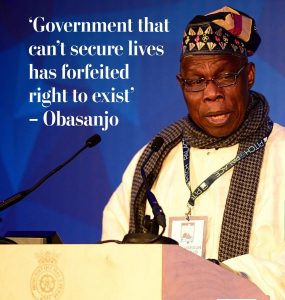
The elephant in the room
The 2027 presidential contest will mark the climax of this long running conflict. It will end in the defeat of whoever of them is vanquished in the outcome of the election. For sure, Obasanjo is not going to work for Atiku. But, as the most active one of the Super 5, Obasanjo cannot be dismissed. Not with his tremendous knowledge of how the system works, domestically and globally. The question, however, is how far that goes in terms of control of the voting population at the regional, religious and class levels. For instance, which of Obasanjo and Atiku has better control of the urban poor? Who of the two has higher electoral reach, even in the South West of Nigeria?
How is it that Obasanjo (and the Super 5 as well) who could neither stop Buhari in both 2015 and 2019 stop an even more determined Atiku or Tinubu now? In 2015, Tinubu ran roughshod over them, first by parachuting Buhari to power before parachuting himself in to the arena in 2023, blocking Obasanjo’s publicly preferred candidate, Peter Obi.
Beyond the Super 5 are two other problems for Atiku. One is the idea that it is the turn of the South. Contrary voices argue this is an Abuja minister, Nyesom Wike’s distortion. They argue that a case of violation of zoning would have arisen if APC were fielding a candidate of Northern Nigerian origin for the presidency in 2027 after Buhari, a Northerner, had been there from 2015 to 2023. This is not the case with every other party such as the PDP whose last presidential candidate was Dr. Goodluck Jonathan, a Southerner. Atiku’s party – the ADC- has thus yet to run afoul of the principle of zoning, it is argued.
This reduces the unanswered question about Atiku Abubakar’s mission in power. What is the endgame as for him to have been contesting for the position? What is that unique element he is bringing to the table as president? He answers this question by pleading experience and contesting for the presidency as an inalienable right. The claim of experience can be granted even though experience is not such a highly rated criterion. In fact, experience can be a drawback, introducing predictability and monotony. Secondly, every other Nigerian of age also has the right to contest.
So, it is only in his fuel subsidy pronouncement that he seems to have made the case for his candidacy. That is because, with that pronouncement, he has indicated the possibility of him destabilising the baggage of neoliberalism and excessive control of Nigeria’s destiny from outside. Although a veteran of hiring elements with ideological loyalty to neoliberalism, Atiku has at the same time simply suggested that if Nigerians organised themselves early enough to hold him to his pronouncement (on subsidy), there is a prospect of commencing the Nigerian moment at last. That is the moment the Obasanjos and Buharis were thought to be better equipped to undertake, given the nationalist orientation of the typical military man. They both failed and disastrously too, descending into apologia in all regards.
Of course, there are those who are not seeing Atiku’s value in that term but in what they perceive as his capacity to reassemble Nigeria back from disarray everywhere. This elements do not agree with the testament of Atiku’s fellow Adamawa brother, Engineer Babachir Lawal, who labelled Atiku a chauvinist. Instead, as a neither pro- nor anti-Atiku academic told Intervention, the one strong factor for an Atiku presidency at the moment is restoring Nigeria. he says class, ethno-religious and geopolitical fragmentation in the North has attained a threatening dimension; the Southeast has been in violent turmoil almost throughout the Fourth Republic; the Middle Belt has been turned into a violent identity battle ground over natural resources. The Southsouth appears to have come out of a violent moment but there are traces of which still require a much more systematic management. The Southwest which has hitherto been a success story in escaping threatening politics of difference is now scared of invaders of its forests. So, everywhere, there is disarray mainly because there are no serious unifying developmental issues for people to bother about, thereby limiting opportunities and compelling people to fall back on or invent beatific narratives in enemy images. It is not clear why those who subscribe to seeing Atiku as a force for displacing emptiness of life with something better do so. Only time will (dis)prove them. But, as one of them says, Atiku’s dinner table has Nigerians of all religious and ethnic identities in conversation.
It is still a long way to the presidential election early 2027. So much could happen along the line. What is clear so far is that one politician is more than determined to be a defining factor in the process. And his name is Atiku Abubakar.
The author is an Editorial Director with Intervention