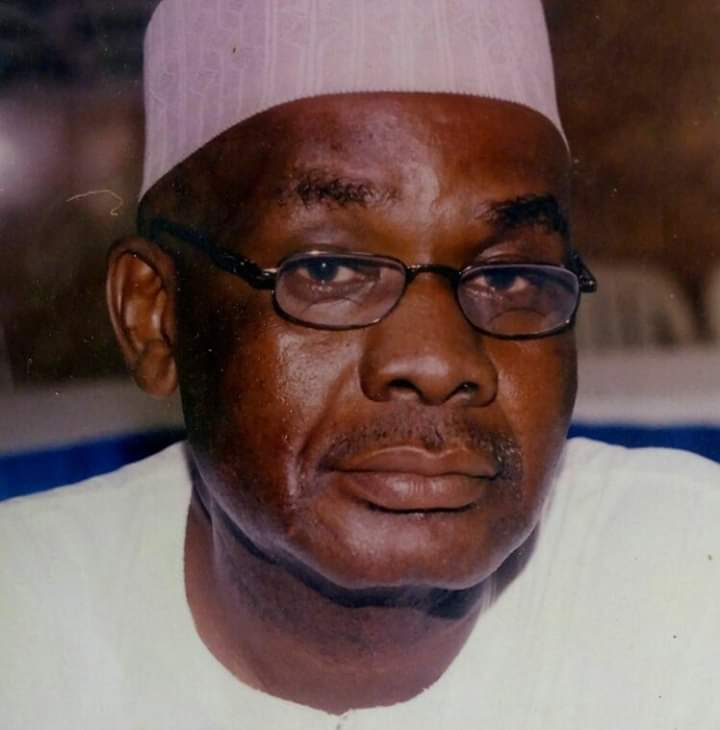
By Adagbo Onoja
It is not a minor breach to be asked to write on or about Mallam Ibrahim Muazzam at a short notice. To write about him is to write about the numerous signifiers the mention of his name implicitly and explicitly invoke or dialogues with as for such a task to be accomplished too quickly without consequences: from BUK where he taught to Political Science which is his discipline but which he read at ABU, Zaria on the eve of the takeover of that university by radical nationalism which itself recalls the radical tradition in the North, thereby connecting the list so far to the Kano-Jigawa axis in the NEPU/PRP formation, its linkages to the Zikists and other radical formations across Nigeria, the intellectual anchoring of that process, the BUK share of that cohort and the significance of the Muazzam-Usman Jalingo/Dandatti Abdulkadir linkage in relation to Philosophy, pedagogy down to Muazzam as a party administrator, crazy reader, a propagandist of Idoma yams and so on.
Any of these and the millions more signifiers that the mention of his name, like anyone else, recalls can intrude and assert itself in a writing process at any point. There is no cure for this intrusiveness of signifiers. Only time and discipline can tame it, up to a point. It is not for nothing that language or words are associated with being dangerous and exercising conditioning power over users.
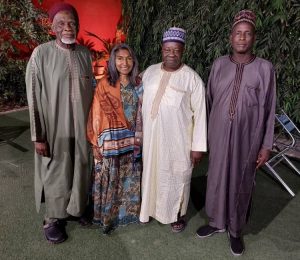
A year old picture of Muazzam, Chermaine, Jibo and Dalha, all ABU, Zaria products except Chermaine
Anyway, there has to be a piece on Mallam Ibrahim Muazzam to a deadline. A plausible way of overcoming that may be to start with referencing the decision last week by a European country making Philosophy degree compulsory or something like that. About a year ago, a Nigerian with some familiarity with the university system suggested exactly that. I immediately opposed him even though we were in a leisurely circumstance where civility was called for. Prof Jibrin Ibrahim who was also there told the story of Bala Usman’s standpoint on the desirability or otherwise of a Department of Philosophy at ABU, Zaria. His was an effort to settle the difference between my position and the suggestion of the senior Nigerian. I doubt that he succeeded and the basis for my roughness is simple: irrespective of what anyone is reading in the university, it is only an aspect of Philosophy and there is no basis in compelling everyone to take a degree in Philosophy before reading something else.
No one who is well taught the methodology component in any discipline misses anything fundamental in Philosophy since methodology is the compromise between Philosophy and the disciplines which secured their independence from it. So, in methodology, we all come across ontology, epistemology, logic and ethics, if it is properly taught. Given the relational structure of knowledge, methodology has everything that Philosophy can give to the average student who has no ambition to be a philosopher.
Education is generally on the decline across the world as neoliberalism has particularly pushed Philosophy to the backseat because knowledge of counting money is over-emphasised. People think the answer to this is to restore Philosophy as a way of curtailing the spread of poverty of thinking in the society. They forget that that reality has nothing to do with lack of Philosophy or that a compromise arrangement is already on the ground. In Nigeria, there is a crisis of crassness but to which methodology is one of the responses, not necessarily Philosophy. We are having problems with methodology in Nigeria because we have stripped it of the metatheoretical component.
My key argument in this piece is that this is the area where Mallam Ibrahim Muazzam was/is distinctive. He erected every courses he taught in the Department of Political Science in Bayero University on the Philosophy of Science. In other words, he took philosophical foundation of knowledge seriously and, as such, made Political Science entertaining, harassing, critical, radical and complete, all at the same time. It is thus with Muazzam that we can say that Bala Usman made a valid argument although Bala’s argument ought not to have stopped ABU, Zaria from establishing a Department of Philosophy. Thank God, ABU, Zaria is now understood to have a Department of Philosophy.
Deciding what to read for a first degree turned out a difficult question to resolve for some of us. Eventually, I didn’t decide it. It was decided for me by the numerous others whom I had known as a journalist over the years and who were too keen on investing in me. A Bachelor’s degree in English was what I wanted. But the late Prof Okello Oculi who was my regular interviewee when I worked in Radio Kaduna and who had become a senior friend would have none of that. You are already a journalist, go and read Law, he would insist. That sounded logical and good in terms of fortifying myself ideologically, law being a major site of struggle. It was no less good from the point of view of the material guarantee it provided. The problem was and is that I am not cut out for law. None of those I wanted to be like came from law. Oculi and I debated it till thy kingdom came.
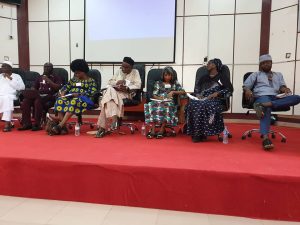
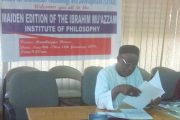
Muazzam (in brown Kaftan) in the midst of other discussants during a panel session at the 2018 Marx and Africa Conference in Keffi
Prof Chris Onunkwo in whose department I took a diploma in Mass Communications in BUK was keen to have me there but the Department of Mass Communications and the Department of English had the same problem from what I got when I mentioned the idea of going there. In fact, the warning was clear: have you heard anybody obtaining a 2:1 from the Faculty? That was a completely new dimension because it meant that obtaining a 2:1 is one of the things I should be thinking about in making the decision. Unlike today when First Class is common all over, only very few ever got that in those days because Nigerian universities were not considered to have the literature access, the professor: student ratio and similar factors that could guarantee a First Class. 2:1 was more feasible for those in the humanities and the social sciences than a First Class because a First Class grade is not just about scoring 70% and above.
Earlier on, I had asked Prof Oga Ajene at the Department of Political Science, ABU, Zaria what would be his choice between Philosophy and Political Science if he were in that situation. He said it was a difficult question and during our next meeting, he said he would take Political Science. There was another set of actors in BUK which finally decided the Political Science option.
But before the H-hour, one was fortunate to receive elaborate update on who was who in BUK academia at the time, particularly those who would be teaching a university degree sceptic as Onoja heading for undergraduate studies in Political Science at Bayero University, Kano in the early 1990s. It was a very comprehensive insight in which almost no one was left out, from Shehu Yahaya in Economics to Ibrahim Bello Kano in English, Yakubu Adams, M. M. Yusif, Haruna Salihi, Attahiru Jega and, of course, Ibrahim Muazzam, all in Political Science. Coming from someone with a vastness of knowledge of the academic world and the credibility of a degree from Oxford, the update was a game changer of a sort.
One had been told, for instance, that one would be meeting MM Yusuf whom the provider called a born teacher. I wouldn’t say today that MM Yusif is a born teacher. He certainly took teaching seriously but I would think that what was distinctive about him was the activist edge he brought to teaching. It was due to that activist edge that his class came alive in itself because of the powerful way it mirrored dynamics playing out in the wider society. With MM Yusif, Political Science was not an abstract course one took just to get a degree. There was also an element of that in Prof Bawa Gusau’s teaching of International Relations. The difference is that, while M. M. Yusif’s came from activist orientation, Prof Gusau’s came from his American training in the discipline. Remember Hoffman’s 1977 journal article about International Relations being an American discipline. M. M. Yusif was certainly a uniquely valuable lecturer. Of course, he was a Marxist but he was not an uncritical guzzler of official Marxism. There was nothing my update giver said about him that wasn’t correct.
Yakubu Adams was another lecturer one was expecting to meet. Our set didn’t meet him. He was one of those who read the signs of disaster ahead once IBB started his surrender of Nigeria to his patrons. But there was Rasheed Moten who is still alive in Malaysia today. He approached academia from an Islamicist point of departure but he gave us a fantastic, incomparable handout on the first year course unit: Introduction to Political Science. I am still looking for my copy of the handout and will pay anything to anyone who can find his or hers because I am now in a scholarly position to declare it to be very solid.
Our set never saw Attahiru Jega until the second year because, for most of the time, he was away, doing ASUU politics. Even if he were around, it is doubtful if he taught first year courses. We met him briefly in ‘Introduction to Political Economy’ in the second year before he disappeared again. We were together in the third and fourth year. The lesson from Rasheed Moten and Jega’s courses is how the much celebrated ban on handouts in Nigeria is a product of the typical mob-inflected public opinion in Nigeria. It is not all lecturers who give stupid handouts. Some lecturers read widely, synthesise and give the students something more appropriate for their level. That is what I can attest to in the case of Moten and Jega.
 Interestingly, it was Jega’s name that scattered a campaign against me when I too became an academic. The campaign had been so successful. It was to the effect that I could not teach in a Department of Political Science because I had no first degree in the discipline. It was when the Professor appointed to investigate the campaign discovered that Jega was my teacher that the campaign lost steam. Although he was angry that I didn’t tell him that I studied under Jega all along, his recommendation was categorical and very acceptable to the Vice-Chancellor who had already interviewed me and concluded that the campaign was nonsensical. The manufacturer of the campaign did not only lose his HoDship, he was disgraced out of the university subsequently. It was another evidence that, in my life, I have never had to defend myself. Somehow, the campaigns against me wherever simply evaporate without me doing anything and this was a perfect example of that.
For sure, Mallam Ibrahim Muazzam was one of those covered in the update. The update made him into a new Ibrahim Muazzam from the one that one had known as, first, a Kano journalist and a diploma student in the Department of Mass Communications previously. My memory of him from the update was of someone close to a madman but in a positive sense. That’s not what the briefer said but that’s what I understood him to mean by saying, among others, that Muazzam’s personal library is likely to be richer than any other in Kano and perhaps Nigeria. And it is not just the content but the point that he had not only read them but also engaged them. These, he said, were claims that could easily be established by anyone who got access in there to select and inspect any texts. Such an inspector would find where Muazzam has made marks on the edge, either cross-referencing or raising a question or something like that.
What I did on entering the university was to ensure I audited Muazzam’s main courses irrespective of which year. Since he knew me, it meant no one could ask me out of the class for being a strange face. Majority of the students in the class immediately above mine were the same students we were doing students’ movement politics, meaning I had no problem there. It paid handsomely because by the time our set got to the third year, Muazzam was not teaching Classical Political Philosophy and the Contemporary component anymore. Or, even the rejuvenated Marxist Political Thought. New academics had entered the department. I lost nothing of the Muazzam flavour.
In auditing his courses ahead of my time, I could see that it didn’t matter which course unit Muazzam was teaching, the philosophical anchor was there. In teaching our set the fourth year course on Strategic Studies which, before its demise in the post-Cold War, was dominated by deterrence theory, Muazzam located the Western strategic thinkers we treated in Western metaphysics, thereby bringing how binary oppositional ontology created problems for their conduct of war. I came to understand the significance of this linkage better and deeper when I encountered strategic thinking in Warwick many years later.
 Across the board, he rarely took off without recalling Descartes and his ergo cogito sum intervention which is the source of the current impasse in epistemology. Of course, Muazzam could not have exceeded the limit of knowledge on Cartesian intervention at the time but, even then, he was adequate. In truth, Muazzam was already looking beyond Cartesianism, given some of the questions he was used to asking. One is certain that he is not surprised by the current messy interrogation of Cartesianism and what I dare say is now a return to Feyerabend’s methodological anarchy, the phrase used by his critics of yore but whom no one is sure would use that phrase again after Patrick Thaddeus Jackson’s 2011 book on the ‘demarcation problem’ in science. Why should one book be that important? Well, for many reasons, including his longish review of the debate on what actually constitutes science but, for me, it was reading Nicholas Onuf’s comment in the blurb that he wished he wrote the book by Jackson. If we recall that Onuf is the scholar who made the statement to the effect that ‘anarchy is what states make of it’ possible, then we may have no problem with seemingly overinvesting in one book.
It is one thing to have read a text but completely another to have interpreted interpret it. The two are not the same as the meaning of a text is up to the reader rather than the author. With Muazzam, this is complicated because he could raise a question on a Marxist contention but only for the ‘resolution’ of that question to drag through one Islamic thinker, a classical or contemporary philosopher down to a critical theorist and back to Marx. He wasn’t a Hegelian and although I heard that some years before our set of students set foot on BUK that he designed and mounted a course unit called ‘Third World Political Thought’ he is not an Africanist scholar either. He was all and none of the above, another grammar for saying he was/is so restless that no analytical camp could contain him or was adequate for his problematising orientation. With people like Muazzam, the promoters of a rise of eclecticism, led by David Lake and his 2013 journal article we overinvested in UCL, failed even before they started.
Philosophy was Muazzam’s perspective, not any particular school of philosophy. But that is the paradox about Muazzam in that he can only be spoken of in the past. Like all who aspired to philosophy, he wouldn’t fit into the typical Department of Philosophy in a typical Nigerian university today. I do not mean to slight teachers of philosophy in Nigeria today whom I expect to contextualise the statement in the general decay of the society and the takeover of the society by a ‘mechanical turn’, from Philosophy to business and even in politics. That is the context I am referring to and in which Muazzam would not fit because Muazzam dealt with questions, not answers. Answers are about closure. Closure is anti-philosophy. So, a Muazzam would be a jobless teacher today if he were still in the job market.
It is, for sure, paradoxical but it is not Muazzam’s failure that we are not seeing the successor Muazzams all over the universities. Or, could it be that they are there and it is ‘we’ who are not ‘seeing’ them? This is not Muazzam specific as I am not sure we are seeing the successor Eskor Toyos, Osobas, Onoges, Nnolis, Akes, Bala Usmans and so on, pushing what these giants had put down in newer directions or even overwriting them, in tandem with the spirit of knowledge production.
Might we stop here for now before we are graded as crazy as our dear Muazzam!