By Adagbo Onoja
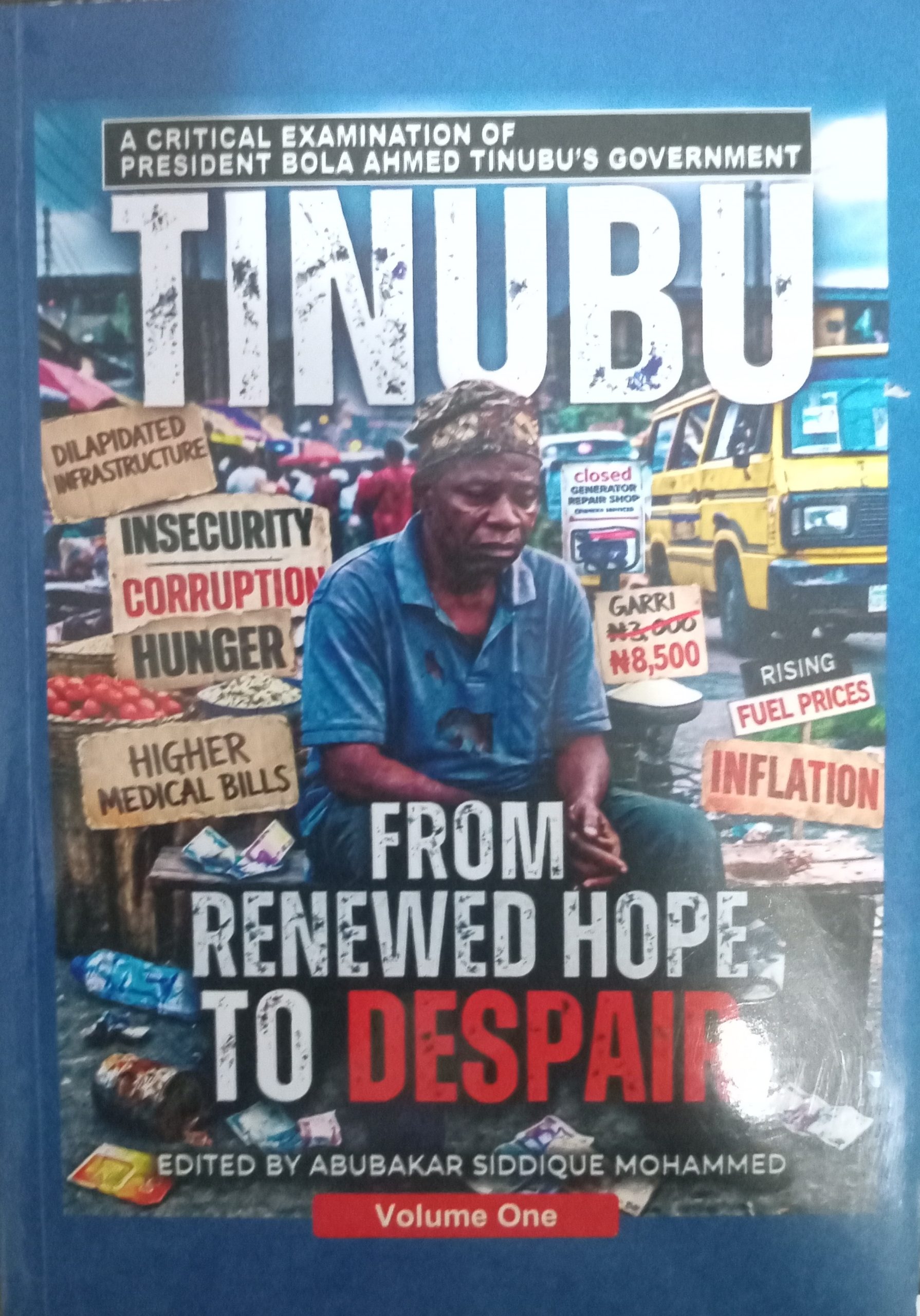
President Bola Tinubu is not good enough to be reelected in 2027 without him wrecking Nigeria beyond repairs in another four years. This became the unifying refrain Friday October 16th, 2026 amongst diverse speakers at the presentation of a newly published book, From Renewed Hope to Despair: A Critical Examination of President Ahmed Bola Tinubu’s Government. The event took place at the Yar’Adua Centre in Abuja, Nigeria’s capital city.
Unfortunately for President Tinubu and the APC, the refrain is not regional, religious or class-centric rhetorical chicanery but national in character. In other words, the speakers cut across ethnic, ideological and religious fault lines.
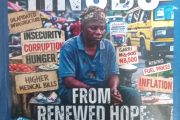
Another angle to the book cover
While many of them such as Prince Adewole Adebayo, the presidential candidate of the Social Democratic Party (SDP); Rotimi Amaechi, Vice-presidential candidate of the African Democratic Congress (ADC) or Dr. Hakeem Baba-Ahmed of the People’s Redemption Party (PRP) are opposition elements, the empirical and/or genealogical weight behind their standpoint at the event were always heavy enough to sustain each of their claims.
Intervention can, however, report that it was not only President Tinubu who was castigated and dismissed, almost everyone else, particularly late President Muhammad Buhari, Chief Olusegun Obasanjo and academics came under attack during the over three hour event. Although Buhari was exonerated from complicity in supporting or making it possible for Tinubu to ascend power in 2023, his failure to perform was referenced as the condition of possibility for Tinubu and his notion of his turn to rule or the ‘emi lokan’ expression in Yoruba language. Three speakers mentioned this aspect of Buhari’s complicity and they are Prof Jibrin Ibrahim who delivered the keynote address, Dr. Hakeem Baba-Ahmed and Hon Rotimi Amaechi.
The charge against Chief Obasanjo as laid by his former admirer and minister, Adamu Maina Waziri, is how Obasanjo, a noted writer of open letters critical of almost every of his successors, could go quiet when a Yoruba kinsman is devastating the country. Mallam Maina recalled Obasanjo postulating Fulanisation and Islamisation in 2019 but only to keep quiet in the face of Muslims – Muslim ticket. What is Muslim-Muslim ticket if not Islamisation, he queried.
But it was Rotimi Amaechi who took a direct shot. Locating himself as usual in NANS/activist credentials and undergraduate training in the hands of Marxist scholars at the University of Portharcourt, Amaechi blames academics for failing to inculcate in students everything against ethnoregional and religious consciousness. That, he said, explains why a Tinubu could have ever emerged as a Nigerian president. It is only in this type of country such a person could become president, said he, which Amaechi explains, happened because most voters voted for him on the ground that he is a Muslim. For this reason, “we must accept that we are the problem”
He went further to recall someone he knew wondering why someone else was voting for a Southerner and a Christian. Amaechi who at a point named only two people he believes in, one of them Prof Jibrin Ibrahim, said researchers should track the Tinubu phenomenon to its root: the identity fix academics taught their students. He was using students in a wider context rather than strictly formal sense.
There is uproar in the country now against Tinubu because, according to Amaechi, the quantum of damage by Tinubu has exceeded all hitherto thought limits. Otherwise, when he said it was his turn, he could only have meant his turn to do more damage than those who preceded him, an expression the country did not interrogate.
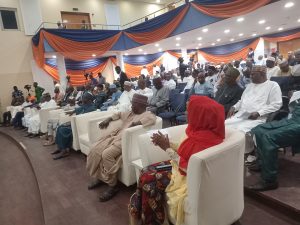
All the big names on the front row, including Prince Adebayo (first, LR), Prof Jibrin Ibrahim (2nd from right)
Prince Adewole Adeoye shared Amaechi’s thesis by saying that Tinubu is a product of a certain sentiment but he quickly diverged to a class analysis. The SDP candidate said there is consternation now only because Tinubu has bolted out of the elite consensus to pillage and plunder. Tinubu has transformed into sole proprietorship, he said, comparing the president to George Taubman Goldie who formed the Royal Niger Company, raised his own army for a clear purpose of cornering resources.
To this extent, he dismisses Tinubu from being a successor to Zik or Balewa, saying the incumbent president is a Leviathan.
The point, as far as he is concerned, is for Nigerians to come to a new conclusion and it should not be by way of doing a regional analysis of Tinubu presidency. For him, linking Tinubu to Yoruba or Southwest is like catching a thief, taking him to court and saying the suspect came to rob the CBN to buy medicine for a sick child. It is, in his view, up to the suspect to say so, not the Police.
The people of Nigeria, he argues, should reach a conclusion and insist on a president with a minimum intellectual capacity beyond capacity to count his or her money, amongst four other criteria.
Dr Hakeem Baba-Ahmed of the PRP thinks that Nigeria probably missed the message in the ‘emi lokan’ expression although he analyses that possibility in relation to Buhari’s failure to deliver and how that left everyone with coming to terms with whatever was being offered. But he says Nigeria has reached where it can no longer go below what he says exists. He means Nigerians cannot go below what he assesses to be the current level of abuse, neglect and plunder. “We are at the bottom and there is nowhere to go anymore” declares the party leader who added immediately “this is not going to continue. They can bring out all the money in the world, Nigerians will not vote Tinubu back”. The powerful pronouncements continued, “we can defeat Tinubu and we must defeat Tinubu”
The strategy for defeating Tinubu was laid out in terms of an evolving coalition. “We are creating a coalition that will take on Tinubu”, he said, adding “Tinubu must never come back to this country for another four years”.
Dr Hakeem accused President Tinubu of lacking ideas, strategy and anything to offer this country. He is asking voters to collect whatever money APC offers them but to refuse voting for the party or Tinubu. “Vote for the candidate of the coalition,” is what he is requesting Nigerian voters. He said something about the option before the INEC which this reporter did not get correctly or missed in jotting down, something like it is up to INEC to behave.
Dr Hakeem had started by claiming that late President Buhari resisted the coming of Tinubu, that Buhari saw Tinubu as bad for the country. It is a claim that now lies permanently beyond verification.
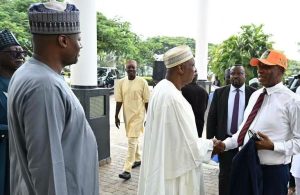
Hon Rotimi Amaechi being welcomed by Prof Alkassum Abba, the historian and a co-author of the book
Dr. Usman Bugaje, the Vice-presidential candidate of the SDP told the audience that as things stand today, Nigeria has already lost it as far as sovereignty is concerned. He said the country does not have control over much of its territorial and even food dimension of sovereignty, with many parts of the country paying taxes to non-government actors. He connects that to argue that the government in power has neither the intention nor the wherewithal to stop the insecurity crisis. For him, 2027 is not an election year but recovering the country from what he described as irresponsible and reckless leadership.
Barrister Tar Atung expanded on Bugaje’s message by saying that Nigeria is experiencing a second colonisation and that January 16th, 2027 would be liberation Day.
He charged President Tinubu with not governing Nigeria but for his family, friends and associates, going into details of the voting blocs in 2027. According to his analysis, President Tinubu lost the 2023 election in nine of the 12 states the APC has listed as where the president would be physically campaigning. So, all that opposition needs to do is to consolidate these states. Going further, he says those around the president scrambling for what they could get constitute no more than 7% in voting strength, contrasting this to the 44% he says are breadwinners bearing the brunt of the president’s reform. His last voting group is the Gen-Z (those between 18 – 30/35 in age) and put at 28% of the voting edge.
The election in 2027 is, therefore, for him, a ‘cost of living’ crisis resolution election.
But these speakers were not those who started giving Tinubu the red cards at the event. It was Prof Jibrin Ibrahim who delivered the keynote address and Prof Abubakar Siddique Mohammed, one of the authors, who did.
Prof Ibrahim had started by characterising the book as telling a story fundamental to the future of the country, provided there will be a future in the first case. Nigeria, he says, faces a critical challenge, a critical articulation of which is necessary. He reduces it to the story of a major actor whose signature tune is zero governance. Although he inherited this from his predecessor in a way, the implication is always that when government doesn’t govern, others govern.
A key aspect of Jibrin’s keynote address is the thesis that there is an essence deducible from the opposition to the Richards Constitution in 1946 and which is the anti-cabalistic seizure of the Nigerian State in favour of democracy and federalism. This consensus, he argues, is being injured by the observable attempt to pocket the NASS and the judiciary by one man.
Typically
Prof Jibrin recalled battles against this tendency in the Fourth Republic right from the PDP Convention in Jos in early 1999 when the late Dr Alex Ekwueme rejected Obasanjo’s offer of the Senate Presidency on the ground that Obasanjo lacked the mandate to award him the position. “There was nothing Obasanjo didn’t do to control the NASS” said Jibrin but the NASS then was able to threaten him with impeachment, a threat he knew was credible. Similarly, he recalled the same attempt by Buhari but only for Bukola Saraki and co to resist it, leading to Buhari’s failure in that.
He asks the question how the spirit of fighting and struggle against the temptation of the executive to pocket the legislature has disappeared and if current members of the NASS could still regard themselves as representatives of the people.
He concludes that what the book does is to show that if Nigerians accept what exists, then infering that there is something profoundly wrong with them is inescapable. Following this is his question about what happened to the gallant souls who rose up against BB and Abacha.
Prof Abubakar Siddique Mohammed, one of the authors spent a long time wondering how a book examining the performance of a democratically elected president could generate so much apprehension. Democracy, he told his audience, is beyond elections. Intellectuals, journalists and civil society activists must be able to speak without fear of threats. Electoral victory does not give a government ownership of the country beyond the right to govern, stated he. The ultimate test of reform is not what government promises but what citizens experience and, for the speaker, the concepts involved are not abstract issues.
The book presentation turned out a massive, scathing x-ray of the Tinubu administration. If the event had been transmitted live on television, the administration might never recover from the conscientising effect. In that sense, the overzealous elements who made Abuja the alternative venue of the event did incredible damage to the administration. A Kaduna event could never have got the stature of a YarÁdua Centre event.
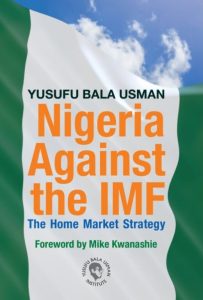
It is not clear why anyone thought that because the content of a book is hostile to a particular set of readers, it must therefore be disallowed. CEDDERT and its leader, the late Dr Bala Usman have been on the culture of documenting its position to almost every regime since the Second Republic. Bala Usman himself challenged the Shagari regime to a debate and subsequently published Causes of the Nigerian Economic Crisis. Under IBB, they published Nigeria Against the IMF: The Home Market Strategy. Under Obasanjo, they published a text against Third Term and so on. Did someone fail his or her ‘O’ Level History?
How come the government is so jittery and manifests its jitters without restraint? While it is true that when Dr Siddique Abubakar and his colleagues in the old ‘BBU’ can be empirically ruthless whenever they handle any subject, the same Siddique said at the event today that, as intellectuals, they are not infallible and are open to contestation. So, why didn’t the Tinubu administration and/or the APC do what their former leader, Dr Umar Ganduje did in 2023 by being present at the presentation of a book he perceived to be critical of the president and the party? As discursive as any such move has to be, it deflected certain arrows. How long will the Tinubu regime be dodging its assessors?