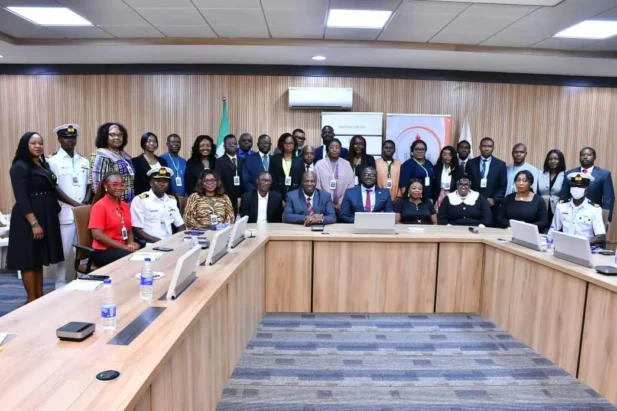
Nigeria is witnessing a new point of departure. The rubric is ‘Leveraging International Diplomacy for Investment, Finance and Sustainable Development’. It is an arena in which the canonical may be no other than this text delivered July 20th, 2026 at opening ceremony of the ‘Certificate of Advanced Studies in International Law and Diplomacy’. The opening address by His Excellency, Ambassador Nicholas Agbo Ella, former Permanent Secretary, Federal Ministry of Petroleum Resources, a career diplomat and legal practitioner is published unedited for reference and record purposes.
The President of the International Law Association (Nigerian Branch), Professor Damilola S. Olawuyi, SAN;
The Director-General of the Nigerian Institute of Advanced Legal Studies, Professor Adedeji Adekunle;
Distinguished Justices and Judges;
Members of the Bench and the Bar;
Members of the Diplomatic Corps;
Distinguished Guests;
Esteemed Faculty Members;
Participants;
Ladies and Gentlemen.
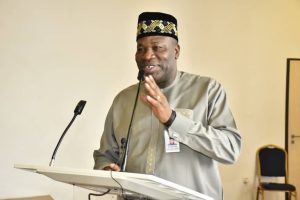
Amb N A Ella, the author of the speech
Good morning.
It is both an honour and a privilege to join you this morning at the opening of this distinguished programme on International Law and Diplomacy. I sincerely thank the International Law Association, Nigerian Branch, and the Nigerian Institute of Advanced Legal Studies for the invitation to share a few reflections on a subject that has shaped much of my professional life.
I commend both institutions for their unwavering commitment to advancing legal scholarship, professional excellence and international understanding. In a rapidly changing world, initiatives such as this are not merely academic exercises; they are investments in the future leadership of our nation and our continent.
The theme before us today — “Leveraging International Diplomacy for Investment, Finance and Sustainable Development” — could not be more relevant.
We are living in an era of profound global transformation. The international landscape is being reshaped by geopolitical competition, economic uncertainty, technological disruption, climate concerns and shifting patterns of global influence. Nations are no longer competing solely through military strength or political alliances. Increasingly, they compete through ideas, innovation, economic attractiveness, institutional credibility and diplomatic engagement.
In this environment, diplomacy has become far more than the management of relations between states. Diplomacy today is a powerful economic tool. It influences where investors choose to invest. It affects access to finance. It shapes trade opportunities. It determines strategic partnerships. It facilitates technology transfer and increasingly drives sustainable development.
In many respects, diplomacy has become one of the most important currencies of national development. Throughout my career as a legal practitioner, diplomat and public servant, I have learned that the foundation of successful diplomacy is trust.
Countries may sign treaties. Governments may enter agreements. Institutions may establish partnerships. But without trust, such arrangements rarely endure. Investors seek confidence that contracts will be honoured. Development partners seek assurance that commitments will be fulfilled.
Citizens expect institutions to be transparent, accountable and fair. Trust remains the invisible currency that sustains international cooperation. This is where international law becomes indispensable.
International law provides predictability in an often unpredictable world. It creates frameworks through which nations with different interests, cultures and political systems can cooperate peacefully. It provides mechanisms for resolving disputes without conflict and enables global commerce to flourish under established norms and rules. No nation, regardless of its size or influence, can successfully navigate today’s interconnected world without respect for the rule of law.
For Africa, this reality carries special significance. Our continent possesses extraordinary opportunities.
We have abundant natural resources, one of the world’s youngest populations, expanding markets and enormous potential for innovation and entrepreneurship. Yet potential alone does not guarantee prosperity.
To unlock these opportunities, Africa must continue to strengthen governance, deepen regional integration, improve investment climates and engage strategically with the global community.
The African Continental Free Trade Area presents one such opportunity. Similarly, the Africa Energy Bank offers us the opportunity to unlock investment opportunities in the hydrocarbon sector.
If effectively implemented, these projects have the potentials to transform Africa into one of the largest integrated markets in the world, attracting investment, creating jobs and accelerating economic development across national boundaries.
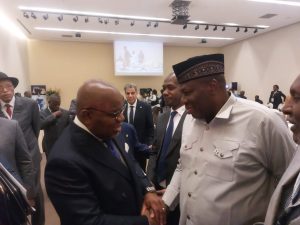
Flashback to a moment in the author’s previous energy diplomacy outing as Permanent Secretary MPR exchanging pleasantries with the Republic of Congo’s Minister on Hydrocarbons, HE, Bruno Jean-Richard Itoua
Ladies and Gentlemen,
One of the most important lessons I have learned over the years is that sustainable development cannot be achieved through economic growth alone. True development requires strong institutions. It requires visionary leadership. It requires responsible governance. It requires partnerships.
And above all, it requires people who are willing to think beyond immediate interests and focus on long-term national and continental priorities.
Diplomacy serves as the bridge connecting these various elements. It enables governments, businesses, development partners, academia and civil society to work together in pursuit of common goals. Allow me to briefly share three lessons that have guided me throughout my professional journey.
First, preparation is indispensable in our daily professional practice. Successful negotiations are rarely won by eloquence alone. They are won through diligent preparation, rigorous analysis and a deep understanding of both your own interests and those of your counterparts.
Second, listening is one of the most underrated skills in diplomacy. Those who listen carefully often discover opportunities that others miss. Diplomacy is not merely about speaking persuasively; it is equally about understanding perspectives, concerns and aspirations.
Third, integrity remains the most valuable asset any lawyer, diplomat or public servant can possess. Titles may open doors. Positions may confer authority. But reputation is what sustains influence. Once integrity is lost, rebuilding trust becomes exceedingly difficult.
Ladies and Gentlemen,
Permit me to illustrate my practical experience of diplomacy through my actions in the birth of the Africa Energy Bank, a landmark initiative that is headquartered here in Abuja.
The establishment of the Bank demonstrates what can be achieved when strategic diplomacy, regional cooperation and visionary leadership converge around a common objective.
The Africa Energy Bank is more than a financial institution. It represents Africa’s determination to shape its own development agenda and finance its own priorities.
At a time when access to capital for energy projects has become increasingly constrained, the Bank provides an African-led solution designed to mobilise investment, strengthen energy security and support economic growth across the continent.
I had the privilege of contributing to some of the engagements that ultimately supported Nigeria’s successful bid to host this important institution. I hosted the member countries with Diplomatic Representation in Nigeria to a reception that turned our fortune in the bid to host the Africa Energy Bank!
That experience reinforced a lesson I have learned repeatedly throughout my career:
Diplomacy produces results. When pursued strategically, diplomacy attracts investment, unlocks opportunities and advances national interests. At the same time, we must recognise that sustainability and development are not competing objectives.
The challenge before us is not choosing between economic growth and environmental responsibility. The challenge is ensuring that both reinforce each other.
Through effective diplomacy and international cooperation, nations can mobilise climate finance, promote technology transfer and pursue a just and balanced transition that reflects their developmental realities.
To the distinguished participants gathered here today, I encourage you to approach this programme with intellectual curiosity, humility and determination. The world you are preparing to serve will demand more from you than technical knowledge alone. You will be expected to understand law, economics, technology, governance, sustainability and international relations. You will need to navigate complexity, build consensus and exercise sound judgment under pressure. Most importantly, you must remain guided by ethical values and an unwavering commitment to service.
As you progress in your careers, remember that success is not measured solely by the offices you occupy or the honours you receive. The true measure of success lies in the positive impact you make on society. Whether you serve in government, diplomacy, the judiciary, academia, international organisations or the private sector, your greatest contribution will be your ability to strengthen institutions, promote justice and build bridges among people and nations.
Ladies and Gentlemen,
History teaches us that nations do not prosper simply because they possess resources. They prosper because they build institutions. They prosper because they inspire confidence. They prosper because they invest in knowledge. They prosper because they engage the world with clarity, purpose and vision. The future belongs to nations that understand the power of diplomacy, the value of the rule of law and the importance of sustainable development.
Let us therefore commit ourselves to building a future where diplomacy attracts investment, investment creates prosperity, prosperity supports sustainable development and sustainable development strengthens peace and stability.
The challenges before us are significant. But so too are the opportunities. If we remain committed to cooperation, dialogue and the rule of law, there is every reason to be optimistic about the future of Nigeria, Africa and the international community.
I congratulate the International Law Association, Nigerian Branch, and the Nigerian Institute of Advanced Legal Studies for organising this important programme.
I wish all participants fruitful deliberations and every success throughout the course.
God bless the Federal Republic of Nigeria.
And God bless our shared pursuit of justice, peace and sustainable development.
Thank you for your kind attention.