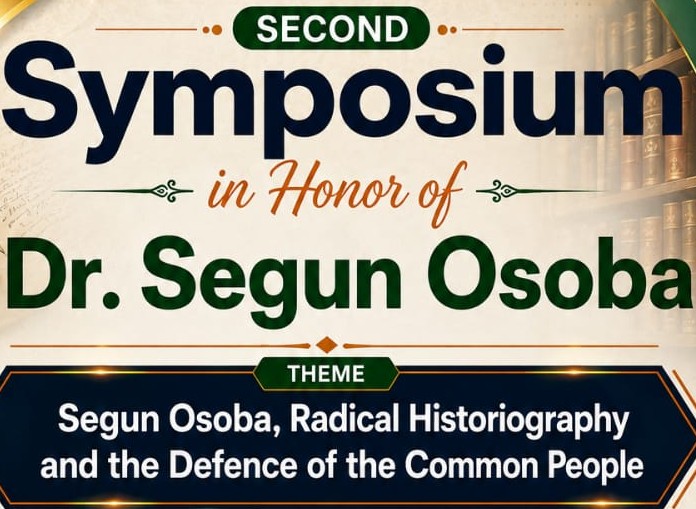
Abuja, Nigeria is set to witness the likely most remarkable if not the most qualitative gathering of the radical assemblage in Nigeria in recent times. It will be the symposium version of the burial rites of the symbolic leader of Left politics, Dr Segun Osoba, the Historian’s Historian as far as the Left is concerned.
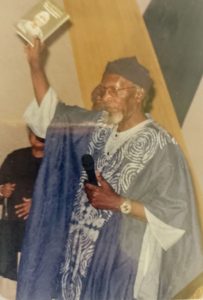
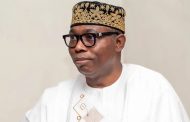
The late Osoba in a 2008 picture.
Osoba who taught History at the Obafemi Awolowo University at Ile-Ife for much of his adult life died on May 14th, 2026 in Ijebu Ode, Ogun State, Southwest of Nigeria. Although he has since been buried on July 3rd, 2026, intellectuals and practitioners of Left oriented politics are gathering in Abuja to further problematise him.
The question they are posing is how far Osoba goes as a case study in History as an instrument of emancipation. It comes in the title of the symposium, “Segun Osoba, Radical Historiography and the Defence of the Common People”.
The topic and the trend it speaks to must have come to observers as a strikingly interesting shift from Left focus on structural, institutional and essentialist categories to a slippery, textual but potentially devastating instrument such as History (and any academic discipline too). It has not always been like this as the topic could mark the beginning of a new era in radical democratic politics in Nigeria.
Osoba was certainly an exceptional Historian. Without suggesting that any of the leading Historians of his generation was any less of a Historian, he stood out in seeing History as an articulatory practice – a political sense of the discipline as a matter of linking agency, institutions, materialities and similar elements to radically create meanings that have hegemonic potential to expand the democratic space of the ordinary people. For him to have done this at a time this crisis had not manifested much speaks to the exceptionalism under reference, academically and ideologically.
Might Nigeria be heading to a confrontation between this text and those determined that the common people do not matter?
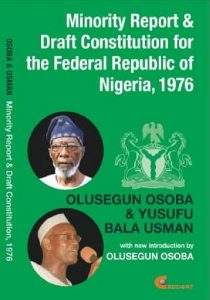
Hence the additional potency in the topic of the symposium as Osoba, along with Yusuf Bala Usman, his friend, fellow Historian, left behind a radical constitutional model around which a struggle more appealing to a broader Nigerian audience could be organised. That is the Minority Report the twosome authored and from which Chapter Two of the existing Constitution emerged.
Observable clouds of opinion around the Minority Report suggest it may not be surprising if it becomes the nodal point around which to reconstruct the democratic imagination and the question of unmet popular aspirations.
To paddle the canoe on July 28th, 2026 at the symposium are Lagos based human rights activist, Femi Falana who will chair the event while Hauwa Mustapha, Toye Olorode, Jibrin Ibrahim and Olutayo Adesina are speakers.
A stormy, uncertain and fear-governed moment as Nigeria is passing through usually trigger fascinating, powerful ideas. The symposium, the second in the series, embody that promise.