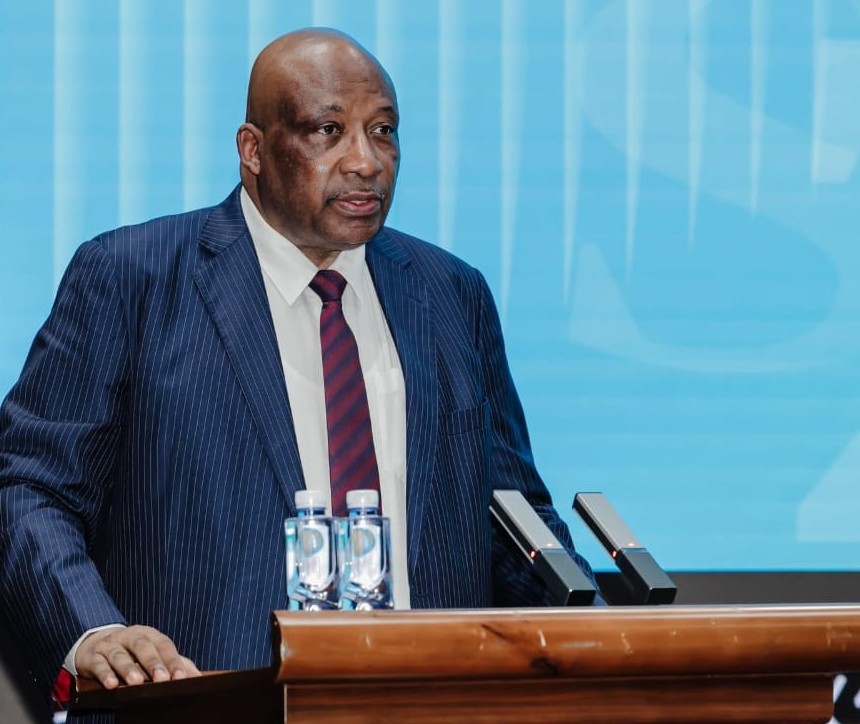
By Prof Chris Kwaja
Introduction
For decades, China’s footprint in Africa was primarily viewed through the lens of economic statecraft, massive infrastructure lending under the Belt and Road Initiative (BRI), and resources-for-infrastructure deals. However, the rising threats of terrorism, piracy, transnational organized crime, and civil instability across West Africa and the Sahel seems to be forcing a recalibration. China has realized that its vast commercial investments and the safety of its diaspora cannot exist in an unstable clime.
Concurrently, African states are seeking partners capable of delivering rapid, unbureaucratic security assistance without the political conditionalities often imposed by Western powers. The FOCAC action plans reflect this convergence, dramatically escalating military grants, joint training, and law enforcement cooperation. At the center of this geopolitical shift sits Nigeria—Africa’s largest economy and a critical security anchor for the West African sub-region.
Ambassador Abdulrahman Danbazau’s diplomatic tenure in China may be emerging as a pivotal case study in navigating the evolving China-Africa security and development architecture. His background as a retired Lieutenant General, former Chief of Army Staff and former Minister of the Interior means that Dambazau brings a combination of frontline military command, internal security expertise, and criminology to Nigerian diplomacy. His deployment to China coincides with a historic shift in Sino-African relations: the transition from infrastructure-dominated trade toward a deeply integrated, technology-driven “security-development nexus” formalised under the Forum on China-Africa Cooperation (FOCAC) Beijing Action Plan.
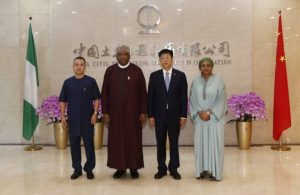
Ambassador Dambazzau with officials of China Civil Engineering Construction Corporation (CCECC) in Beijing early June 2026
Why Dambazau Matters
The appointment of Lt. Gen. Abdulrahman Dambazau (rtd) as Nigeria’s Ambassador to China marks what looks like a deliberate move toward “securitized diplomacy”. Dambazau is not a conventional career diplomat; his background uniquely positions him to decipher and direct the complex machinery of China’s expanding global security role:
- Military and Intelligence Credibility: As a former Chief of Army Staff (2008–2010), he understands tactical procurement, military doctrine, and institutional bottlenecks.
- Internal Security Oversight: Serving as Minister of the Interior (2015–2019), he managed domestic law enforcement, border controls, and responses to emergencies and complex asymmetric threats like banditry and terrorism.
- Academic and Criminological Expertise: Holding a PhD in criminology, his published work focuses on the societal root causes of crime, victimology, and the precise conditions under which systemic conflict festers.
When Dambazau addresses Chinese defense conglomerates or the Group of African Ambassadors in Beijing, he speaks as both a policymaker and a veteran commander. This duality allows him to engage with China’s security apparatus on peer-to-peer terms.
Dambazau’s Security-Development Nexus:
A core tenet of modern Chinese foreign policy is the idea that development is the ultimate antidote to insecurity—a narrative Beijing aggressively promotes across the Global South. Dambazau has notably adopted and refined this concept through a distinctly African lens.
In his strategic frameworks, Dambazau argues that pure kinetic military actions are insufficient to secure lasting peace. True security is achieved when a farmer can safely harvest crops, children can attend school without fear of abduction, and youth have viable economic alternatives to joining extremist networks.
Within China-Africa cooperation, Dambazau advocates for a direct intersection of security planning and rural economic recovery. He positions agriculture, irrigation, and local supply-chain infrastructure as frontline counter-insurgency tools. For instance, a processing facility built with Chinese technical aid is only effective if local security infrastructure permits farmers to safely transport their goods to market. By linking these domains, Dambazau aims to use bilateral cooperation to resolve the structural deprivations that violent non-state actors exploit.
Dambazau’s public assertions emphasize that security solutions cannot simply be imported or carbon-copied from Beijing’s model. Because African nations maintain distinct political systems and local realities, partnerships must strictly follow a blueprint of African ownership.
A recurring critique of Africa’s security relationship with foreign powers is the risk of an “accountability deficit” and a total dependency on imported weapons systems. Under Dambazau’s leadership, Nigeria’s diplomatic engagement with China has sought to disrupt this buyer-supplier paradigm in favor of technology transfer and indigenous capacity building.
Conclusion: A Blueprint for Sovereign Security
Lt. Gen. Abdulrahman Dambazau’s diplomatic presence in Beijing may eventually serve as a model for how African states can intentionally engage with global superpowers. By steering the conversation away from simple resource extraction or passive equipment purchasing, he demonstrates that a highly specialized, security-minded emissary can effectively bargain for structural technology transfers and sustainable development models.
Ultimately, his work in the shadow of China-Africa cooperation proves that true stability is an internal task. Foreign partnerships are highly valuable for securing advanced tools, technical frameworks, and capital investments. However, the long-term protection of sovereign borders, local economies, and human dignity depends entirely on an African-led strategy that seamlessly treats development as a core pillar of national security.
Chris Kwaja is a Professor of International Relations and Strategic Studies at the Centre for Peace and Security Studies, Modibbo Adama University, Yola, Nigeria.