By Prof Chris Kwaja
Introduction
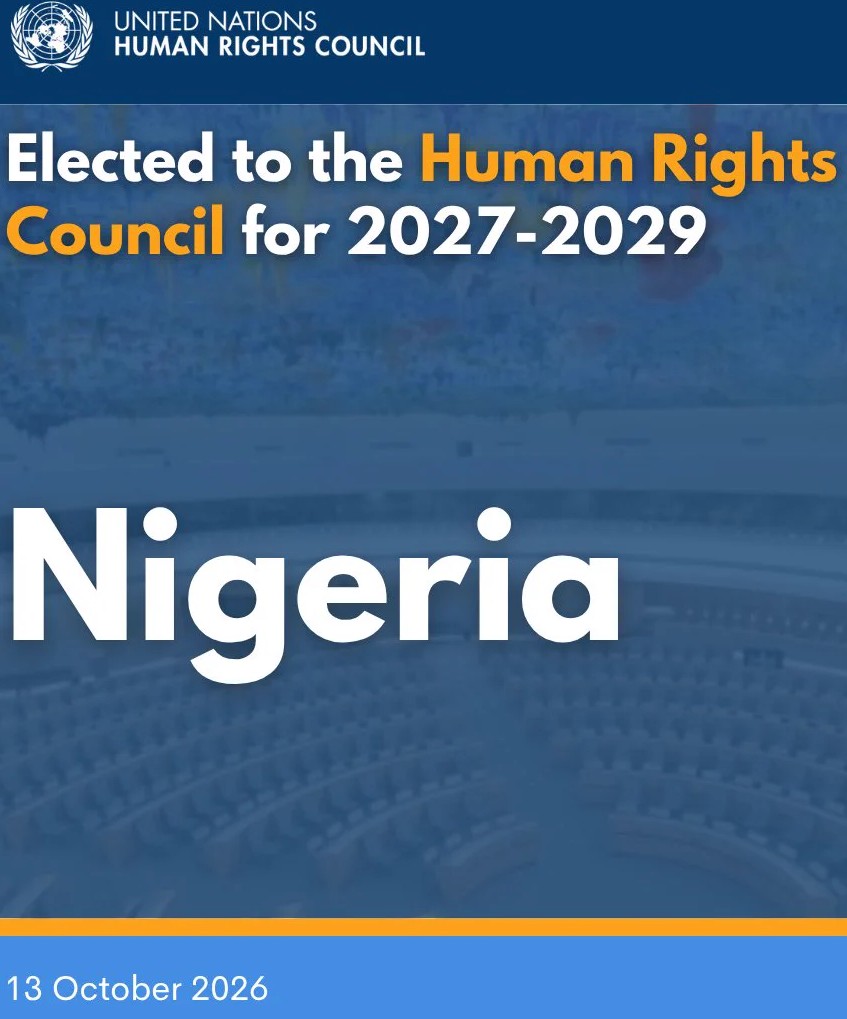
On the international stage, elections to multilateral institutions are rarely merely procedural events. They are moments of diplomatic positioning, international recognition and strategic opportunity. Nigeria’s election to the United Nations Human Rights Council (UNHRC) for the 2027–2029 term, announced on 13 October 2026, represents an important moment in the country’s multilateral diplomacy and its engagement with the international human rights system. Nigeria secured 172 votes in the General Assembly, joining Burundi, Ghana and Zambia as the African States elected for the forthcoming term. Yet the significance of this development extends beyond diplomatic recognition.
Membership of the Council places Nigeria in a position to contribute to the promotion and protection of human rights globally while inviting greater scrutiny of its own human rights record. Nigeria’s membership will be measured not simply by the number of votes it receives at the United Nations, but by the extent to which it advances accountability, strengthens democratic institutions, protects vulnerable populations and demonstrates consistency between its international commitments and domestic practices.
The Human Rights Council is not simply another international forum where governments exchange statements and pursue diplomatic interests. It is a central United Nations intergovernmental body responsible for promoting and protecting human rights around the world. Its work encompasses the examination of human rights situations, the consideration of allegations of violations, the development of international standards and the Universal Periodic Review of the human rights records of all UN Member States.
Ultimately, Nigeria’s election presents an opportunity to redefine its global identity: from a country seeking a greater voice in international affairs to one capable of exercising principled leadership in the defence of human dignity.
Understanding the Significance of Nigeria’s Election
Nigeria’s election carries diplomatic, political and institutional significance. First, it reinforces the country’s position within the United Nations system. As a major African state with considerable demographic, economic and diplomatic weight, Nigeria has the potential to contribute to discussions on conflict prevention, democratic governance, civic freedoms, humanitarian protection and the strengthening of international human rights institutions.
Second, the election provides an opportunity to articulate African perspectives on global human rights challenges. These include armed conflict, displacement, poverty, inequality, access to justice, gender-based violence and the protection of children. Nigeria can help ensure that international responses reflect the experiences and priorities of African societies while remaining firmly grounded in universal human rights principles.
Third, membership offers Nigeria a platform to build coalitions, contribute to resolutions, engage with international experts and participate in debates concerning the implementation of human rights obligations. It can use this platform to promote constructive dialogue, technical assistance, institutional capacity-building and the strengthening of national human rights institutions.
Nevertheless, diplomatic significance must not be confused with an unconditional endorsement of a country’s human rights record. Membership is an opportunity to serve; it is not a certificate of perfection.
The International Service for Human Rights observed on 13 October 2026 that the latest Council election, like several previous elections, was uncompetitive because the regional groups presented candidate lists matching the available seats. This context makes it particularly important not to interpret election to the Council as conclusive evidence that every elected country’s human rights practices have received universal approval.
Nigeria must therefore resist the temptation to treat its election as the end of a diplomatic campaign. Rather, it should recognise the beginning of a demanding period in which its conduct, positions and commitments will be judged against the principles it has undertaken to uphold.
The Credibility Challenge: Human Rights Leadership Begins at Home
The greatest test of Nigeria’s membership will not occur exclusively in Geneva or New York. It will begin at home. Nigeria’s constitutional and international commitments recognise the importance of human dignity, personal liberty, fair hearing, freedom of expression, freedom of peaceful assembly and protection against discrimination. These principles are essential to democratic governance and to the rule of law.
Yet the practical protection of human rights depends on more than constitutional language or international treaties. It requires functioning institutions, independent oversight, accessible courts, professional security services, transparent public administration and effective remedies for victims of violations.
Nigeria continues to confront serious challenges relating to insecurity, displacement, access to justice, the protection of civic freedoms, allegations of abuses by security personnel, discrimination and gender-based violence. The effects of these problems are often most severe for poor communities, children, women, displaced persons and other vulnerable populations.
The existence of these challenges does not invalidate Nigeria’s election. Rather, it makes the responsibilities associated with membership more consequential. A country cannot credibly advocate for the protection of civilians abroad while neglecting the safety of civilians within its own territory. It cannot convincingly defend freedom of expression internationally while failing to safeguard legitimate criticism at home. Nor can it demand accountability for violations committed elsewhere while treating credible allegations of domestic abuse with indifference.
This is the fundamental credibility challenge confronting Nigeria: the need to close the gap between the human rights principles it endorses internationally and the lived experiences of the people it governs. The Council should provide an incentive for Nigeria to confront this challenge openly. Genuine leadership is not the absence of problems; it is the willingness to acknowledge them, address them systematically and demonstrate progress through verifiable results.
Security and Human Dignity: Reconciling National Safety with Human Rights
One of Nigeria’s most pressing governance challenges is the protection of citizens amid persistent security threats. Terrorism, insurgency, banditry, kidnapping, communal violence and other forms of insecurity have caused profound suffering in affected communities.
However, the pursuit of security must remain consistent with constitutional guarantees and applicable international human rights and humanitarian law. Security operations should be guided by legality, necessity, proportionality, accountability and the protection of civilians. Allegations of unlawful killings, arbitrary detention, torture, enforced disappearance or other abuses must receive credible and impartial investigation, with appropriate remedies where violations are established.
At the same time, communities affected by violence require more than military intervention. They need functioning schools, accessible healthcare, reliable justice systems, economic opportunities, psychosocial support and effective mechanisms for resolving local disputes.
Nigeria should use its membership of the Human Rights Council to promote an approach to security that recognises human rights as an essential component of sustainable peace rather than an obstacle to it. This requires a clear policy position: security institutions must be adequately equipped to protect the population, while being subject to effective civilian oversight and the rule of law.
Nigeria and Africa: The Opportunity for Principled Regional Leadership
African countries face a diverse range of challenges, including violent conflict, unconstitutional changes of government, displacement, discrimination, restrictions on civic space and weaknesses in accountability institutions. These challenges require solutions that combine regional cooperation, national ownership and respect for universal human rights.
Nigeria can use its diplomatic influence to encourage dialogue, share institutional experience, support capacity-building and promote cooperation between the United Nations, the African Union and relevant regional human rights mechanisms. However, regional solidarity must not become a justification for silence when credible allegations of violations arise.
The defence of human rights loses credibility when political alliances determine which victims deserve attention or which abuses warrant condemnation. Consistent principles are therefore essential to Nigeria’s potential leadership. Nigeria should advocate for impartiality, constructive engagement, fair procedures and equal application of international standards. It should oppose the politicisation of human rights without using concerns about politicisation to dismiss legitimate scrutiny.
African leadership in this field should not be measured by the ability to shield governments from criticism. It should be measured by the capacity to protect people, strengthen institutions and make accountability more effective. Nigeria has an opportunity to help demonstrate that African sovereignty and international human rights obligations are compatible: sovereign states exercise their authority most legitimately when they protect the dignity and rights of their populations.
Conclusion
Nigeria’s election to the United Nations Human Rights Council for the 2027–2029 term is an important diplomatic development. It offers a platform to advance international cooperation, strengthen Africa’s voice in global affairs and contribute to the promotion and protection of human rights.
The country must recognise that membership comes with responsibilities that extend beyond speeches, ceremonies and diplomatic engagements. It requires principled participation, constructive cooperation with international mechanisms, credible domestic institutions and a demonstrated willingness to confront human rights challenges.
Nigeria’s credibility will depend on whether its international positions reflect consistent principles, whether credible allegations of abuse receive appropriate investigation, whether vulnerable populations enjoy stronger protection and whether citizens experience meaningful improvements in their ability to exercise their rights.
The country should therefore treat its forthcoming term as an opportunity for renewal: a chance to strengthen the rule of law, deepen democratic accountability, improve access to justice and make human dignity a more visible priority of public policy.
Ultimately, the strongest evidence of Nigeria’s leadership will not be found in the applause that accompanied its election. It will be found in the lives protected, the injustices corrected, the institutions strengthened and the freedoms secured during its time on the Council.
The author who worked within the United Nations Human Rights Council as an African Representative on the Working Group on Mercenaries between 2018 and 2024 is a Professor of International Relations and Strategic Studies at the Centre for Peace and Security Studies, Modibbo Adama University, Yola in Nigeria