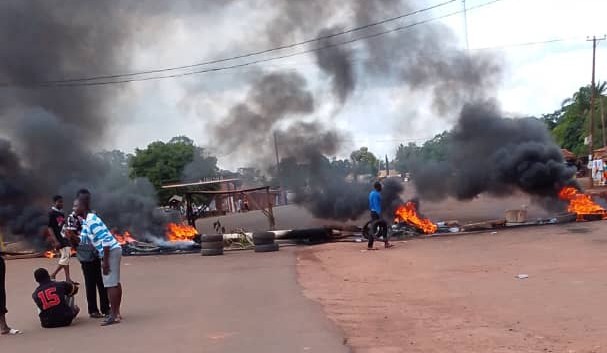
Otukpo, one of the two most urbanised townships in Benue State of Nigeria has been blocked off the country. Protesters have closed entry into as well as exit from the town.
Not even Mister Cletus Nwadiogbu, the Benue State Commissioner of Police was spared the effects of the blockage of the town. Although Intervention understands that, after two hours, the protesters eventually allowed him passage to one of the sites of killings earlier this morning, the permission has, so far, been restricted to the CP and with qualifications. No other state officials have been known to have been granted such permission again as yet.
An eye witness account suggests that over 3000 vehicles are on both sides of the Otukpo town by around 1 pm this afternoon. Some are understood to have since commenced exploring alternative routes.

CP Nwadiaogbu
Idomaland has been boiling for the past three weeks. The trigger for today’s blocking-off of Otukpo town is obviously the confirmation of 10 persons dead during a pre-dawn raid July 12th, 2026. The list of the dead stretches from children to women, not to talk of men. The pictures do not rule out use of guns but equally suggest use of knives and other pointed items.
Unimpeachable sources put the time at 4 am and the worst hit site seems to be Otukpo-Nobi which still falls into outskirt of Otukpo town. The Sunday morning raid was preceded by another one yesterday (Saturday, July 11th, 2026) at Akpachi village in Ugboju District. Being a more remote rural space, the details of that earlier raid have not filtered in as much.
These raids appear to have caught everyone off-guard. A spectre has been haunting Idomaland. It is the spectre of a militia attack anywhere in the kingdom in the aftermath of the killing of the late Benue State Chairman of Miyetti Allah Cattle Breeders Association of Nigeria (MACBAN), Ardo Risku Muhammad.
Like all such speculations, there were no empirics to it. But the spectre had basically crippled life. Going to the farm has been out of it as women and even men have been asked to stay off farms. Without going to the farm on a daily basis, most families have no guarantee of the daily meals and material sustenance. Communal life revolves around the farm and the local market in most settlements outside Otukpo and emerging urban centres as in most agrarian states in Nigeria.
When the attack series started Saturday, it neither took place where the Ardo was killed nor at Idekpa where he lived. Instead, it happened at Otukpo-Nobi and Ugboju. Depending on the quality of the road, Ugboju from Otukpo falls into an hour affair.
This has led to questions. There are those asking, for example, if someone somewhere is up to provoking a crisis in Idomaland. By that, they are asking if different communities have been targeted so as to not make it look like reprisals for the Ardo? Each of such a question embody both frustration and boiling point anger, some of which are exploding on the road and elsewhere against the Benue and Federal Government but also the Och’Idoma.
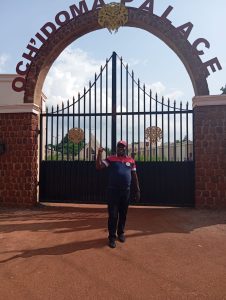
For instance, commuters stormed the Och’Idoma’s Palace in Otukpo in utter desperation and to demand for protection before the seizure of the federal highway into and out of Otukpo. While the Och’Idoma’s Palace attracts anger because it is the centre of power closest to the communities, the question is whether any traditional rulers has formal authority over repressive state apparatuses in Nigeria. Of course, they do have supernatural powers as two prominent traditional rulers invoked the ancestor master code last week. How far this goes in Idomaland remains to be seen in the current phase of generalised insecurity since 2016.
 Before this spate of attacks, Prof. David Salifu, a former Secretary to the Benue State Government was shot dead by bandits. This, Intervention learnt, occurred around the same time as Ardo’s killing. Unlike the quick visit of Dr Sam Odeh, the Benue State Deputy-Governor, to the Ardo family, an action welcomed by many, critics say there were no such widely reported visits to Prof Salifu’s family.
They link this to claims of no such visit either to the over 250 victims killed in previous deadly encounters in the major theatres of violence in Idomaland in the past few months. A critic told Intervention how it took the Benue State governor, Fr Hyacinth Alia, nearly a week before paying a visit to the victims of the Yelwata killings in mid-2025 where over 200 were officially believed to have perished.
These are some of the ‘silences’ grounding the anger now exploding as there are those who frown at what they see as blatant discrepancies in government responses. While the late Ardo seems to be actually popular around Idomaland (Intervention was told of intractable conflicts he waded into and resolved in the communities), what brings about reservations could stem from elsewhere. It was understood, for instance, that one of the complaints of protesters against the CP this afternoon is arrest of “people too old to know anything about the Ardo’s death”. When such perceptions accumulate or are not addressed, they transform into a different layer of the problem, it was argued.
It is not clear what has precisely triggered this spate of violence although the truth is that violence has not been far away from most parts of Idomaland since 2016. Much of that bear the footprints of what is popularly labelled as Fulani militia in struggle for land and water resources or cultural authority such as establishing parallel cultural cum religious authority in an area. This is the theory of Fulanisation which captures a twin agenda of Islamisation and land take-over. On this, there is considerable consensus across the Middle Belt.
However, while each killing session is articulated in terms of Fulanisation, a politics of engagement does not always follow. In other words, nobody sees any collectivity engaging the Nigerian State or the symbols of the Fulani nationality on the crisis. Yet, politics is supposed to be the art of the possible.

Benue State governor, Fr Hyacinth Alia
This is where those who are not bothered with Fulanisation theory or the Nigerian State are coming from. As argued to Intervention, they prefer to see the emergence of a coalition of players made up mainly of those they call genuine Idoma traditional, political, intellectual, business and civil society leaders to lead the process of de-escalation in Idomaland by leading a delegation to wherever they think peace is hiding, starting, of course, with the federal authority in Abuja. The key idea behind this option, as Intervention was further told, is that Idomaland as it is, does not have the strength to withstand or absorb intractability.
Part of this argument goes like this. While Idomaland is not and cannot be an island in a sea of violence and threats, it is first and foremost only a minority ethnic group. Like every minority groups around the world, it feels vulnerable and seeks guarantees. It has got this guarantees through the generous attention of Nigeria to it by, historically, always having an Idoma in a high profile political office. As much as the symbolic import of that for a minority group with no such opening anywhere else in a federation cannot be underestimated, it is becoming inadequate.
The complexity of the problems arising explains that. Unemployment, rising incidence of poverty and general crisis of economy have challenged the symbolic import. It is worsened by the recent crash of the garri market which constitutes local economy, for example.
Resort to sycophancy, criminal and counter-cultural temptations have, not surprisingly been rising as many young people leave schools and pour into Makurdi, the Benue State capital to confront nothingness.
Critics use nothingness in this case to refer to paucity of functional agro-industrial efforts that can absorb any reasonable number of job-seekers. Yet, it is a time when migrating to Lagos, Port Harcourt and other more active urban centres is no longer an option compared to before. Neither are there the textile mills of yesteryears.
Even though Idomaland is on the Enugu-Otukpo Federal Highway and an axis of commerce, what passes for the markets are overstressed. Apart from multiple taxation points to local revenue mechanisms, the markets are buyers’ markets in which the sellers can hardly determine the volume of transactions or the price.
To cap the mess, the only higher institution of learning in the area – The Benue Polytechnic – is but a shadow of itself in all metrics, to quote a Makurdi based assessor. It is no wonder that the question is said to be popping more regularly nowadays: who will bell the cat of hunger and anarchy in a small but potentially volatile Nigerian entity called Idomaland?