The 2026 version of the Center for World University Ranking (CWUR) is out and the United States of America, the UK, Japan and France are still the global knowledge powers if the ranking exercise is used to measure that. The first twenty top global universities are, by that ranking, located in those four countries, with Japan and France having one each, UK three while the US has the rest.
Among the top global universities in the US are the usual names of Harvard, MIT and Stanford. UK’s Cambridge and Oxford enter the list at numbers four and five and the US returns at numbers six to twelve: Princeton, Pennsylvania, Columbia, Yale, Chicago, CALTECH, Berkeley.
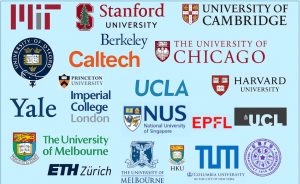
It is a permanently changing list even as some of these universities are ever present!
The University of Tokyo in Japan breaks the US dominance at number 13 but the next six are all US. These are Cornell, Northwestern, Michigan (Ann Arbor), UCLA and John Hopkins. The University College London brings the UK back into the list at number 19 while the 20th position is taken by the Paris Sciences et Letters (PSL) in France.
Hitherto, Chinese universities have been high performers in this and other ranking exercises. But Tsinghua University which is generally regarded as China’s equivalent of the MIT is number 36, the first from China on the list as the US continues to dominate between 21st and almost throughout. Canada’s University of Toronto is number 23, followed closely on number 26 by its (Canadian) rival, McGill University.
A few shockers. The first university from Australia on the list is neither the Australian National University, the University of Sydney nor the University of Melbourne, their traditional first rankers but the University of New South Wales at number 52 while the University of Melbourne is at number 64. The Australian National University, the University of Melbourne (all in Australia), the University of McGill and the University of British Columbia (all in Canada) are among universities generally rated as global rising stars in contemporary times, mostly by pedigree, virtue of one big name or another or self-understanding.
From Africa comes another shocker: although South Africa and Egypt are the continent’s knowledge power houses in the ranking industry, the University of the Witwatersrand in Johannesburg has broken the University of Cape Town’s monopoly of number one. The University of the Witwatersrand, known for short as Wits has taken Africa’s number one spot as the number 200th on the list, pushing Cape Town to number 276 in this ranking.
The top five universities from South Africa on the list of over 20,000 universities are Wits at 200; UCT at 276; the University of Stellenbosch at 461; the University of Kwazulu Natal at number 532 and the University of Pretoria at 565. The University of Cairo in Egypt is its number one on the list at 517 while the University of Ibadan is Nigeria’s number one on the list at number 1047.
What Intervention finds interesting about UI in this ranking is that, even at number 1047, it still came ahead of big name universities such as the American University in Washington (known for big names such as Prof Patrick Thaddeus Jackson, Prof Amitav Acharya and so on), the University of Aberystwyth, Copenhagen Business School (which is a very tough scholarly space in Sweden), the University of Canberra, the University of Bucharest, the University of Kassel in Germany, the European University Institute, Howard University in the US, the University of Seoul in South Korea and the University of Ghana, to name a few. It means that, aside from the top five from South Africa and the University of Cairo in Egypt, only Makerere University in Uganda (at number 904) and Mohammed V University in Morocco preceded UI in Africa (subject to closer checking).

A little more qualitative rather than quantitative touch and it will fly!
Four other universities mentioned from Nigeria are the University of Nigeria, Nsukka at number 1533; UNILAG at 1683; ABU, Zaria at 1779 and OAU, Ile-Ife at number 1884. What this means is that the Nigerian equivalent of elite universities have re-asserted themselves and taken the lead from private universities in terms of the first five. All five leading universities from South Africa are also public research universities. Same as the University of Cairo in Egypt and the University of Nairobi in Kenya which occurred at number 1425. The question is what this trend says about private universities in the African context in terms of performance in the ranking exercise. Is this too singular to sustain any generalization regarding the public/private binary yet?
Notwithstanding very justifiable reservations about certain aspects of the global university ranking industry, the result of every ranking still hits the headlines every year, particularly the ranking conducted by QS, Times Higher Education (THE) and this one. There are several others, each one using its peculiar methodology. While almost no one is unhappy with subject ranking because it is a better ranking of what a university’s actual strenght, the global ranking is generally assessed to be problematic because it hides more than it reveals aside from promoting university chauvinism. Above all, universities in Africa can hardly come up on score-points such as staff-student ratio or number of international students.
While a country such as Nigeria can easily make its university system to attract international students by fundamentally reforming the university system, smaller African countries cannot do so on any serious scale. At the moment, it would seem that just South Africa, Kenya, Egypt and probably Dakar or Ghana have that advantage. Whether theirs is on a substantial enough scale is not what Intervention can attest to.
Meanwhile, the University of Witwatersrand is in celebration of its ascendancy. It announced in a statement on its website titled ‘Wits is ranked No. 1 in Africa’ how it has now claimed the top spot in the 2026 Center for World University Rankings (CWUR) out of 21, 291 universities, adding how that position means a Wits ‘standing firmly within the top 1 % of universities worldwide. This, said the Vice-Chancellor, Prof Zeblon Vilakazi, is a milestone “reflecting the University’s enduring commitment to academic and research excellence, innovation, and the advancement of the public good”.
Not done yet, the VC said “Being ranked number one in Africa and among the top 1% globally is a testament to the collective excellence, resilience and ambition of our students, staff, alumni and partners.”
Even while acknowledging misgivings around ranking systems, Prof Vilakazi called the ranking important, arguing it used objective data to rank universities on education, research, faculty and the employability of graduates. Connecting the performance to exceptionalism in areas that speak directly to real-world influence and graduate success, Prof Vilakazi remarked how important Wits “achieved a remarkable Employability Rank of 97 globally, highlighting the caliber and competitiveness of Wits graduates in the international marketplace”.
Generalising from his university’s ascendancy, the VC maintained it affirmed the capacity of African universities to “compete with the very best in the world whilst remaining deeply committed to advancing knowledge, opportunity and progress on the continent”.
The obvious good news for Wits comes with its own challenge in that it is one thing to climb to the top but another thing to stay on top for long, especially as there are competitors eyeing that exclusive club. In any case, CWUR is only one of the about half a dozen rankers in the emergent industry.