Nigerian youths seeking expansion of the scope of meaningful participation in politics have been told to learn from how their counterparts in Kenya went about it although there is still controversy on the meaning of youth participation. Is it for the youths to take over and enjoy the perquisites of office the way incumbents are doing or is it to take over and transform the Nigerian society? Notwithstanding the inconclusive debate for now, the argument is that the pathway to deepening youth participation is for Nigerian youths to organise and assert themselves electorally the same way their Kenyan counterparts have gone about it.
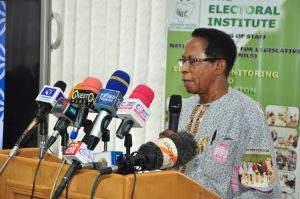
Prof Asobie delivering his lecture
Although a senior Nigerian politician at the occasion described the suggestion as exciting but inciting, Professor Humphrey Asisi Asobie, notable Political Scientist, former National President of the Academic Staff Union of Universities, (ASUU) and Guest Lecturer at The Electoral Institute, (TEI)’s First Abubakar Momoh Memorial lecture who is pushing this idea says that is why there are now Kenyan youths of 19, 24, 26 years who have been elected into parliament and other elective offices. But the model unfolded at the lecture attended by nearly a dozen high officials of Nigeria’s election management body – Independent National Electoral Commission, (INEC), diplomats, academics, civil society leaders, leaders of political parties, women and youth leaders as well as the late Prof Abubakar Momoh’s family, particularly his widow, came with a qualification: the youths cannot accomplish this alone, they need to align with platforms such as the Nigeria Labour Congress, (NLC).
Indirectly saying that the Nigerian State is so alienated and alienating, Asobie declared how low participation generally is in Nigeria and specifically the youths, a low scale participation he blames the Nigerian Constitution for sanctifying by its provisions which set the age for most of the crucial offices such as that of the president, governors and senators at youth exclusionary ages of figures of 35 and above when no upper ceiling exists for the oldies.
Prof Asobie said it is not a question of homogenising youth agency because he accepted that the youths have also been incorporated into the representation and practices of the power elite, especially the construction of crisis in ethno-religious terms by ethic warlords. It is in realisation of this that he said he qualified his idea of youths as those ideologically clear and can think of politics in terms of rapid social transformation.
Challenging the youths to reckon with democracy as “what you do for yourself, not what somebody does for you”, Asobie said youth exclusion in Nigeria is scandalous, ridiculous and undemocratic, adding that Nigerian youths are actually subjects, not citizens, deriding the impossibility of talking about democracy when youth participation is that low.
Arguing how youth participation in itself is functional to democracy, he concluded how important it is to say that youths cannot wait endlessly. They have got to use their numerical strength and alliance to present a new pattern of politics in favour of transformative rather than transactional leadership, said Asobie who asks of them to know that the majority in every society are the poor and the numerous and that, in choosing, “people who are unlike you cannot represent you. Those who should represent you are people who are like you”.
 He further argued the impossibility of youth participation without a financial level playing ground, noting how INEC could help; how the existing Constitution has provisions that could have resolved the problem. The constitution provides leeway by providing for a manner of managing the economy such that existing inequality level would not have arisen. Additionally, “If you take Section 16 and provide education, it would amount to youth empowerment because there is a positive correlation between high achievement in education and consciousness”.
The Guest Lecturer warned against how what he said has happened in China could happen here in which youths moved away from seeking participation into new technology in contrast to Norway where a much more organised response to youth participation produced a more participation-inducing system and outcome.
This is, however, not what he is expecting in Nigeria because Nigeria is in the category of a pseudo-democracy, notwithstanding a better election in 2015, recalling how late President Umaru Musa Yar’Adua was honest enough to admit this much in a documented manner.
Prof Asobie identified the state and social order context of youth participation in Nigeria in the fragmented, incoherent and very fragile state with which there is clearly something structurally wrong. Incoherence, insecurity and instability all go to show that something is wrong beyond just any particular regime even as he did not award the incumbent a pass mark, saying governance is very low. Nigeria had made some progress on her fragility status, it is still next to the worst in categorisation, said Asobie who put his fingers on what is wrong with the Nigerian State in the emphasis on sharing rather than production. “The state is a problem in itself”, he said, adding how the social order context of the Nigerian State is such that the leaders do not feel obliged beyond projectisation. The gap between the rich and the poor is also a point in this.

Prince Tony Momoh making his point
Prince Tony Momoh, a former Minister for Information and chieftain of Nigeria’s ruling party – All Progressives Congress, (APC) as well as a relation of late Prof Abubakar Momoh did not accept everything Prof Asobie said, arguing that the problem is that the Nigerian Constitution had privileged democracy over and above development. He called for decongestion of the political space because “we are spending much money on democracy”. He was basically saying that the Constitution put the rights to enjoy in Chapter 4 ahead of the duties to perform in Chapter 2, a contribution Professor Okey Ibeanu, another Political Scientist and an INEC Director who chaired the occasion subsequently framed as the “democracy – development’ debate in African politics. But, when given the floor again, Prof Asobie to whom the question was directed said it was not enough to say that democracy promotes development. For him, it is more important to ask what sort of democracy and what manner of development. He put it to the circumstance, saying Lee Kuan Yew of Singapore has been rated as such a success story in autocracy promoting development but that he worked with communists, itself a potential controversy.
Prof Ibeanu put some laughter to the conversation when he distinguished between a dead and a living constitution. One is the letter, the other is the practice of it. Those who wrote the Nigerian Constitution, said Ibeanu, “took everything that is important about our existence and put in Chapter 2 but tied it down with the justiciability/non-justiciability provisions. But, according to him, Section 14 of the Constitution is actually the basis on which Nigeria should be organised and that is Social Justice. For him, the point, however, is not whether the Constitution provides but the politics of enforcing certain provisions.
Another contestation came from Mohammed Baki Lecky, an INEC Resident Commissioner who did not accept a distinction between transformative and transactional leader, preferring to see a continuum there. Arguing that some of the points about youth participation were overstated, the REC maintained how youths do not necessarily have to be local government chairmen, governors or ministers in order to change things. They could do so using their votes to change things around. His worry is rather about the ideological level of Nigerian youths.

A group photograph which captured most of the attendees
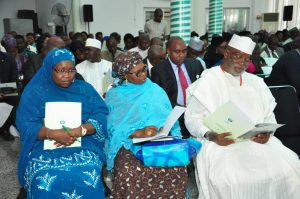
Another line of attendees
Prof Anthonia Okoo-Simbene, another INEC top official who responded to a question posed in her schedule of duty told the gathering howINEC cannot do anything about whether aspirants should pay or not pay for nomination forms that political parties ask for. What INEC can do is in respect of monitoring party expenditure. That is provided for, she said, but even then parties submit such statements sometimes three years after an election.
Professor Okey Ibeanu, the Chairman of the occasion had sort of wetted appetite of attendees at the memorial at the beginning of the occasion by relating what the man who delivered a homily at the 7th day prayer for Prof Momoh said. The man said a dead man’s grave is not the most important thing because many would no longer even be able to find it after some time. What is more important is the number of graves a person made in the heart and minds of other people and which makes life a question of how many graves one dug in others. Or, what impact did one make on the life of others! Abubakar Momoh’s life, he said, was in the graves he dug in the minds of many people, from CODESRIA in Dakar to the lecture halls of King’s College London to the slums of Lagos. “Momoh would have been very happy with the prospects of youth participation”, he maintained but that is participation beyond the statistical sense. Rather, participation in transformative, progressive sense, he said. He was sure Prof Asobie under whom the late Momoh served ASUU as treasurer was best placed to deliver the first of the memorial lectures, an event they in INEC hope to keep alive.
Dr Sa’ad Umar Idris, Acting DG of TEI had taken basically the same position earlier in his welcome address by saying youth participation was one of Professor Momoh’s best themes and on which he researched and wrote.
It is exactly one year today Prof Abubakar Momoh passed on. There has been a very steady remembrance of him since then, in the past one week and in the coming week. But why? Could that be be... Read more

It is a bit long but never boring video, from start to finish. There is the appetizer in what his host, Dr Akinwumi Adesina, the President of the Africa Development Bank, (AfDB), said about the emir at the beginning of the video. The pair speaks to the Nigerian paradox- united abroad, divided at home! There is the main meal and we can lump the rest into the deserts. Economists hardly agree on even the most central issues in their discipline. But Muhammadu Sanusi 11, the incumbent Emir of Kano in Nigeria’s speech provides a useful checklist that can move forward the conversation on the African crisis. The Afrocentric verve here and there, the privileging of industrialisation and the advocacy for an African review of the China phenomenon define the grand strategy to the presentation.
There are many who will go after the emir after watching this video. Philosophers would certainly be one of those because he has splashed mud on a key fascination for them. Local protagonists of unchecked neo-liberalism would certainly not be happy with him because he is contesting the space from within with a new orthodoxy. But this video would also have its fans, in fact, the majority although what the video demands is beyond fandom. It is not for fans or haters of the emir but for thinkers. It is a tough video, from the technical difficulty of uploading it from YouTube here to the content in terms of the silent debate on the mess in which Africa is.


One of China’s statements in developmentalism
In fact, Africa is a threat to all now – to the poor, powerless humanity trapped in its poverty as well as to the rest of the world, at least the Western world. That is what Western authors such as Robert Kaplan articulated in his widely read book in the international policy mill – The Coming Anarchy. But an African Political Scientist of note has equally said that, since SAP, much of African countries are either at war or just coming out of war or just about entering war. That was in 2005 and nothing has changed. In 2018, three of the continent’s much talked about powerhouses-Nigeria, South Africa and Egypt – are in crisis. The newer power houses such as Ethiopia and Kenya are not at peace either. Beyond Rwanda and Botswana, there are no such great sustainable success stories. The never ending war in the DRC must be the continent’s greatest embarrassment that such a rich land could be turned into a permanent waste of human beings since independence, engineered and sustained by forces Africa is too weak to do anything about. Add South Sudan to that and it is time to go drink Umqombothi because, as the street wisdom goes, he who drinks goes to sleep and he who is asleep escapes committing sins, thereby paving the way for admission into Heaven.
As far as this video is concerned, Emir Sanusi is worth listening to at all party headquarters, think tanks, universities, NGOs, media houses and so on for sketching out what is clearly a grand strategy for de-securitising Africa. The video has touched an ensemble: from the knowledge requirement for industrial leap, the technocratic requirement, the energy framework, the inter-African trade necessity, the imperative for responding to negative corruption perception rating, an Afrocentric re-conceptualisation of the migration imbroglio, his models of critical or sensitive governance in Africa and the bad guys thereto, the need to undo the interior-coastal differential in African development, Dangote’s strategy of conquering challenges of industrial investment in the era of the famished presence of state-based elbow room and a host of such critical themes. It is debatable but there is a sense in which the video can be comfortably reduced to his point about the imperative for an African re-engagement with China vis-a-vis getting it right.
That point ought to have been a running debate across Africa, not the current continental silence. Even for curiosity sake, China since 1978 ought to be well understood across the continent. 1978 was when the ‘liberals’ miraculously succeeded in taking over and reworking orthodoxy in favour of an assemblage of ideas, models and expertise from wherever, following the paradigm of welcoming cats of all colors, provided they caught mice. It could have gone either way. Today, it is such a phenomenal success story which no one has provided an apt enough phrase to capture. As late as last March at the 19th China Development Forum, Stephen Roach of Yale University said “No large developing economy has ever done what China has done …, transforming itself into the world’s most powerful export machine”. Roland Berger, founder and former head of the global strategy consulting firm by that name agreed with Roach by saying that China had confounded every forecast about it in the last 40 years and it had become uninviting to predict what could happen next. Mark Moody-Stuart, former head of Shell simply said China from 1978 is a story in “astonishing achievement” and thus the role model that other developing countries cannot but be interested in, mentioning Africa in particular.
It is against this background that what the Emir said at the May end Board of Governors meeting of the African Development Bank, (AfDB) in Busan, South Korea must be subject of further debate. Although he used Nigeria a lot to illustrate most of his claims, many of his listeners felt he was speaking to the situation in their own country:

President Muhammadu Buhari and Chief Olusegun Obasanjo, one of his many living predecessors, have each manoeuvred himself to become the lodestar of oppositional ships in Nigerian politics. W... Read more
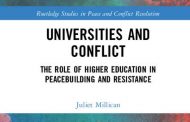
It was one of the questions Intervention tried to deal with very early in its formation. The puzzle is why more conflict and violence in Nigeria at a time there are more universities and think tanks dealing with formal study of peace and peace politics? The question came about following what was clearly a massive expansion in opportunities for formal study of Peace and Conflict in Nigeria, something that was available in scattered forms in International Relations, Sociology, Psychology, Political Science, Geopolitics, Linguistics and Religious Studies.
Whereas by 2003/4, it was just the University of Ibadan programme in Peace and Conflict Studies and the same university’s Centre for Peace and Conflict Studies, (CEPACS) as well as Programme on Ethnic and Federal Studies, (PEFS), there were over 20 universities, INGOs, independent think tanks and sundry centres offering one programme or another in Peace Studies by 2016. The correlation should be very clear and if that is not the case, then the question must be posed regarding what might be the intervening variable between the reality of more such centres without corresponding decrease in the quantum of violent intra and inter-group conflicts. Intervention interviewed academics and other stakeholders across the country in a two-part narrative. Each gave his or her own analyses, (See “Nigeria: Why the More Conflict Management Training, the More Conflict, Sept 5 & 6th, 2016/www.intervention.ng).

Pioneer Peace and Conflict Studies centre in the Nigerian university system
An expert from the Peace and Conflict programme at Ibadan who assessed the story post publication, however, interrogated the assumption entirely. He said the expansion under reference was overblown because many of the centres and Peace Studies programmes lacked the staff strength and the vibrancy to warrant a claim of lack of correlation between expansion in the number of study centres and decrease in (violent) conflicts. That was 2016. Now, this is 2018 and there is a book trying to account for the relationship between universities and conflict.
It is an interesting book because, for one, it has analysis from across different parts of the world – Middle East, Asia, Europe and Africa. It may not score an ‘A’ in inclusivity because there is just a chapter from (South) Africa, it is an improvement when compared to other such efforts.
Two, it basically agrees with the notion of universities as conflict managers in their own right because they are theatres of discourses of conflict, discourses which are reproductive of peace as well as conflict, depending on what the discourses are and how students of these discourses operationalise them.
The newness of this research agenda means that most readers would find the introductory chapter and Chapter Three interesting. Chapter Three is where Dr Sansom Milton of the Centre for Conflict and Humanitarian Studies at the Qatar based Doha Institute for graduate Studies reviewed the literature on universities and conflict. Those who are, however, more interested in practical issues might find the case studies chapters (4 – 11) more inviting. The case studies in university – conflict nexus cover some of the hottest conflict spaces or universities concerned with the discipline: Israel/Occupied Territory, Myanmar, Belfast, Bradford, Bosnia and Herzegovina, South Africa.

Dr Millican of the University of Brighton and editor of the new book
Edited by Dr Juliet Millican of the University of Brighton in the UK, this book contributes to closing the gap on scarcity of reading materials in a discipline still borrowing heavily from other disciplines and trying to resolve fundamental subject matter issues. Only last month, Professor John Gledhill of the University of Manchester published an article calling for an intellectual insurgency to put peace back into Peace Studies because much of the works in the discipline so far are concentrated on violence/war compared to peace and peacemaking. That could sound strange to students of Peace and Conflict in Nigeria, for example, given the strong distinction between Negative and Positive peace in Peace Studies on campuses across the country. However, Gledhill made his call based on a study he carried out last year with Jonathan Bright at the Oxford Internet Institute, Oxford University in which they described Peace Studies as a ‘divided discipline’ on the basis that “there is limited exchange between academic studies of war and research on peace”. It is possible because the quantum of Peace and Conflict Studies and publications coming out from Nigeria might be so minor of global percentage as for the two scholars to make their claim.
In all cases, this is an interesting time than any other to study and/or practice peace. This is simply because the world is still in the Interregnum: the old order is so discredited and going but the successor order is still nowhere to be seen, leaving not a void as such but an empty space upon which anyone could smartly write anything.

Veteran Nigerian Political Scientist and politician, Dr Bala Takaya is dead. He died 2 O’clock on Sunday morning. Until his death, he was the national leader of the Middle Belt Forum,... Read more

The 2018 Africa Day has come and gone but still lingering for reflection is how civil society activists marked it. Put together by the CDD, CISLAC, CITAD, Centre LSD, WRAPA and the Abuja Col... Read more

There is now a distinctly Catholic voice and practice on the insecurity crisis in Nigeria. Until the procession across the country yesterday, this was not the case although individual and group voices of Catholics have been heard, now and then. An emergent Catholics theory and practice in response to contemporary insecurity in Nigeria is a complicated issue because Catholicism, one of the eight civilisations in Huntington’s schema, is about difference/diversity on a global scale and, therefore, an issue in global security to the extent that diversity defines security today.

Nigerian Catholic Bishops with the Pope
Now, the global and the local are indistinguishable in this case because an event that took place in Abuja, the Federal Capital city, Lagos, the commercial capital, symbolic capitals such as Ibadan and Enugu and far flung corners such as Benin, Minna, Uyo, Auchi, Yola, Lokoja, Warri, amongst others, is a serious early warning in national security, more so if it is by a distinct community as the Catholics. This complexity stretches far into faith because, if the voice of the people is the voice of God, then the spread of the procession cannot but be understood as God speaking to Nigeria and its centres of power.
It is interesting and elating that the Catholics have never called for violence, suggesting their interest in inter-subjective approach to threat management which violence would have foreclosed. This analysis is no more an academic claim after yesterday’s procession passed without any slight incidence of violence. Instead, some leaders of the Catholic establishment such as John Cardinal Onaiyekan were calling on Nigerians to transcend ethno-religious fault lines and retrieve Nigeria from drifting into anarchy, anarchy being the ultimate sort of chaos that every human group must work against. And the slogans, all socially critical but emphatically consensual on one Nigeria! All these speak to a contextually radical praxis as far as popular responses to the on-going impasse in Nigeria is concerned.
If the procession is an early warning sign, then the complication can be reduced to a security complication. What is security is, however, always a question of who is securing whom from what. It is not a technical, specialist or objective matter of spies and men under arms. Otherwise, the defunct USSR would not have suffered what the inheritors of the Soviet State came to call “the greatest tragedy of the 20th century” because it had the most proficient spies, commanders and fighter pilots. But the Soviet State, like the Roman Empire before it, collapsed without anyone firing a shot. Both empires collapsed in that manner because all societies in decay are vulnerable to such shocks, shocks which spies, commanders and fighter pilots are never ever able to make sense of because, like beauty, security is in the eye of the beholder. Security is not an objective practice but always one essentialism or the other.
 The implication of that as far as yesterday’s procession is concerned is for the Nigerian security establishment to transcend whatever its essentialist hook-up might be and open up the space for a dialogue on the spate of killings. In contemporary times, that is the only approach to conflict management that never fails because it provides space for the feelings of live human beings instead of paradigms and grand narratives produced by powerful people who neither have any experience of what is happening nor are disinterested parties to such crises. It means a better way to resolve the impasse of this magnitude is to allow for inter-discursive engagement with the threat at hand. It is a threat the solution to which must reflect the subjectivity of protest groups, religious and otherwise, in an open process that can re-assure all Nigerians in every corner of the country.
It is no use playing up any particular segment of Christianity and its entry point in a crisis situation but, in this context, the subjectivity of the Catholics has become a key factor, they being the chief mourners of the two priests who were killed as targeted victims in a spate of killings that has generated a siege unknown in the history of the country. That siege is not unconnected with this being the first time the Nigerian State looks incapable of framing a threat to state survival in a way satisfactory to all stakeholders, much less confronting the threat. Yet, it has the monopoly of not only legitimate use of force but even of discourse. The implications of such a state and situation must be frightening to everyone except those reading partisanship to it, either out of false sense of security or a famished threat analysis or just narcissism.
Above all, both those who are Catholics and those who are not and even non Christians listen to Catholicism because, as one of them argued recently, Catholic Humanism has always provided the world with a discourse of ‘security as emancipation’. That was Bishop Mathew Kukah speaking at the First National Conference of the Centre for Peace and Development of the Catholics’ own university – Veritas University, Abuja – in November 2017. It is such a weighty claim that would have been the subject of a lively debate if it had been made when Nigeria were still its ebullient liberal self. But the times are uninviting of such debates basically because security in its various dimensions is on leave in Nigeria. There is no human segment where the Catholics who assert the competence of its social teachings to serve humanity at every turn, before, during and after the Cold War can or should be ignored if peace is to be guaranteed.
It is still possible to really re-define Nigeria in a way which would excite all those who have perished in the current siege in their graves. But such would not come from essentialism. In moments of social impasse, essentialism is necessarily an invitation to more crisis because it is essentialism that created the atmosphere for the impasse in the first case.
Although it challenges conventional wisdom, Prof Michael Adikwu, the sitting Vice-Chancellor of Nigeria’s capital city university – the University of Abuja who is propounding it says that’s... Read more

It used to be said that the gender revolution will be more difficult to accomplish than a Socialist revolution. Is that still so or not and what might make it otherwise, either way? Would th... Read more