Since independence in 1994, South Africa has been a succession of big, important but sometimes not very encouraging stories. First, there was the snappy shift from the Reconstruction and Development Programme (RDP) to Growth, Employment and Redistribution (GEAR). One was a radical democratic document, the other smells more of the Washington Consensus. Then stories of a distressful inclusion of disadvantaged groups kept filtering out. Third, the ANC began to suffer poor outings in electoral terms, contrary to its image as a perfect example of Amilcar Cabral’s idea that independence anywhere in Africa has to be a national liberation movement in power. Things have since degenerated to the last of the embarrassing series of violent Afrophobia.
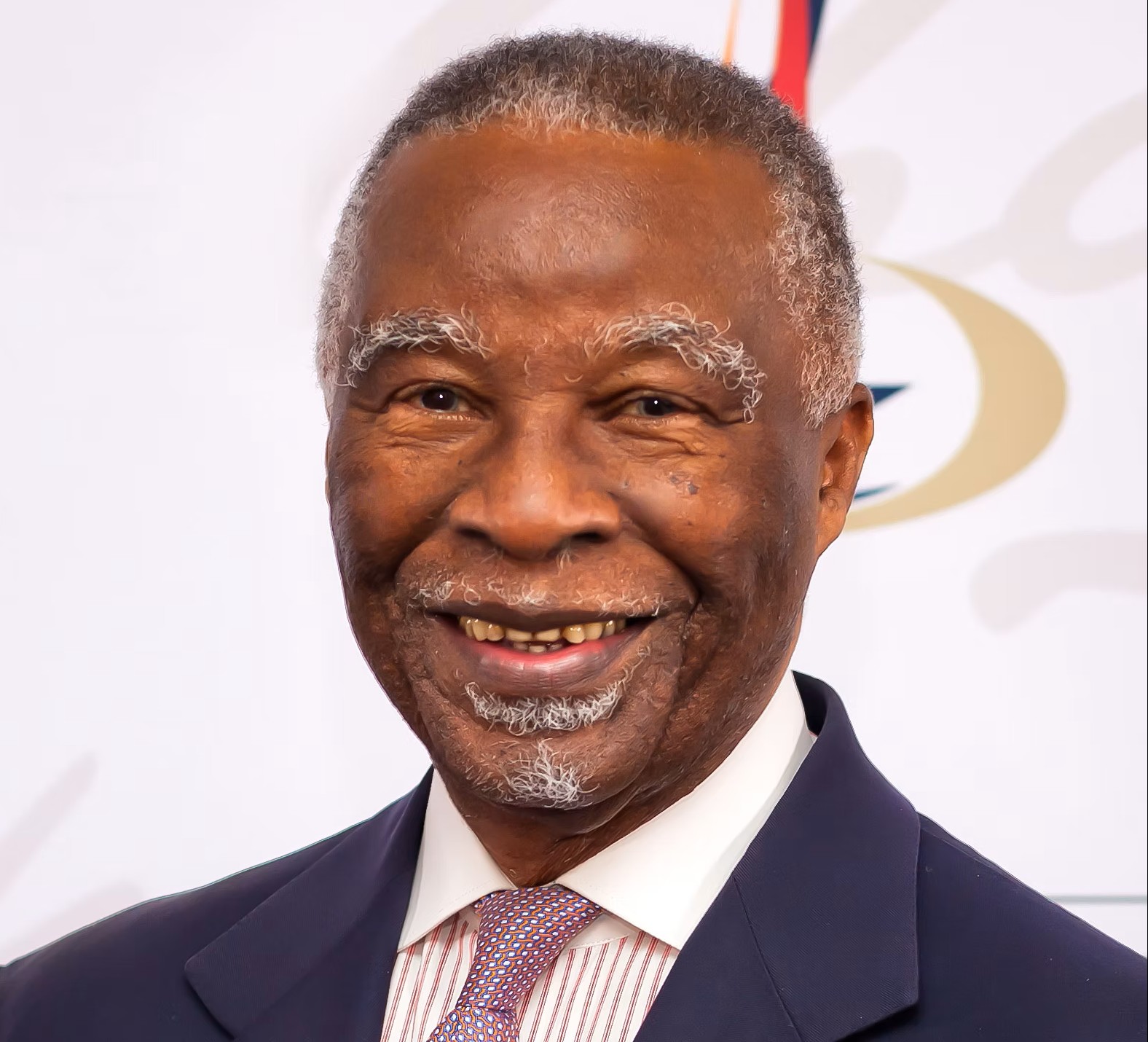
As long as these distressing stories keep coming out, so also the debate as to why and how the ANC appears not to be adding value to South Africa. Now, Thabo Mbeki, former South African president, has spoken in over a 2-hour long interview, alleging a counter-revolution, the details of which no higher hierarchy of credibility exists beyond him on their believability.
Apart from being a former president, he is, arguably, ANC’s most all-round trained cadre, making him a crown witness. There is yet no knowing how this interview has echoed across Africa but it won’t be surprising if things are no longer the same after Mbeki has opened up and put the matter firmly in the global public sphere. The end of the electoral adversity of the ANC would be a relief to many interests in and outside South Africa.
Intervention expresses gratitude to the reader who drew its attention to the video of the interview and the idea of its publication. The transcript is AI generated and many names and entities are incorrectly spelt. Some have been corrected within the limits of the editor’s knowledge. Others must still be lurking in the text. So, a caveat emptor. Ride on!
Nov 11, 2026 #SouthAfrica #ThaboMbeki #AfricanRenaissance
In this in-depth episode of the African Renaissance Podcast, former President Thabo Mbeki sits down with a panel of senior journalists, policy analysts, and scholars to unpack South Africa’s most pressing political and economic questions. Following the release of the foundation’s landmark monograph, President Mbeki discusses the complex dynamics of counter-revolution, state capacity, the Truth and Reconciliation Commission (TRC) prosecutions, and South Africa’s evolving relations with the United States. He also shares candid reflections on the decline of the African National Congress (ANC), the true meaning of renewal, the challenges of coalition politics, and the urgent need to reclaim Pan-African unity on the global stage.
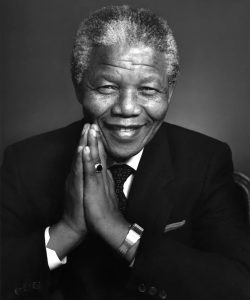
Symbolising independence in 1994
Moderator: Okay, welcome eh everybody to the African Renaissance podcast and thank you so much for creating a time. Today, we are having a much larger circle of people, journalists and scholars, policy makers. We’ll introduce them as we go.
Mbeki: Very intimidating. (laughter)
Well, first, let me let me welcome President.
Mbeki: Thanks.
Moderator: president is back to the African podcast. Thank you so much and welcome. Yes, these two young people (pointing at them) run the biggest show on South African Broadcasting Corporation (SABC). It’s called The Host, very, very big platform. They recently put me into trouble but that’s not the conversation today. (Introduces a few others including a deputy Vice-Chancellor at the University of Johannesburg (UJ) and about five others more).
The main target is to conclude the series which had begun I think in circulation for about two weeks ago following the monograph that the foundation released (a reference to an August 2026 monograph the Mbeki Foundation published under the title ‘The United States of America and the Future of the Afrikaners in South Africa’) to really frame the South Africa-US relations and the future of Afrikaners. Uh I’m requesting president that maybe we start there in this conversation. Uh and the opening question would be there’s been a lot of reaction to the first four episodes we’ve had. What is the strategic objective that the paper and the monograph was trying to achieve first and foremost? What is it that South Africans and maybe American citizens who are engaging with it and some of our people on the continent in the main have to take out of the monograph? Mbeki: (clears throat) In 2021, The Mbeki Foundation was approached by some Afrikaners who said to us that uh there was a serious problem among the Afrikaners which was a problem of alienation. That’s the word they used. Alienation. They feel very alienated. They recognize that they’ve got many capacities, many professions among themselves which could make important contributions in terms of solving the problems of the country but, because of this sense of alienation, they are standing back. So this is a problem. This is a challenge they put to the Foundation. What do we do about it? So, we talked about it and we were saying that, first of all, we don’t understand why but we can’t say you are not alienated because we think you are not alienated. If you say you are alienated, you must be. So, the result of that was that we had a two-day conference with the Afrikaner establishment in 2021 in Cape Town and all of them were there. All the Africana names you will see in the monograph were all there. (he names a few). All of them were there. So, for two days we were discussing this question of the alienation of the Afrikaner population as they put it and what we do about it. At the end of that discussion, we actually signed a joint declaration as to what is to be done.
Uhm, they are Africans like the rest of us and have a common responsibility like all of us to work together to solve the problems of the country. And we’re saying to them, the only way for them to overcome the sense of alienation is to do something positive to get the country out of it problems like poverty and all of that. And because of the contribution they would make, they would find that the population as a whole, black and white, gives them a standing ovation. So that sense of alienation will disappear because of their own involvement.
So I’m saying that we met for two days in Cape Town signed the declaration committing us to what is to be done. Uhm, so, for instance, as a consequence of that, one of the municipalities in the Free State managed to start working with the Foundation to sort out problems of that particular municipality, water, sewage and all of that. And the Foundation then drew in Afrikaners to say, in terms of the agreement we signed, one of the provisions is that we will work together to show that the municipal government works. So we’ll choose a number of municipalities and work together on those you bring whatever capacities you have and we’ll work together to make sure that give an example to the nation. Yes. So this was the first example and then, indeed, Foundation then asked them to come in to work with us and the mayor and the municipality and they did. They sent people to come and help us to deal with water problems, storage problems and all of that. So this is a background.
So, when a few days later, the same people pop up BUT they are no longer the Afrikaners with whom we signed this agreement to work together to solve the problems. They are a western community inside South Africa and they are linked up with the US because we’re mistreating them, genocide and all of that. It took the Foundation by surprise. This same, exactly the same people with whom we had had a meeting in Cape Town and whom I signed an agreement. So, that’s why the Foundation then said, look, it’s important for us to understand this phenomenon. It was also incidentally surprising, even from the point of view of the US because during President Trump’s first administration, the US ambassador that he sent to South Africa worked very closely with the Foundation very, very closely with the Foundation. But then pops up in 2025 this alliance between these Afrikaners and the Americans, both of whom had been with us on this side. So the Foundation this time decided, look, we need to understand this matter because clearly it’s got serious implications domestically, internationally.
So that’s the background to it. So we needed first of all to understand it in order to be able to say what is to be done to answer that question. That’s the background to the monograph. So, we thought that uh what, what, what it suggested was the need to look at the complexity of this issue from all points of view as I said in order to understand properly. How to get all of these things sorted out was a problem. It needed thorough understanding. Hence the monograph.
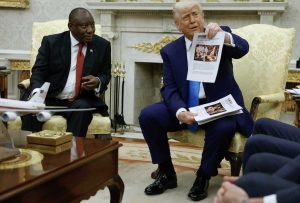
The initial Trump-Ramaphosa face-face on the Afrikaner issue in 2025
Question: President, maybe you would want to take us into this difficult aspect it seems for most people which got elevated above everything else above the fact that there was affirmative action, BBE (black empowerment), expropriation of land without compensation, in US policy thinking long before even the founding of apartheid. But the difficulty people seem to have is the aspect on the counter revolution. And maybe I will ask it because we have canvassed it so many times in here on the African Renaissance podcast. Uh, what is the connection being drawn between counterrevolution the story of which started with the two ages and this line we see and we are still in that starts after the change of leadership in Bulungula. How are we drawing the parallels in the paper (monograph) between these two phenomena, the US’s alliance with the Africana right-wing groups as well as the counter revolution and the fact that it took over and undermined the democratic gains for the last, it’s been 17 years now by my calculation. What is the parallel?
Mbeki: You’ve now asked too many questions at the same (laughter) time.
Um, with the issue of the counter revolution, here arises completely outside of this context of what we’re discussing. It arises in terms of our own thinking in the foundation with regard to the problems that South Africa is having. Eh, unemployment and in all of these things. What is also happening to the ANC, the rest of the liberation movement, the broad democratic movement. All sorts of negatives. In an attempt to understand all these, the question of where do these come from. That’s where this discussion about the country revolution comes from. It has got nothing to do with the with the Afrikaners in the first instance.
So, for instance, the question that that you are raising. You have all of these educated people like Professor Mulunga here who would say if you look at a certain period from 1994 up to around 2007/2008, what was happening to this country is very positive in all respects. If you look at the economy, the economy was growing like this. It reaches levels of 5% more or less annual rate of growth. Uh it’s very spectacular.
Even you get to a situation where, in the management of the public finances for the first time in South Africa’s history, you get budget surpluses. Things were happening positive. You get a new Constitution during the same period with all of the constitutional mechanisms put in place, Constitutional Court and this and that and the other. And even in terms of the impact on the lives of the people, when you look at 1994 formal employment, formal employment in the economy was something like 8 million. By the time you get to 2007 it’s, it’s 14 million. So we added 6 million new jobs during this period. So this story about jobless growth is false. There’s no such thing. All this positive, with poverty levels going down. And then 2008, 2009 the opposite happens with regard to the economy. It goes the opposite direction. Yes.
You end up in a situation where the economy is growing around 1%. On a sustained period up to today, this starts from around 2009 2010. So the question arises uh what, what changed? First of all, you have this period one like this and then period two, then the opposite direction. There must be a reason for it.
And really the only reason we can find is it is a political change, the political change in the ANC because you have, during this first period, the ANC is the governing party. Then during this other period when the economy goes in the opposite direction, the ANC is still the governing party. Why is this political leadership behaving in a strange way?
First period, everything is going up. Second period, everything is going down. There must be a reason for that. And it’s not economic because, again, the economist will say you had the global financial crisis. It originally starts as a financial crisis, becomes more general economic crisis from 2008, starting with US banks before impacting on the whole world including South Africa, a regression but South Africa peer countries recover by 2010 from that 2008 crisis financial crisis and are growing, growing again at 3%, 4%, % 5%. But South Africa doesn’t recover. It’s the only one that continues in this downward thing and remains where it is till today. So you can’t say it was the economic impact of the crisis of 2008 which resulted in this economic crisis here. So you could say that but then you’d have to ask a second question. So everybody was impacted negatively by that crisis but everybody else recovered. Why didn’t you recover?
So I’m saying as we looked at that question, that’s where this counter revolution issue comes up because we are ANC, I mean I’ve been in the for many years. So you know something about the organization, you can see when things are going wrong, that this is not quite not, not how normally how the ANC behaves. So, for instance, uh in the preparation for the 2007 national conference of the ANC, I could see that there were certain things that were happening around the ANC which were not normal.
So, one of the things I did was to ask one of the former chiefs of the Apartheid Intelligence Services and I said to him, you know uh, there are certain things that are happening around the ANC which are not quite ANC and it seems to me your people might be involved, meaning older apartheid Intelligence agencies.
So he said to me, “No president, you are wrong. My people are not involved in any such thing.” But when I said your people, he thought I meant the particular Intelligence organization of which he had been a member. But I was referring generally to the apartheid Intelligence Services. So he said, “I’ll tell you what’s been happening.” And then he told me. He said what is happening is that uh, people who were in the apartheid Defense Intelligence uh took a decision that they must eradicate your legacy.
 I’m quoting him, eradicate your legacy. And therefore that’s how they have intervened. The objective is to eradicate your legacy and therefore they are very interested in what happens at your conference in 2007. And he actually gave me the names. He says it’s general so and so and so and so and so and so. If you keep an eye on those generals, then you will know what is happening in the ANC. So, I said to him thanks. He says that’s where the problem is. Actually I can tell a longer story about that.
So, you could see what the ANC had been saying we had been saying. You look at the documents of the ANC but particularly the strategy and tactics documents of the ANC. For instance, we start with 1997. It raises this problem, the challenge of counter revolution. It says we must not lull ourselves into some wrong belief that the forces that we fought against would go to sleep because 1994 came. They haven’t gone to sleep. Don’t fool yourselves into believing that your opponents have now given up. So this thing was in our minds.
I will keep saying we made a strategic mistake about it. We understood the issue but we understood wrongly. Our assessment as to how that counter revolution would BE acted was wrong because the assessment was they are going to come at us by assassination of leaders, by bombing, a general physical destabilization of the country, and all of these people. That’s how we thought the counter revolution was going to attack us.
And so even Madiba paid particular attention to this issue because that was the expectation you know of the time, this is from 1994, the cabinet had three cabinet sub-committees: economic, social and the security one. Madiba always attended the security one because our understanding was yes, counter-revolution but the way it’s going to come at us is, for instance, this old order people to bomb people that matter.
We were wrong. Well, that happened for some time, that bombing and so on and the people got arrested, etc but in fact, the real offensive of the counter revolution was not from outside but essentially from within the ANC. We raised it in the context of this monograph about the US and the Afrikaners because you have essentially an Afrikaner section of our population who, for instance, as I was told, many of whom came from Defense Intelligence of the SADF. These are Afrikaners bent on a very destructive cause in order to defeat this ANC and eradicate its legacy. But parallel to that, you get another group of Afrikaners
who are creating capacity among Afrikaners to be able to replace the capacity that would have been lost for the state. So the state capacity is destroyed by Afrikaners. The other Afrikaners were developing alternative capacity. These are two related processes. That’s how in the in the monograph why we’re discussing this matter the relationship between these two tendencies in South Africa. A very destructive tendency. Destructive in all ways. Look at the collapse of the state corporations. That’s not a spontaneous thing. The story that is said about cadre deployment,
that it was deployment of cadres that destroyed these institutions is not true. It is part of a deliberate, systematic effort in order to defeat this legacy as I was told by this former chief of intelligence. Their target is to make sure that they destroy your legacy and that’s what happens. We can detail that as to what actually happened.
I’m saying at the same time as that is happening you are having this alternative capacity being developed among the Afrikaners who are going to say because the state has failed now, here is capacity to deal with our challenges. That’s the relationship in the monograph between the counter revolution and this other tendency which ends up working uh with the US. That’s that’s the relationship.
To be continued!