All hands, heads, eyes and ears are on deck because Nigeria is heading for a General Election early 2027. Rosa Luxemburg Foundation (RLF) is no less concerned and involved but in a particular way: the role of young people in promoting credible and democratic elections, being the segment of the population generally assessed to be the majority. As a process encompassing voter registration, political party primaries, political party activities, election day, vote collation, and the declaration of results rather than a one-day event, informed and critical conversation with students in particular is considered a requirement for their positive contributions.
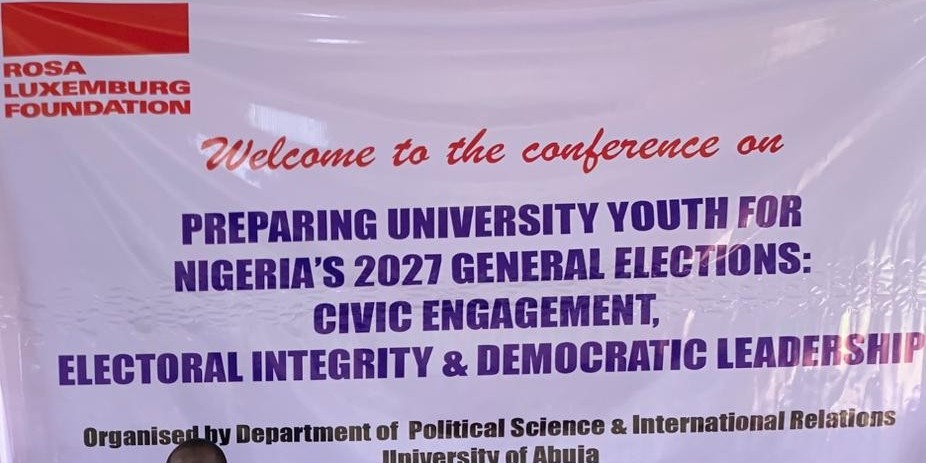
That was precisely what the German INGO sought in a Conference on ‘Preparing University Youth for Nigeria’s 2027 General Elections: Civic Engagement, Electoral Integrity and Democratic Leadership’ in Collaboration with the Department of Political Science and International Relations at the University of Abuja July 6th, 2026.
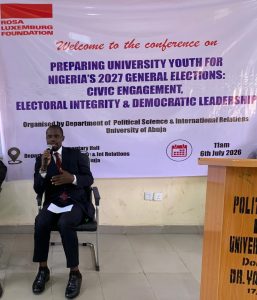 As is usual with such a conversation, there were the preliminaries. This began with what Professor Yusuf Zoaka, the Dean of the Faculty of Social Sciences, told the audience. It was his optimism that, as future leaders and change makers, the participating youths would gain valuable insights from the conference designed to deepen their understanding of democracy and elections in Nigeria, noting that one of the major challenges facing young people is their greater engagement with social media than with active participation in the political process. The Dean emphasized the need for youths to engage beyond social media and voting, calling on them to become more actively involved in democratic governance and nation building.
Cde Angela Odah, RLF’s representative in Nigeria, seconded that position, stressing the need for students in particular to engage actively in every stage of the electoral process towards it being more transparent, peaceful, inclusive, free from electoral violence, vote-buying, and other forms of manipulation that undermine democratic governance.
Comrade Odah thanked the Department of Political Science and International Relations and the University of Abuja for their sustained partnership with the Rosa Luxemburg Foundation, explaining that the Department and the university have been the Foundation’s first academic partner following the expansion of its activities in Nigeria in 2017. Although the Foundation had been supporting civil society organisations in Nigeria since 2010, she explained that the collaboration with the Department marked the beginning of a stronger and more enduring academic relationship, stretching far research initiatives, policy dialogues and round table discussions which have culminated in the conference. Odah singled out the Head of the Department of Political Science and International Relations, Professor Adeniyi Samson, and the Dean, Prof Yusuf Zoaka, Odah whose efforts initiated the partnership between the Rosa Luxemburg Foundation (RLF) and the Department in 2017.
Giving the lead paper for Panel 1 on ‘Youth Political Participation and Democratic Consolidation in Nigeria’, Prof Samson Adeyinka Adeniji argues the indispensability of young people to national development and democratic sustainability on the grounds of their numerical strength, energy, and capacity for innovation. Conceptualising the category along United Nations’ range of 15–24 years, the African Youth Charter of 15–35 years and Nigeria’s youth policy which broadly categorises youth as persons between the ages of 18 and 35, Professor Adeniji puts the youth as the single most significant proportion out of the estimated 230 million Nigerian population, making their participation an essential component of democratic consolidation.
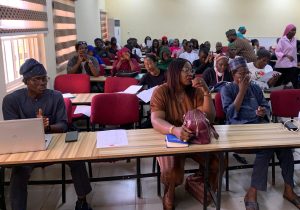
Faces at the conference
While conceding improvement in youth participation in recent years with particular reference to involvement in political campaigns, election observation, civic advocacy, digital activism and voter mobilisation due mainly to the enactment of the ‘Not Too Young To Run’ Act, he still identified constraints hindering fuller participation of youth in politics. Among factors he identified are high cost of politics, particularly exorbitant nomination fees for elective offices, pervasive influence of political godfatherism who determine a lot of the outcomes, electoral violence, poverty, unemployment, and weak internal party democracy. While young people are frequently mobilised to perpetrate electoral violence, they are equally among its greatest victims, he asserted, pointing out how poverty and unemployment make many young people vulnerable to vote-buying and political manipulation, while the dominance of political parties by powerful elites restricts opportunities for young members to emerge as candidates.
He has a two-pronged approach to enhancing the participation of young people politics. One, is for governments to promote greater youth inclusion in governance through appointments, advisory roles, and youth-friendly policies while also addressing unemployment, poverty, and electoral violence. Political parties should reduce nomination fees, strengthen internal democracy and create genuine opportunities for young people to emerge as leaders. Still within this tier, civil society organisations and educational institutions should intensify civic education and political awareness programmes to equip young people with the knowledge and skills required for meaningful democratic participation. His second tier is the challenge to young people to move beyond passive observation into active participants in governance by registering to vote, joining political parties, engaging constructively in civic processes.
Discussion and Question and Answer sessions a number of questions, comments and responses, two of which might suffice. One was the question of the extent of the impact of social media on youth political engagement and the challenges of misinformation. The second would be the question of how far reserved seats for youth in leadership would increase participation. A resource person, Dr Navuluz Sulyman, for instance, argues against reserved seats, preferring that young people build their capacity to engage actively in politics. Other equally agreeable ways out in the sessions include Legislative reforms to create deliberate space for youth participation rather than token representation; improving economic opportunities and addressing unemployment to reduce vulnerability to vote-buyers and, lastly, youth self-organisation and constructive engagement.
Panel 2 presentation shifted the issue-area to ‘Digital Politics, Electoral Integrity and Peace building in Contemporary Nigeria, with Prof Saleh Dauda as lead presenter while discussants were Prof Magdalene Igbolo, Dr Naomi Phinos and Dr Peter Upeli.
Examining the relationship between digital politics, electoral integrity and peace-building, Prof Dauda contended that while digital politics has the potential to enhance political participation and improve democratic engagement, its benefits are only realizable when supported by credible electoral institutions, responsible digital governance and sustained peace building initiatives. These, he noted, are essential for safeguarding electoral integrity and promoting peaceful democratic development.
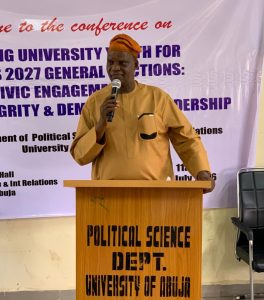
Prof Zoaka, Dean of Social Sciences
Defining digital politics as the intersection of technology and political engagement, Prof Dauda identified the three broad approaches he said scholarly perspectives on the concept generally fall into. First, is the participatory and mobilisation approach, which emphasises how digital platforms such as social media, blogs, online forums and search engines empower citizens to participate more actively in political processes. According to this perspective, digital spaces enable individuals to bypass traditional gatekeepers, enhance civic engagement, and democratise political participation. Second, is the strategic communication approach which focuses on how political parties, candidates, governments and other political institutions utilise digital platforms to communicate with citizens, conduct election campaigns, mobilise supporters, and shape public opinion. And the third is the critical and institutional approach which, he says, adopts a more sceptical perspective by highlighting the risks associated with digital politics. Professor Dauda explained that this approach draws attention to concerns such as government regulation of digital spaces, misinformation and disinformation, surveillance, algorithmic manipulation, and the influence of corporate interests on political communication and democratic processes.
Noting the close connection between the variables in the political landscape of developing societies, Prof Dauda maintained that increasing use of digital technologies has significantly transformed political engagement and electoral processes, creating both opportunities and challenges for democratic governance. Political developments in many developing countries are characterized by high levels of primordialism and identity politics, he told the audience, explaining that when electoral processes are not managed in a transparent, credible, and inclusive manner, they could trigger electoral violence and political instability.
Hence his caution on how digital platforms can facilitate the rapid dissemination of misinformation and fake news, which may reinforce identity politics, deepen social divisions, and undermine electoral integrity. He therefore emphasized the need for responsible use of digital technologies and effective measures to curb the spread of false information during electoral processes. Consequently, he stressed that sustained peace-building efforts are essential for sustained peace, promotion of reconciliation, and ensuring long-term democratic stability.
Discussant, Prof Magdalene Igbolo took Prof Dauda’s paper from the angle of the potential of digital politics to make the electoral process easier and more transparent but also to complicate elections by way of what she calls the possibility of rigging elections through digital means. She wonders how far strengthening legal and institutional frameworks to ensure electoral integrity could go.
Framing digital politics to mean both online political engagement by citizens especially the youth and digitalization of electoral management by the state (INEC), the prof questioned attempts at state control measures on Nigeria’s digital space, extending that to hacking and the lack of control over digital platforms. She did not forget to mention the gender dimensions of each of the plausible risks and exclusions in the use of digital technologies and platforms especially social media for political communication, mobilization, campaigning, opinion shaping and election related activities.
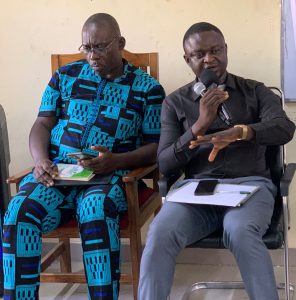
Two UNIABUJA academics, Dr. Uchenna Umeorekwu and Dr. Segun Maiye
Fellow discussant, Dr Peter Upeli, brought to the fore a gap in the youth-digital space relationship in particular. For him, social media mainly produces awareness rather than guarantee participation. As he puts it, having millions of followers online does not equal real electoral strength, a claim he gives an example of a Lagos candidate with many online followers but poor actual voters. Nevertheless, he acknowledges that the social media has expanded civic engagement, creating a digital public sphere where youth follow political actors, debate issues and mobilize around causes such as the EndSARS in which the youth shook the system.
The last discussant, Dr Naomi Phinos, followed that line of argument about digital politics enhancing civic awareness and communication among youth in particular, enabling more rapid mobilization and exposure of malpractices, thereby strengthening integrity through digital practices. But she argues that digital systems can still be undermined by vote buying, manipulation of results before/after upload and weak institutions and courts. For the way out, she privileges government provision of basic needs and education for citizens vis-à-vis electoral integrity in Nigeria, especially fair and transparent electoral process.
Interesting questions popped up at the point of discussion and comments. Again, two of them can be considered most interesting. One was the student who wondered if young people who speak up do not risk being picked up for doing so, especially if what they said did not appeal to the leaders. Then came the even more interesting one about the attainability of the expansion of the democratic space for women in the present and even in Heaven. The participant who asked the question had his basis: Jesus Christ did not have a female disciple. He was not sure too if Prophet Mohammed had women as disciples. If the two leading prophets of God didn’t privilege women, how would it happen otherwise. In other words, there was the serious as well as the entertaining dimensions of the conversation.
This was the point the Dean, Prof Yusuf Zoaka, brought the conversation to a close by adding his voice to the issue-area. Digital innovations should contribute to improving the electoral process and address insecurity, he argues, hinging his position on the potentials which inhere in digital technology. On the overarching theme of youth involvement in politics, the Dean goes for that, being why he insists on a more conducive environment for that to happen. He sees a big role for digital platforms in achieving this too. Prof Zoaka was all kudos to the resource persons for their interventions on enhancing the participation prospects of the youth participants at the conference.