By Prof Hassan A. Saliu
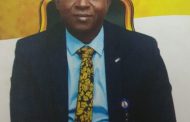
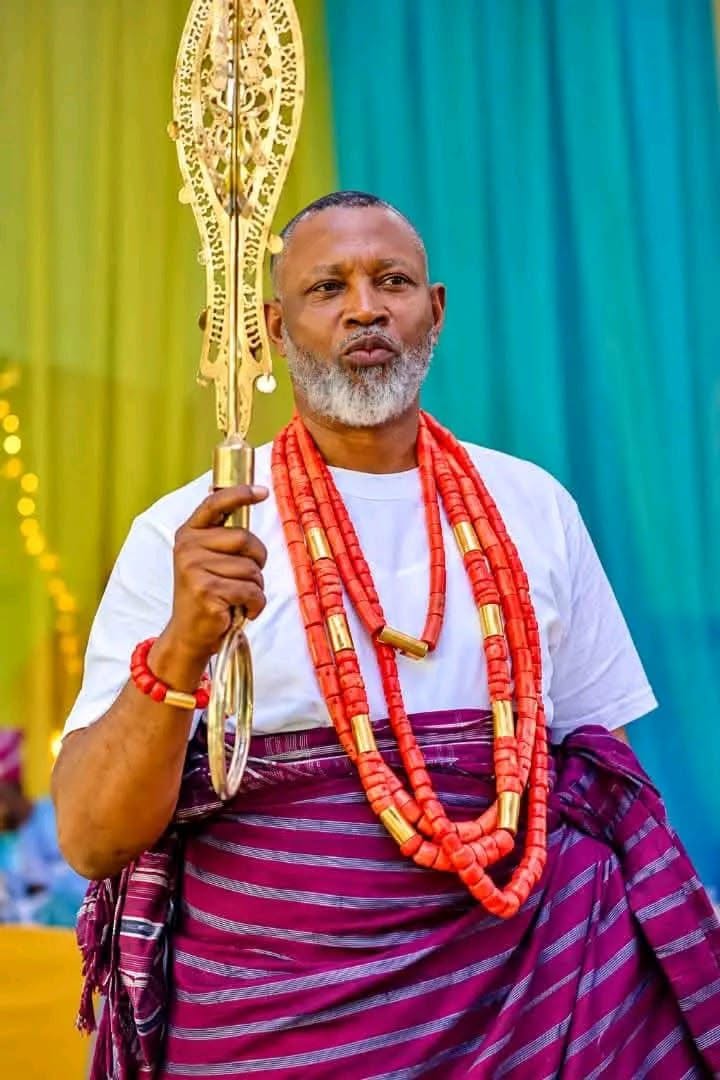
Professor Nahzeem Oluwafemi Mimiko, mni, presents a compelling case for the role of contingency, perseverance, and destiny in academic and public life. A review of his career trajectory reveals a pattern in which deferred ambition, institutional crisis, and eventual recognition converged to shape his professional ascent. Born into a notable family in Ondo town, he has consistently sought to define his career on merit, rather than on the privileges of birth.
 Mimiko began his academic career at the former Ondo State University, Ado-Ekiti, as a lecturer. Following the creation of Ekiti State by General Sani Abacha in 1996, he transferred to the new Ondo State University in Akungba. During his service there, he rose to the position of Deputy Vice-Chancellor and later Acting Vice-Chancellor, a position he held for some six months without incident. The university functioned effectively under his leadership, and there was a general expectation that he would be confirmed as substantive Vice-Chancellor. Although he applied and was rated the best candidate, he was bypassed on the ground that he lacked the requisite experience to head the same institution he had already effectively led for close to a year. The argument then was that the university needed an old hand, given the fragility of its structures as a fledgling university.
So many things happen in our system that one cannot understand. Eventually, the result of the selection exercise was upheld by the government of the day, which for sundry reasons was not particularly enthused by the Mimiko family name. This compelled Professor Mimiko’s return to his alma mater, Obafemi Awolowo University, Ile-Ife, as Professor and lecturer.
As fate would have it, the selection process that had excluded him to appoint one of the professors he beat in the first exercise, and the tenure erected on it, subsequently ran into crisis at its tail end. A new selection process was thus initiated, in which Professor Mimiko participated, came first again in the selection exercise and emerged as Vice-Chancellor. He served for five years (2010-2015) before proceeding to the National Institute for Policy and Strategic Studies (NIPSS), Kuru, for the Senior Executive Course, which he completed, earning the award of Member of the National Institute (mni).
Professor Mimiko’s tenure at Adekunle Ajasin University, Akungba-Akoko, was marked by remarkable achievements that cumulatively repositioned the institution as a foremost centre of learning in Nigeria. The record of his stewardship was such that many Professors aspired to succeed him. Until his recent appointment, he was associated with Obafemi Awolowo University, Ile-Ife, and the Nigerian Army Resource Centre, Abuja, where he served as Director of Research.
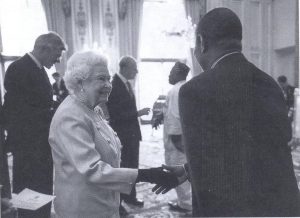
Backing the camera seems to be Prof Mimiko in a handshake with the late Queen Elizabeth 11
Intellectually, Mimiko is distinguished by his commitment to the Marxian perspective and, more specifically, to the political economy approach. He represents a distinctive mode of its deployment: he seldom relies on its jargon, yet his analyses, which I have generally found to be thorough, testify to the depth of his conviction. He is attentive in discourse, although he can be firm in defending his viewpoints, albeit in a diplomatic fashion. He has published extensively in his chosen field. As an alumnus of the Great Ife, he carries forward the Ife scholarly tradition, though with an uncommon inflexion. Based on his varied contributions and extensive academic engagements, both at home and abroad, he may justly be described as a proud product of Ife.
Due to his academic prowess on display, Professor Mimiko has travelled widely and won many honours and recognitions, including serving as SSRC-MacArthur Foundation Visiting Scholar at the Watson Institute, Brown University, Providence, RI; as Senior Fulbright Scholar at the United States Military Academy, West Point, NY; and as Korean Foundation Visiting Fellow at the Academy of Korean Studies, Seoul, South Korea. Nationally, he was a member of the National Constitutional Conference held under the President Goodluck Jonathan government.
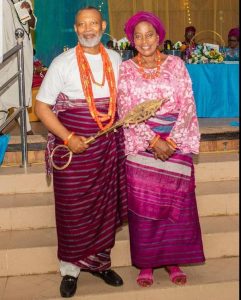
His career, however, has not been confined to scholarship alone. He has remained closely connected to his roots. Before his ascension to his new position, he held two traditional titles in Ondo Kingdom. These were “Gbobaniyi” and “Jomuulala” of Ondo Kingdom. His new appointment constitutes a promotion, placing him as second-in-command to His Imperial Majesty, the Osemawe of Ondo. The history of the exalted office which he now occupies goes back to 1510 the date from which the history of the Ondo monarchy has been recorded and archived. I strongly believe that destiny has a hand in his new attainment, as far as I can tell from my base.
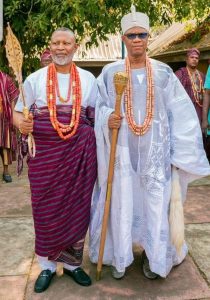
Prof Mimiko with Oba Adesimbo Victor Kiladejo, the Osemawe of Ondo Kingdom
This development raises an important scholarly question: how will he reconcile his radical political economy orientation with his involvement in the cultural traditions of his people? There is a strong possibility that his entrenched radical posture will yield to the imperatives of tradition. It also raises a practical question for his associates: how will his friends greet him, by standing up or by “dobale” prostration?
At a personal level, I have interacted closely with Professor Mimiko. He has been my confidant, both as President of the Nigerian Political Science Association (NPSA) and now as interim President of the Nigerian Society of International Affairs (NSIA). He is a good listener and very considerate in our conversations. He treasures friendship and goes out of his way to maintain it. My first doctoral student, Professor Aladegbola, was employed at Akungba-Akoko during his tenure as Vice-Chancellor. Upon seeing my name on his project, his mind was made up to employ him, which he eventually did. On at least three or four occasions, he featured in the NPSA online programmes, either as sole presenter or co-presenter, and performed each time excellently. It is on record that his paper on Nigeria-South Africa relations was used to revive the NPSA Monograph in 2022. Currently, he chairs one of the Study Groups of the NSIA. I am in the process of finding a replacement for him, given his traditional appointment. He is an honoured member of the NPSA.
On behalf of the NSIA, I extend our members’ felicitations to the new High Chief Lisa of Ondo Kingdom, Professor Nahzeem Oluwafemi Mimiko, mni.
Oye Amari,
Allah ja samani Lisa.
Eze, iga adi ndu luo mgbe ebighiebi.
The author is the Interim President of the Nigerian Society for International Affairs (NSIA)