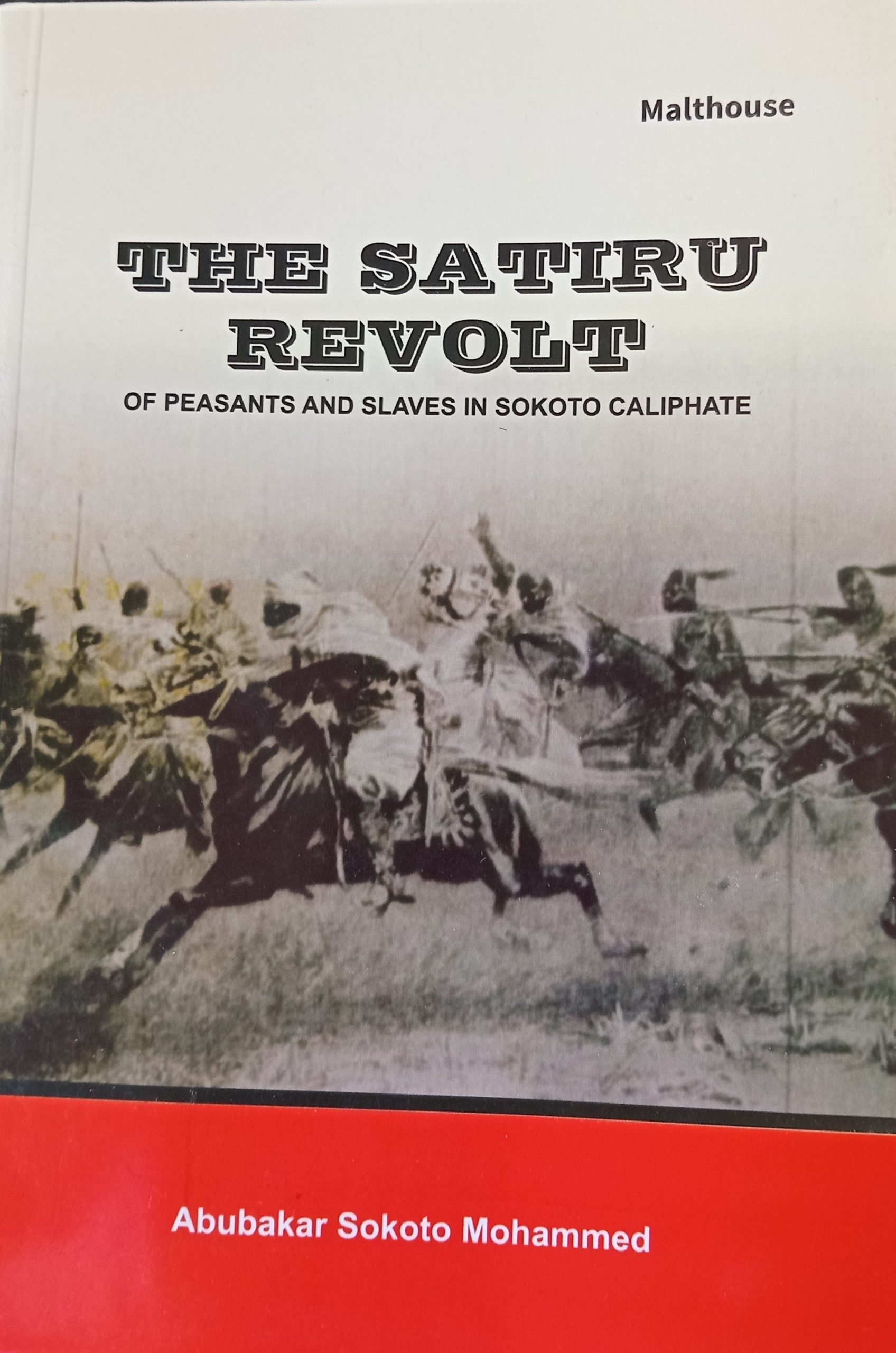
Although a return to the barricades looks farfetched, a powerful sense of the radical project in Nigeria as an unfinished mission struck activists and mourners of Cde Abubakar Sokoto Mohammed in Abuja Wednesday, April 29th, 2026. It was at the symposium and book presentation honouring the late Abubakar Sokoto who died December 11th, 2025.
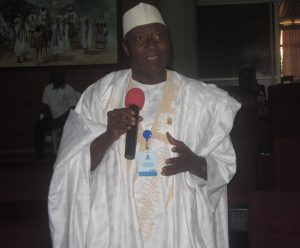
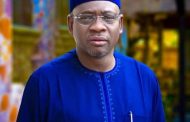
The late Dr Mohammed
Speaker after speaker at the event made both direct and indirect references to what was called the struggle in those days, with particular reference to Cde Abubakar Sokoto’s pivotal role in the process, as an Ahmadu Bello University, Zaria trained Sociologist and later academic before his migration to the National Institute for Policy and Strategic Studies (NIPSS) in Jos where he served in every department except finance.
The symposium was a paradoxical gathering all the way down. It was a relatively small (or compact) but sober audience; complex (in professional, regional, gender and even class diversity) but nearly homogeneous in the sense that more than 75 % of the people in the hall were involved in the struggle to remake Nigeria into the signifier for the black world up to a few decades back. The last paradox is Cde Abubakar Sokoto Mohammed (hereafter simply called AS) asserting the struggle more in death than when alive as it was at the memorialisation that the attendees realised the gap between what they understood themselves to have been doing in that struggle and what they were understood to have been doing in the larger society.
In other words, there is a paradox in how, in most cases, comrades were perceived as trouble makers or people who didn’t like to make money but happier with being rebellious when, in fact, these were dedicated activists making sacrifices for an alternative Nigeria. It was only in the last decade of military rule that Nigerians began to appreciate the NLC, NANS, CLO and so on as SAP started scattering livelihood through retrenchment, non-payment of salaries and mounting unemployment. But, by then and since then, the system has not been able to systematise anything again.
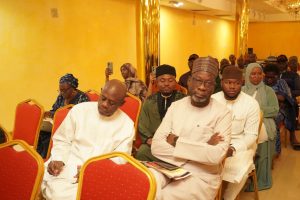
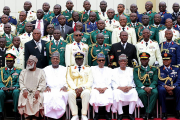
In black cap atop green dress behind the front row is one of AS Mohammed’s sons who just completed his NYSC.
Education, health, public transport and other social services have collapsed. The few industries have collapsed and millions of graduates are roaming the streets which have, in any case, been taken over by terrorists, bandits, kidnappers and sundry threat bearers, forcing both the masses and the power elite to realise that the comrades were the ones actually holding the country together through their capacity for articulating popular democratic aspirations and agenda setting praxis.
In a sense, the people may not be blamed. The comrades have not written the history of what they were doing as to have availed its audience the details of what they were doing, what they achieved, what they didn’t achieve, why and the course-correction options. This is the big sense in which AS can be said to still be at work even in death because it was at the memorialisation of his death these came most frontally to the fore.
The problem today wasn’t with hopelessly poor internet connection but Intervention‘s lateness to the event, arriving when the President of the Alumni of the National Institute for Policy and Strategic Studies (NIPSS) as well as Prof Jibrin Ibrahim had already spoken. But scholar-diplomat, Prof Tijani Bande, was still on, declaring wars on many fronts and sending the audience into hilarity. He said one of AS’s special attributes was speaking clearly which is not what Sociologists, according to him, are known for. No Sociologists in the room took up the challenge. Prof Bande recalled AS trying to teach Prof Olu Obafemi etiquette, another big name in their circle as students but that AS failed. He added yet another serious joke: when AS retired from NIPSS and went to teach at Usmanu Dan Fodio University, Sokoto, he was kept in the Department of Sociology even though he was a Political Scientist in mind. But Prof Bande was not all hilarity. He made the weighty pronouncement that, no matter what politicians may think or say, scholarship is fundamental. Scholars are central to society and “our job is not a marginal one”. AS, he added, lived the life of a scholar.
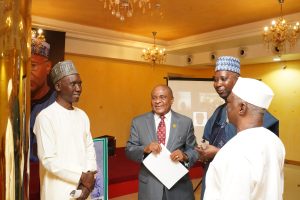
Faces at the memorial, among them Amb Emeka Obi Okafor mni, Prof Musa Umar, Prof Tijani Bande and another backing the camera
Prof Musa Umar, NIPSS incumbent Director of Studies, told the story of how AS got into trouble at some point at NIPSS on a point of principle. NIPSS stopped his salary for six months. It got to a point solidarisers planned a protest but told AS not to be involved. Yet, his name was on top of the list of the ‘trouble makers’ compiled by the authority. Suspicion can lead to any conclusion because suspicion converts every evidence into a supporting data.
Interestingly, AS served in every other departments in NIPSS, from editor of Publications to Directing Staff and so on until he himself became a NIPSS laureate, all tributes to his integrity. The bond between him and people like Prof Musa predated NIPSS. “He was our patron at YUSSAN (Youth Solidarity on South Africa in Nigeria) – one of the many platforms in which anti-Apartheid activism was raging in Nigeria in the 1980s.
Cde Ayuba Waba, former president of the NLC recalled AS’s great welcome into NIPSS for him once John Odah, a former General Secretary of the NLC, linked the two. The subsequent bond between him and AS thereafter explains him involving AS and also the late Festus Iyayi in the educational programme of his union thereafter, an initiative with immense beneficial outcome in trade union consciousness of members of his union.
Dr Junaid Maina who was then called to read Dr. AS’s biography revealed AS’s having his primary education in a Catholic owed school in Sokoto, an exposure to diversity that showed throughout his life, especially marriage to an Igbo lady and what Dr Julie Sanda later added when she spoke as a one-time colleague of AS: he never carried his identity on his shoulders. In the secondary school, AS made an incredible self-identification move by adjusting his name from Garba Mamman to Abubakar Sokoto Mohammed. Intervention learnt that while Abubakar is an alternative to Garba and Mohammed is an alternative to Mamman, the addition of Sokoto in the middle is a bit puzzling as it is not the common practice for people from that part of Nigeria.
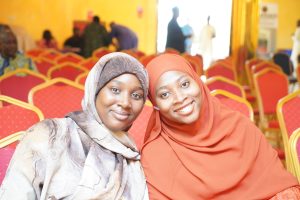
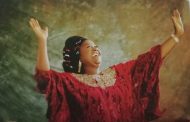
Gender and generational faces of the event, the lady in red being one of Abubakar Sokoto’s daughters, currently an undergraduate!
It was all part of an independent mindedness of the son of a Second World War veteran who went on to read Sociology at ABU, Zaria, became absorbed in the Marxist ferment of the era and membership of the fronts pushing for the expansive sense of justice, gender equity and democracy such as the radical campus front – Movement for Progressive Nigeria (MPN); Women in Nigeria (WIN), Nigeria-ANC Friendship Association; the Socialist Congress of Nigeria (SCON) and so on. It was as a graduate student in Zaria that he wrote a thesis on the Satiru revolt in the old Sokoto Caliphate. Of course, he was a Fulbright scholar which took him to the United States. The father of six children in all died at 75 in December 2025.
Prof Benedicta Daudu used her time on the podium to reinforce the point about the centrality of scholarship, this time as a form of immortality, connecting that to AS from the point of someone whose scholarship touched everyone. But Prof Benedicta does not want honouring AS to stop there but for everyone to be challenged in the direction of AS’s endeavours.
Dr. Yahaya Abdullahi, a one-time ASUU Chairperson of the ABU, Zaria branch recalled AS as a childhood friend and their convergence at ABU, Zaria. For him, there can be no better evidence of AS’s super human dedication than the testimony from people in NIPSS that AS worked in every other department of the institute except finance.
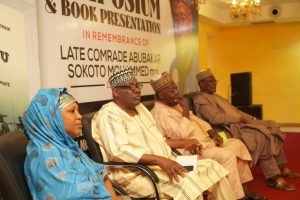
Panelists all: Prof Ahmad, Mahmud Jega, Prof Ibrahim and Dr (Senator) Yahya Abdullahi who chaired
Prof Aliya Ahmad of the Usmanu Dan Fodio University, Sokoto (UDUS) continued the story of AS as the only female member of the symposium panel which had taken over at this point under the Chairperson of Dr (Senator) Yahaya Abdullahi. She told the story of AS’s numerous pressure from behind, pushing her to exceed routine limits, culminating in more publications than she would have. She grew up to know the late AS as more or less a father because he and her father had been together.
On the same panel was Mahmud Jega, (not to be confused with Attahiru Jega who is the elder brother). Jega who is today more known as a journalist started as a revolutionary academic at Usmanu Dan Fodio University, Sokoto (UDUS). It is not clear whether it is from UDUS or from the family or from radicalism that he acquired the skill of delivering powerful ideological messages via humour. Anyway, Mallam Mahmud Jega regaled the audience with how AS as a practitioner of the front strategy in radical democratic politics got him immersed in that, involving numerous meetings he attended from Zaria to Bauchi to Ibadan, Benin, Lagos. Above all, it was from AS and only last year or so he got to know about the Satiru revolt when he ‘made the mistake’ of consulting the late AS for a brief background. It turned out to be a ‘mistake’ because, instead of a few paragraphs enough for a journalist’s column, he got a deluge from AS. The Satiru revolt is a story that the traditional institution has suppressed even though it is, according to Jega, the revolt that almost reversed British rule (and Caliphal authority) in Nigeria but for its vicious crushing.
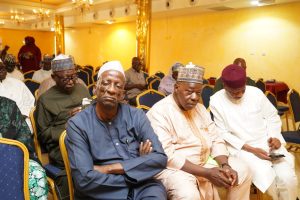
Faces of mostly ex-Zaria academics at the event
Jega connects AS to the era in Nigeria when there were what he calls dedicated comrades and socialists playing patriotic and progressive politics all over the country, one of whom Chimere Ikoku, who had been a lecturer at UDUS but took over leadership of one of socialist oriented platforms from Samuel G. Ikoku, his elder brother.
Prof Jibrin Ibrahim had no disagreement with framing AS as a very gentle, networking minded activist. But he went into the wider ABU, Zaria dynamics involving the two dominant ideological factions within the Left. There were those who saw the PRP in the Second Republic as the place for radicals to pitch tent and there those who congregated into the Zaria Group who criticised the PRP ‘enterism’ as it were and called them petit-bourgeois reformers. In the end, neither bourgeois radicalism nor the protagonists of the Nigerian Revolution won. The 1983 coup scattered both. While PRP leaders were all hauled into detention by the Buhari regime after the December 1983 coup, the Babangida administration, through SAP-induced exchange rate regime as well as repressive means, depleted the rank of the Zaria Group, especially the expatriate component. Jibo puts the tragedy in the untold story of the struggle and therefore the unposed question of which of the radical movements has been more useful to Nigeria, which he says is a very important part of AS’s history. “He did a lot in his life time and didn’t do any of that for recognition”, Jibo said.
Dr. Julie Sanda, the last member of the panel to speak did so online. She brought the female membership of the panel to two, contrary to the wrong information in the earlier version of this story that Prof Aliya Ahmad was the only female speaker on the symposium panel. In Dr. Julie’s case, relationship with AS began much earlier than NIPSS. It started at the now defunct Faculty of Arts and Social Sciences (FASS), ABU, Zaria where they were both students. It assumed NIPSS character only when the two found themselves there again before it moved to the United States, specifically Washington DC where they were both Fulbright scholars. Dr. Julie went first as a junior scholar at the George Washington University (GWU) while AS went a few months later as a senior scholar at the Catholic University of America. It was thus an authoritative insight when Julie said AS was not just a smiling man of integrity but also above wearing his ethnic, religious and class identity on his shoulders. The two were in Women in Nigeria (WIN) together where, according to Julie, AS brought along his progressive and equalitarian lens on women emancipation
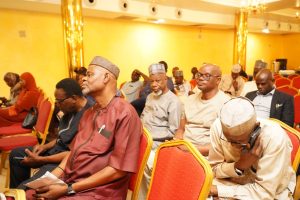
Pastoral faces at the event
Dr. Julie Sanda’s contribution brought the Symposium Panel session to a close. Question and Answer time made it possible for the audience to take up issues raised or scorched by the panelists. Prof Adele Junaid took up one through “a footnote”. Prof Junaid notices a tendency to overlook the concept of contradiction in radical social analysis and politics. And he sees the contradiction in pervasive presence of particularistic identity everywhere. Yet, there seems to be a license to the politicians to make everyone to embrace identity framing of the crisis. What is important for him is confronting the national bourgeoise instead of allowing becoming more and more insular through ‘divide and rule’ engineered and articulated by colonialism but now perfected by politicians who have no better stories to sell to the people. But it is failure to reckon with contradiction that accounts for radicals allowing politicians to turn the national question into the ethnic question, his words. And this trend has reached so deep that when the late Gaddafi was trying to revive Pan-Africanism and anti – imperialism, he was labelled as promoting Arab imperialism. His message is the case for reversing the trend, a move to which he links some recent programmes and events by which to bring back that agenda, particularly the Pan-African dimension.
Dr. Otive Igbuzor concurred with Prof Junaid. AS, said he, was a one-time Secretary – General of the SCON, the highest position available there and his name therefore invokes a significance. Yet, today, there is no document framing the crisis, a sharp contrast with the past. Dr. Otive argues the importance of documenting the dynamics. “40 years after SAP in Nigeria, what did Idika Kalu, Chu Okongwu, Olu Falae said would happen and what actually happened” is a question that only documentation can sort out, said the Socialist turned pastor.
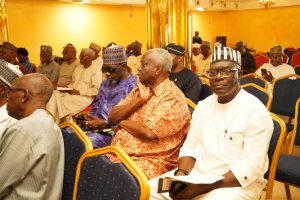
Ptofessorial faces at the event
University of Jos political economist, Prof Pam Dung Sha, started by paying tribute to the lecturer who taught him Walter Rodney as a Political Science undergraduate – Norman Perchonock and who was in the audience. Prof Pam recalled his interaction with AS in Jos where they both lived, especially exchanging visit during religious festivals. In any case, he succeeded AS as president of the Fulbright scholars in Nigeria. For him, AS was the archetype organic scholar and, therefore, “tells the story of what we should be doing”, said Prof Pam. By that, the professor meant that AS was not just in the classroom but entangled in the struggles of the peasants, working class and the political. In an indirect way, Prof Pam connected with Prof Junaid by posing the question of what banner an ageing generation of activists might be handing over to the successor generation. For answer and in a recognition rare in radical politics, Prof Pam argues for all the groups and tendencies coming together to look at the question of what the bourgeoisie is doing with identity politics. “We need to talk to ourselves”, he said.
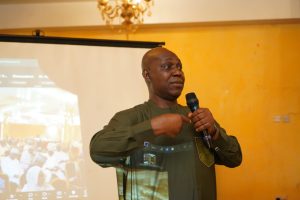
Cde John Odah rounding off events
The rising discomfort of the radical community with the overwhelming of politics in contemporary Nigeria by ethnic and religious frame games came to its fullness in the review The Satiru Revolt of Peasants and Slaves in Sokoto Caliphate. It was handled by Mohammed Kuna, formerly a Professor of Sociology at UDUS. The highlight of the review is his stress on AS’s transcendence of the interpretation of the revolt in ethnic, religious and racial categories. Instead of that, AS brought a materialist perspective to understand the leadership, structure, the tactical preparations and execution of the revolt by peasants and slaves against Caliphal authority and incipient British colonial authority. He referred to the 134 page book published in 2025 as one of the smallest but most original, powerful and simplified account of that moment, the difference between it and previous works being in it as a materialist rejection of reducing the revolt to ethnic, religious and racial interpretation of the revolt and its annihilation in 1806 which was the last days of aristocratic power/early days of colonial rule. It is thus a continuation of AS’s struggle against oppression and his vision of an alternative society, said Prof Kuna. He calls Chapter Two the crux of the book, quoting at some point what Lord Lugard said about the revolt and how necessary an overwhelming crushing of it was necessary so as to send signal to other peasant formations across the then emerging Nigeria that might have been contemplating such resistance. In that book is thus the earliest indicator of Fanon’s powerful prediction that the day after independence, the national bourgeoisie will cheat the people by collaborating with the colonialists.
It had been a great day in reflexivity for every attendee!