A Segun Osoba/Bala Usman moment is, indeed, unfolding in Nigeria. It flows from their authorship of the text which has survived as epitaph to the monument called Left struggle for democracy in Nigeria, especially as lasted from the mid-1970s to the mid-1990s. In the context of the text in question, Osoba implies Bala Usman and vice-versa.
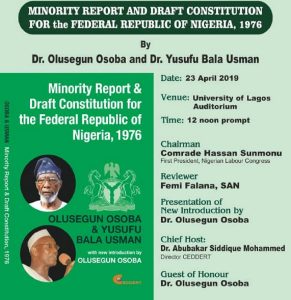
Through this document, Osoba and Usman, consciously or otherwise, taught the Nigerian Left the discursive strategy of change!
The text in question is the Minority Report the duo produced as members of the Constitution Drafting Committee in 1976, capturing a socialist slant on how Nigeria may work. The establishment did not accept the report but the establishment as then understood its ideological import and made an ‘enlightened self-interest’ concession. The concession is what has remained Chapter Two of successive versions of the Nigerian Constitution ever since the late 1970s.
It is very interesting that the Left is conscious of the significance of the Osoba/Usman moment and could be said to be on top of it within the framework of a recent memorial turn in radical democratic politics in Nigeria. There has, indeed, been such a turn in terms of instrumentalising memorialisation, contrary to scant value for memory, emotion and affect as opposed to classes, class struggle, the state or the economy and similar structuralist variables in much of Left politics. In other words, death has finally and formally advanced Prof Segun Osoba into a discursive formation.
But, as far as Intervention can see, the Osoba/Usman moment extends farther into the Nigerian society, especially the power elite. Aside from the technocrats such as Chief Rotimi Williams who presided over the CDC and obviously exercised informed right wing technocratic discretion, there was another theatre where no rating of the pair of Osoba and Usman was a misplaced rating.
In 1982, then Kano State governor, Muhammadu Abubakar Rimi, for instance, said at a seminar that “We of the radical PRP in both the PPP and the PPA felt that to turn Nigeria into a socialist state required mainly the installation of a revolutionary administration at the centre. The existing Nigerian constitution (1979) need not be unduly altered to attain the goals of socialism through a constitutional process. This is because Chapter II of the Constitution on ‘Fundamental Objectives and Directive Principles of State Policy’ has adequately provided a framework for a socialist government in Nigeria if and when a radical party controls the centre”.
It wasn’t Rimi alone as Professor Jerry Gana, another star actor in the ‘progressives camp’ at the time declared his stance against what he called ‘a bloody revolution’ at the same Conference at the Africa House at Government House, Kano, calling instead for “the force of popular will or the overwhelming immense majority”, all of that based on Chapter 11 of the Constitution. Gana’s own problem was what he called ‘the critical question’: whether capitalist democracy would respect its own legal order in case of an electoral triumph for socialism. In other words, if the progressives in Nigeria were to win a decisive victory at the polls against the reactionary forces, would such forces not revert to illegal and unconstitutional means to defend their interest?”
The above is the sense in which he can be credited with anticipating or predicting June 12. (These quotations can be found on pages five and 30 respectively of Towards a Progressive Nigeria edited by Askikpo Essen-Ibok who was one of the faces of Rimi’s experiment in diversity management in the Second Republic).
Interestingly, Jerry Gana was among those who, as a member of Babangida’s Politburo, recommended socialist ideology for Nigeria. That is part of history’s non-linear script but the overarching point is that informed segment of the power elite came to grips with the many sided imports of Chapter Two and the two statements above reflect that. After all, the People’s Redemption Party (PRP) in which Rimi, for example, was a force is where Prof Eskor Toyo, the late leading Left intellectual, believes every Leftist should have been.
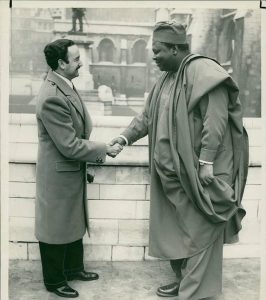
This is a Facebook stuff in which the towering other there is Chief Rotimi Williams, the enlightened face of the Nigerian establishment who chaired the CDC in 197/76
As it played out, the PRP wasn’t where all the Leftists converged. Perhaps, without that, a golden opportunity slipped the Left. A jovial but apt capture of the paradox of the tendential bickering around the PRP at the recent Abubakar Sokoto Mohammed’s memorial in Abuja is how neither the PRP elements nor the puritans in the Zaria Group as it were made progress at the collective level.
So, why didn’t Nigeria buy into the Rimi formulation on Chapter Two, for example? That is, the Rimi formulation that Chapter II of the Constitution on ‘Fundamental Objectives and Directive Principles of State Policy’ has adequately provided a framework for a socialist government in Nigeria’. This has to be an important question because, although Rimi and Jerry Gana conditioned this on their alliance winning power at the centre, a powerful equivalential formation had also began to emerge from the late 1970s independent of the realm people like Rimi and Gana and their fellow travellers in the PPA were thinking about. Why didn’t this coalition make its move to achieve the same thing by drawing on its strength to make demands and insist on them? Wasn’t this what it did in the case of SAP subsequently?
First of all, it is part of the mystique (and paradox) of radical politics in Nigeria that it operationalises certain unique features far, far ahead of its counterparts elsewhere even as such farsightedness rarely translate into the cataclysmic moment. That is probably something to explore at some other times. In other words, it was still five full years before the publication of Hegemony And Socialist Strategy, for example, when the coalition bonding students, professional associations (academics, doctors, lawyers and so on), labour, gender platforms, technocrats and even politicians emerged in Nigeria. While it is true that anti-colonial resistance operationalised a coalitional approach, there had been nothing like what the brains behind the emergence of the National Association of Nigerian Students (NANS), for example, were doing in ideological, strategic and organisational thinking and NANS was just one out of several other fronts. There was the national labour centre with a thoroughly patriotic grounding.
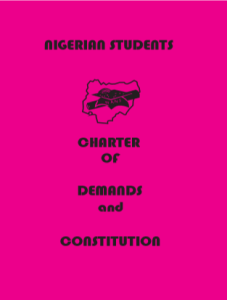
This coalition meant two defining moves in radical politics. One, it meant the emergence of a composite constellation of interests and forces which had concluded that it had a radical and antagonistic Other to fight for Nigeria to make it. The NANS Charter of Demands would be a credible evidence for this claim, unsophisticated as it is. Second and even more important, the Left in Nigeria had come to terms too early with the postfoundational moment. By the postfoundational moment is meant the notion that the world has no ultimate grounding. Yes, God created the world but God immediately entrusted or transferred to human beings the authority to dominate the world. Neither nature, law, Reason, the state nor any other transcendental signified can account for how the world works. They cannot, not when we all know how Hobbes performed the state into being, for an example. It was a theoretical or articulatory performance. The inference from this is the notion that the world works through unending unmaking and remaking of the social in a cycle of play of equivalence and difference.
There lies the potentially transformative significance of the equivalential coalition that had emerged in Nigeria in the early 1980s, signifying polarisation of the political space between the friend/enemy binary played up in Carl Schmidt’s theory of the political. Notwithstanding his Nazi traces, Schmidt is, unlike Heidegger, not ridiculed or pushed away. Instead, his text is a canonical referent in the literature on the political. Perhaps, this is because of his fascinating formulation of it, the very idea that, like good versus evil in the moral order; beautiful versus ugly in the aesthetic order; profitable versus unprofitable in the economic order, so also is friend/enemy defining of the political order. Schmidt’s interpreters, however, insist that Schmidt’s understanding of the concept of the enemy is strictly ontological: what is existentially different, alien, the stranger or the radical Other, not personal. The totality is a sense of the political (the friend/enemy dynamics) as the ontological condition of possibility for the social, that without which nothing can happen as there is nothing which can take away this antagonism.
This is the context which makes the question significant. But there would hardly be one answer to that question. One line of reasoning would, however, surely be that the option wasn’t taken (and the coalition didn’t stop SAP even when the option was taken) because the Left wasn’t operationalising a strategy of attaining socialism by aligning elements towards a test of strength with reference to making the Minority Report the founding document of the Nigerian State. It didn’t see socialism coming through that pathway although it would still have been socialism as Rimi and Gana envisaged because all key elements such as citizenship, the Nigerian nation, the Nigerian State, its structures and processes, the economy and so on would have, by now, assumed the character of the document and people would have even forgotten how such a structural arrangement emerged at all. In other words, it didn’t subscribe to achieving socialism through ‘domination by consent’. As such, the Left didn’t leverage on its advantage and near monopoly of discursive articulation to assert itself in insisting on making Chapter Two of the Constitution justiciable.
 It was probably too early for the coalition, dominated by activists steeped in classical Marxist orientation looking forward to the possibility of seizing the state as the foundation for a new beginning. Locked into that Jacobinist paradigm, it couldn’t stretch its farsightedness to certain features already building up against that strategy. One of such features was the condition the Frankfurt Scholars were revolting against. Prof David Held offers a profile I always find most fitting: They were faced with an orthodoxy in Marxism (established by the Third International in particular) that reduced the Marxian project to an ideology that could legitimate Stalinism, a science that could steer an all-powerful state, and a body of ideas that ran directly contrary to the revolutionary, emancipatory and fundamentally democratic dimension of Marx’s programme. At a theoretical level the reduction of Marxism to dialectical materialism trivialized the significance of human agency, and, at a political level, justified the exclusion of the active participation of the mass of people in decisions that affect their lives”. This is a 1981 critique.
Other features were also emerging which were also probably too early to have been that clear. The Sino-Soviet split; the Thatcherite success in discursive constitution of the social in the image of neoliberalism (especially as documented by Stuart Hall) and the China turn to neoliberalism (though ‘with Chinese characteristics’) would be three of such developments in terms of how the grounds were shifting in favour of the discursive rather than materialist character of change. The foregoing draws on the retrospective. The real question thrown up by the Osoba/Bala Usman moment today is what the Left makes of the moment, with particular reference to the politics of the political.
Can it do it now? That depends on whether everything that have happened since when the Left disappeared in 1994 has taught the lesson that Jacobinism is not, in any ways, more profitable pathway to change as much as articulatory practice? Articulation in this sense is the political process of meaning production and thus the production of the social order through the power relations every meaning comes with. If the world is on a postfoundational march, why should it be difficult to come to grips with the point that the social cannot be constructed once and for all through a Revolution, given the inherent openness of that social, the resulting abundance of meaning and the impossibility of the kind of authoritarianism that can stop multiplicity of viewpoints? Does it require any extra collective reflexivity to appreciate that the winner of the unending competition between contending viewpoints in that context must be the one which enjoys popular consent as Chapter Two of the Nigerian Constitution does today and thus makes ‘domination by consent’ possible or inevitable? Is that not the sense in which Chapter Two and its drafters provide the Left with the take-off point in the current phase of the contestation over Nigeria?
Making Chapter Two the cornerstone of popular democratic pressure is nothing new in Nigeria but a moment such as this gives the demand an additional quality of newness. As some people argue, seizing on the Osoba/Usman moment and the Chapter Two discourse will provide training in articulatory praxis of emancipation for a successor generation which has not had the benefit of quality undergraduate training in particular and will, in time, become a burden on nation building. It is also said it will be the most complete homage to the sacrifices of all those destroyed through expulsion, rustication, detention and even worse fates in the struggles between the 1970s and the mid-1990s when NANS, in particular, actually died. Seizing on Chapter Two, it is further added, has a promise of fullness for all the confluences of agitation in contemporary Nigeria as to be understood and supported into hegemony from those quarters: gender, religion, regions, class, professional associations, generations and political parties.
Only the field of play may best show whether the existing Left can overcome fixation with the emancipatory call to action in Marxism or realise that the dialectical teleology underpinning the Marxist ontology makes spectators of human beings in the arena of politics if Jacobinism is retained. There is nothing ideologically wrong anymore with open, democratic contestation instead of leaving the space for the professional politicians. As Gianmaria Colpani observed in her 2022 essay, it is no longer about dividing the Left to kick against absolutising old ways but rather a case of the Left (not referring to the Nigerian Left) injuring itself by not transforming itself in accordance with transformation taking place.
A decidedly Left intervention would seem to be something the power elite would be happy about because, without the Left as its ‘constitutive outside’, the power elite, particularly since 2015, has not been able to know when the country slipped far below the threshold in terms of decline. Never before has it been this bad, with particular reference to the dullness of the political space, not to talk of mass misery. There’s no law which says that a capitalist order or an aspiring capitalist country cannot be very organised, functional, rule of law compliant and have a dignified sense of itself in the comity of nations.