Although the late Prof Abubakar Momoh was not the visceral, expressive type in terms of family matters, perhaps in tandem with personal and ideological discipline, he spoke fondly in few pri... Read more
Academia has a new entrant. Throughout this piece, the said entrant would be known and called Dr. Olu. No disrespect is intended in this naming system. It is for simplicity. It is avoidance... Read more
The university system in Nigeria is still not off the critical gaze of its assessors. But unlike the recent past when it was the Federal Government and university administrators throwing dar... Read more

Would the quality of education in Nigerian universities be raised by mobilising and injecting Nigeria’s reserve force of well heeled professors and senior academics who have left the system formally but are still capable of, individually and collectively, making a decisive contribution to the re-making of education in Nigeria?
This is the question on a considerable number of lips now partially in response to the spate of grudges against the system recently. A prominent Vice-Chancellor told Nigerian undergraduates recently to leave Facebook and face their books. The Nigerian government is complaining. The World Bank complained much, much earlier. Even the regulatory agency –the National University Commission, (NUC) is threatening a reform whose dimensions no one knows yet. All of them are raking against the university system, particularly on the overall quality of education.

Prof Mike Adikwu, VC of FG own University of Abuja and proponent of the postdoctoral research strategy
So, haven’t the dynamics worked out in such a way that it is time to construct a pact between the Nigerian government and Nigerian academics who are though formally retirees from the system but can be pulled back. Pulling back the category of retirees into the system has been reinforced into currency by the recent argument of Professor Michael Adikwu, the Vice-Chancellor of the University of Abuja that there is no other way to resolve the crisis of quality in the university system other than an aggressive pursuit of the postdoctoral research strategy as opposed to the illusion of dealing with the crisis from below. Critical observers of the system are thinking that it is even the starting point of the Vice-Chancellor’s proposal because the entry of that quantum of well versed elder academics prepares the ground for producing PhD materials that can go out and engage the system while also increasing the quality and quantity of PhD products domestically and immediately.
The argument is that these professors and senior academics are all very much available, the engagement can be immediate and the resources required to put them to work is minimal. They are not going for battles for Vice-Chancellorship, HODs, competition for research grants and any of those things that creates tension on campuses. They are not on the wage bill of the individual universities and there is no university that cannot find offices for its own quota of that pool. At 164 universities, it is very unlikely that each university would get more than two, depending though on what formula for sharing is approved.
Above all, the idea is argued not to be that strange after all. The late Prof Takena Tamuno was around and about at the University of Ibadan and even writing and publishing almost till he breathed his last. At 80, the late Prof Abiola Irele was still teaching at the University of Ilorin before his death. And even now, there are those such as Professors Asobie, Toye Olorode and Dipo Fashina still teaching, one way or the other, after retirement. Prof Biodun Jeyifo spends his time between the US and Nigeria. He can be doing something on a Nigerian campus each time he is around. So, the Nigerian government can pull back most if not all retired academics in and around the country to contribute to managing what is believed to be some kind of emergency in the university system, if the range of people complaining about the system is anything to go by.
These are no ordinary academics. Most of them have gone to the best schools around the world. If you take those that emerged as leaders of the ASUU, Biodun Jeyifo went to Cornell University, Mahmud Tukur to ABU, Zaria, Asisi Asobie to London School of Economics, the late Festus Iyayi to Kiev and later Bradford in the UK, Attahiru Jega to Northwestern University, Dipo Fashina to the University of California, Los Angeles and so on. There is nothing like the best university but these are some of the most outstanding elite universities in the world. Even people who knew Prof Asisi Asobie long before now were awed when his citation was read at The Electoral Institute’s First Abubakar Momoh lecture last Thursday. And that is what one finds with most of them in that generation. So, why would such collection of people who are sound, committed and available not be pulled back and injected, goes the question.

Igbinedion University, Okada’s Prof Eghosa Osaghae, VC with awesome CV
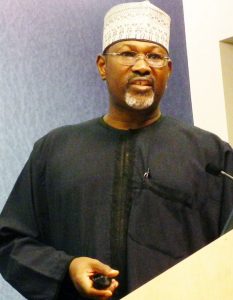
Prof Attahiru Jega, experience spanning ASUU, VCship, INEC Chairman
Such a list would stretch from those who have completely retired but are not tired; those who are either on the verge of exit from the system or are serving as Vice-Chancellors and might not move into other things but can still assist the system somehow; the category that are not currently teaching because they are on government service but are irreplaceable and, finally, there are those in NGOs who are, nevertheless, mobilisable. A sampler of the list across the different categories would stretch from Professors Enoch Oyedele, Okello Oculi, Y.Z. Yau, David Ker, Asisi Asobie, Egite Oyovbaire, Isawa Elaigwu, Yakubu Aliyu, Bolaji Akinyemi, Adiele Junaidu, Idowu Awopetu, E. R Ajayi, Moses Ola Makinde, Soji Amire, Kola Torimiro, Prof Dandatti Abdulkadir, Oga Ajene, Tony Edo, Mike Kwanashie, Eghosa Osaghae, Alli, Alemika, Alubo, Sule Bello, Nuru Yakubu, Toye Olorode, Dipo Fashina, Sonny Tyoden, Jibrin Ibrahim, Alex Gboyega, Bayo Adekanye, Okechukwu Ibeanu, Sam Egwu, Ogaga Ifowodo, Adebayo Williams, among many others that cannot be recalled immediately. It is difficult to place Yusuf Bangura on the list.
Some people estimate that no less can 2000 can be compiled. The assumption is that Vice-Chancellors would be disposed to such an arrangement, especially those of some of the new, private universities that are most conscious of standing out from the crowd.
There was a time they were chased around mainly for “teaching what they were not supposed to teach”. This was the ‘crime’ the state imagined them to be committing and which was framed as such by the late General Emmanuel Abisoye, one of the most sophisticated intellectuals of the Nigerian military in his time and who was head of government investigation into student uprising in Ahmadu Bello University in the mid 1980s. On its wisdom, the state went after ‘them’, mostly those in the leadership of the Academic Staff Union of Universities, (ASUU). Today, the government itself is in the forefront of complaining that the university system is not performing its role to the state and that university workers were right in their perspective of the crisis. It is in that context that some stakeholders assume that government is most likely to look into Professor Adikwu’s argument, he being the VC of Nigeria’s capital city university. But even if government accepts the idea and finds the money, how soon can it produce outcomes without an emergency measure such as injecting tested and untainted academics?
Their presence, it is argued, would be a mentoring system in itself. “Their mere presence on the corridors of Departments means that certain things wouldn’t happen, younger academics would get the benefit of solid processing and they can best handle certain core courses such as theories and methods, especially at the postgraduate level”, it was argued. The clincher appears to be the question as to whether anybody would say that there wouldn’t be a big shift if Nigeria can inject 1000 solid academics into the system today, meaning that they would be coming as guides, especially in designing the courses which some academics say is more crucial that delivery of courses.

Nigerian youths seeking expansion of the scope of meaningful participation in politics have been told to learn from how their counterparts in Kenya went about it although there is still controversy on the meaning of youth participation. Is it for the youths to take over and enjoy the perquisites of office the way incumbents are doing or is it to take over and transform the Nigerian society? Notwithstanding the inconclusive debate for now, the argument is that the pathway to deepening youth participation is for Nigerian youths to organise and assert themselves electorally the same way their Kenyan counterparts have gone about it.
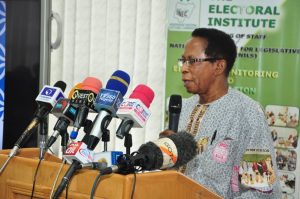
Prof Asobie delivering his lecture
Although a senior Nigerian politician at the occasion described the suggestion as exciting but inciting, Professor Humphrey Asisi Asobie, notable Political Scientist, former National President of the Academic Staff Union of Universities, (ASUU) and Guest Lecturer at The Electoral Institute, (TEI)’s First Abubakar Momoh Memorial lecture who is pushing this idea says that is why there are now Kenyan youths of 19, 24, 26 years who have been elected into parliament and other elective offices. But the model unfolded at the lecture attended by nearly a dozen high officials of Nigeria’s election management body – Independent National Electoral Commission, (INEC), diplomats, academics, civil society leaders, leaders of political parties, women and youth leaders as well as the late Prof Abubakar Momoh’s family, particularly his widow, came with a qualification: the youths cannot accomplish this alone, they need to align with platforms such as the Nigeria Labour Congress, (NLC).
Indirectly saying that the Nigerian State is so alienated and alienating, Asobie declared how low participation generally is in Nigeria and specifically the youths, a low scale participation he blames the Nigerian Constitution for sanctifying by its provisions which set the age for most of the crucial offices such as that of the president, governors and senators at youth exclusionary ages of figures of 35 and above when no upper ceiling exists for the oldies.
Prof Asobie said it is not a question of homogenising youth agency because he accepted that the youths have also been incorporated into the representation and practices of the power elite, especially the construction of crisis in ethno-religious terms by ethic warlords. It is in realisation of this that he said he qualified his idea of youths as those ideologically clear and can think of politics in terms of rapid social transformation.
Challenging the youths to reckon with democracy as “what you do for yourself, not what somebody does for you”, Asobie said youth exclusion in Nigeria is scandalous, ridiculous and undemocratic, adding that Nigerian youths are actually subjects, not citizens, deriding the impossibility of talking about democracy when youth participation is that low.
Arguing how youth participation in itself is functional to democracy, he concluded how important it is to say that youths cannot wait endlessly. They have got to use their numerical strength and alliance to present a new pattern of politics in favour of transformative rather than transactional leadership, said Asobie who asks of them to know that the majority in every society are the poor and the numerous and that, in choosing, “people who are unlike you cannot represent you. Those who should represent you are people who are like you”.
 He further argued the impossibility of youth participation without a financial level playing ground, noting how INEC could help; how the existing Constitution has provisions that could have resolved the problem. The constitution provides leeway by providing for a manner of managing the economy such that existing inequality level would not have arisen. Additionally, “If you take Section 16 and provide education, it would amount to youth empowerment because there is a positive correlation between high achievement in education and consciousness”.
The Guest Lecturer warned against how what he said has happened in China could happen here in which youths moved away from seeking participation into new technology in contrast to Norway where a much more organised response to youth participation produced a more participation-inducing system and outcome.
This is, however, not what he is expecting in Nigeria because Nigeria is in the category of a pseudo-democracy, notwithstanding a better election in 2015, recalling how late President Umaru Musa Yar’Adua was honest enough to admit this much in a documented manner.
Prof Asobie identified the state and social order context of youth participation in Nigeria in the fragmented, incoherent and very fragile state with which there is clearly something structurally wrong. Incoherence, insecurity and instability all go to show that something is wrong beyond just any particular regime even as he did not award the incumbent a pass mark, saying governance is very low. Nigeria had made some progress on her fragility status, it is still next to the worst in categorisation, said Asobie who put his fingers on what is wrong with the Nigerian State in the emphasis on sharing rather than production. “The state is a problem in itself”, he said, adding how the social order context of the Nigerian State is such that the leaders do not feel obliged beyond projectisation. The gap between the rich and the poor is also a point in this.

Prince Tony Momoh making his point
Prince Tony Momoh, a former Minister for Information and chieftain of Nigeria’s ruling party – All Progressives Congress, (APC) as well as a relation of late Prof Abubakar Momoh did not accept everything Prof Asobie said, arguing that the problem is that the Nigerian Constitution had privileged democracy over and above development. He called for decongestion of the political space because “we are spending much money on democracy”. He was basically saying that the Constitution put the rights to enjoy in Chapter 4 ahead of the duties to perform in Chapter 2, a contribution Professor Okey Ibeanu, another Political Scientist and an INEC Director who chaired the occasion subsequently framed as the “democracy – development’ debate in African politics. But, when given the floor again, Prof Asobie to whom the question was directed said it was not enough to say that democracy promotes development. For him, it is more important to ask what sort of democracy and what manner of development. He put it to the circumstance, saying Lee Kuan Yew of Singapore has been rated as such a success story in autocracy promoting development but that he worked with communists, itself a potential controversy.
Prof Ibeanu put some laughter to the conversation when he distinguished between a dead and a living constitution. One is the letter, the other is the practice of it. Those who wrote the Nigerian Constitution, said Ibeanu, “took everything that is important about our existence and put in Chapter 2 but tied it down with the justiciability/non-justiciability provisions. But, according to him, Section 14 of the Constitution is actually the basis on which Nigeria should be organised and that is Social Justice. For him, the point, however, is not whether the Constitution provides but the politics of enforcing certain provisions.
Another contestation came from Mohammed Baki Lecky, an INEC Resident Commissioner who did not accept a distinction between transformative and transactional leader, preferring to see a continuum there. Arguing that some of the points about youth participation were overstated, the REC maintained how youths do not necessarily have to be local government chairmen, governors or ministers in order to change things. They could do so using their votes to change things around. His worry is rather about the ideological level of Nigerian youths.

A group photograph which captured most of the attendees
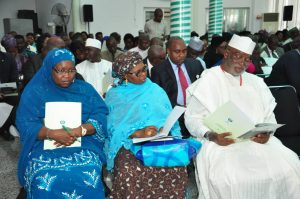
Another line of attendees
Prof Anthonia Okoo-Simbene, another INEC top official who responded to a question posed in her schedule of duty told the gathering howINEC cannot do anything about whether aspirants should pay or not pay for nomination forms that political parties ask for. What INEC can do is in respect of monitoring party expenditure. That is provided for, she said, but even then parties submit such statements sometimes three years after an election.
Professor Okey Ibeanu, the Chairman of the occasion had sort of wetted appetite of attendees at the memorial at the beginning of the occasion by relating what the man who delivered a homily at the 7th day prayer for Prof Momoh said. The man said a dead man’s grave is not the most important thing because many would no longer even be able to find it after some time. What is more important is the number of graves a person made in the heart and minds of other people and which makes life a question of how many graves one dug in others. Or, what impact did one make on the life of others! Abubakar Momoh’s life, he said, was in the graves he dug in the minds of many people, from CODESRIA in Dakar to the lecture halls of King’s College London to the slums of Lagos. “Momoh would have been very happy with the prospects of youth participation”, he maintained but that is participation beyond the statistical sense. Rather, participation in transformative, progressive sense, he said. He was sure Prof Asobie under whom the late Momoh served ASUU as treasurer was best placed to deliver the first of the memorial lectures, an event they in INEC hope to keep alive.
Dr Sa’ad Umar Idris, Acting DG of TEI had taken basically the same position earlier in his welcome address by saying youth participation was one of Professor Momoh’s best themes and on which he researched and wrote.

By Adagbo Onoja A conception of reality in its contingent sense would always provide the basis for confidence in the coming of the Nigerian moment in history, notwithstanding what appears to... Read more
It is now official that Nigeria is contemplating increasing the duration of the First Degree programme. This is the suggestion the Minister of State for Education, Prof Anthony Anwukah has a... Read more
The labour roots of the editorial minders of the Abuja based The Worker positions the periodical in terms of the best possible coverage of the recent 40th anniversary of Nigeria’s central la... Read more

If Bayero University were to be a country, it could be said to be at American economist, W. W. Rostow’s stage of take-off now. At its 34th Convocation ceremony staggered over last week, it a... Read more

For a few hours on January 31st, 2018, the controversy in the public sphere would shift from any of killer herdsmen, President Buhari’s political future, 2019 and the likes to the political... Read more