By Adagbo Onoja
The 30 – page PDF text is already the subject of a thickening controversy in the US. So much that the Provost of Washington University, one of the two sponsor universities, Mark West, is almost distancing the university from it. That could be a cruel reading of his statement thereto but it is implied in the section of his June 10th statement to the effect that “the report is an invitation to discussion, not a conclusion”. He added how the university has no specific plans to act on the report.
There are hasher reactions, with some calling it a worthless report. It isn’t and cannot be, as a text which can be interpreted in many ways, none of which can be dismissed as wrong. It is, to that extent, a text every and anyone who has anything to do with scholarship must engage with.
The scholars who produced the report started working in September 2025 and submitted their report on April 5th, 2026. It seems to Intervention that the subsequent uproar is still limited to the United States even as it seems to surely spread.
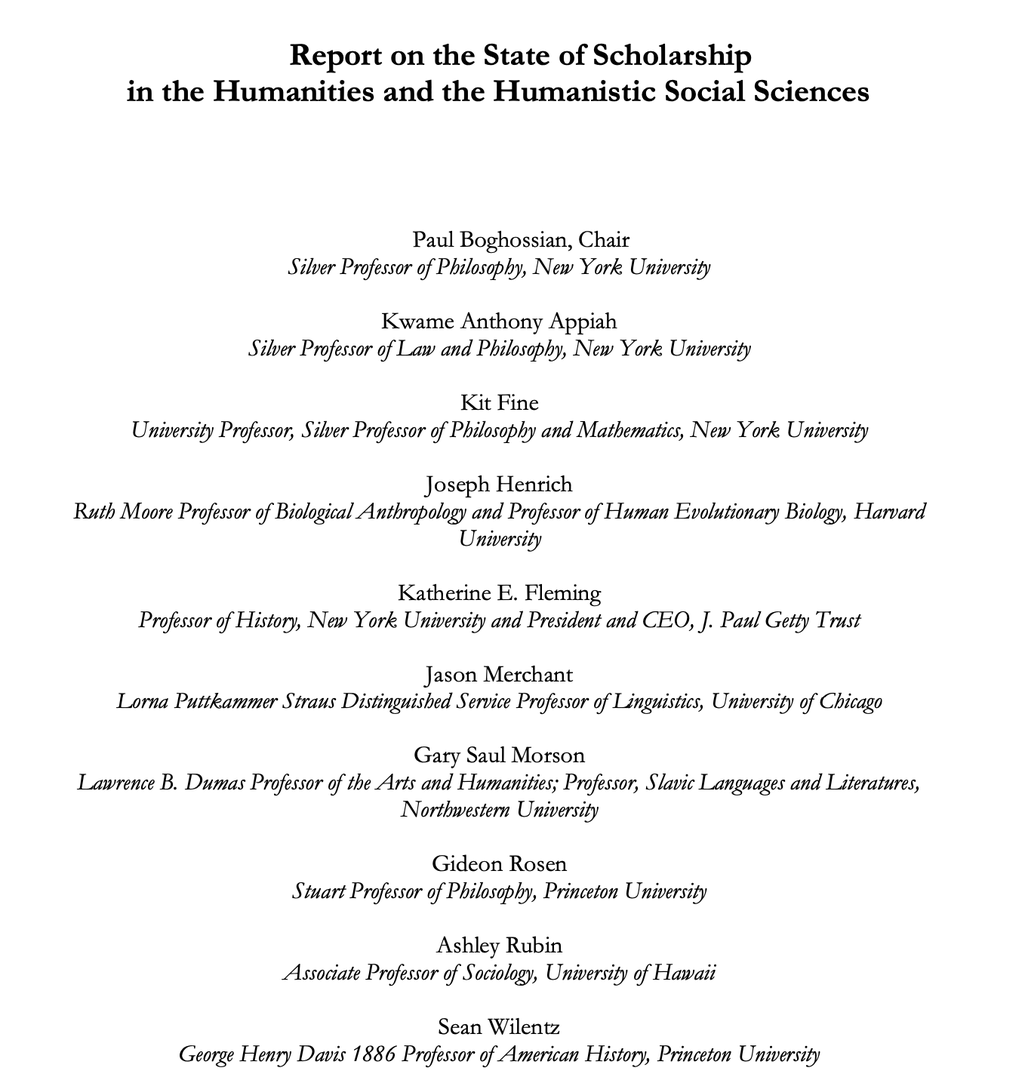
Everything about the report is interesting, particularly the impeccable formulation of the claims and conclusions. And the composition: crack scholars, 10 of them in all, from New York University, the University of Hawaii, Harvard, Chicago, Northwestern and Princeton.
The Committee was summoned into being by the Chancellors of the University of Vanderbilt and Washington University in response to concerns about ‘state of academic scholarship in the humanities and social sciences’. It was a concern informed by what the chancellors call ‘dramatic erosion of support’ for the humanities and the social sciences by all the crucial constituencies: students, parents and government as well as by complaints against observed decline in quality of scholarship. And how these are aggravated by questions of creeping naturalism as well as tendential intrusion into determination of truth, evidence and knowledge.
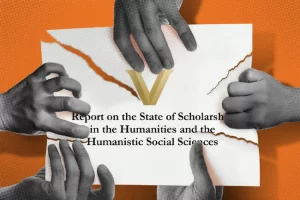 Titled Report on the State of Scholarship in the Humanities and the Humanistic Social Sciences, the document brings back all the questions the community of scholars in the two domains would have thought have been addressed and closed since 2000, particularly after the Perestroika methodological revolt in the US. Interestingly, the report is emanating from the same US from where the Perestroika revolt originated.
They set out to assess the state of scholarship in the humanities and the humanistic social sciences in light of this complaints. Basically and categorically, they did reject the complaints but only to some extent. “As we will emphasize, there is serious scholarship in every field we have studied, and at their best, the humanities and the social sciences are as rigorous and as fruitful as they have ever been”
But that seems to be the end of the good news as they then said that “Taken as a whole, however, our review of the disciplines paints a mixed picture. Every field we have studied shows some signs of the pathologies sketched above: a deterioration in scholarly standards fueled by the substitution of political criteria for properly scholarly criteria in the assessment of research and a more general repudiation of long-standing ideals of rigor and objectivity”
From there, the trouble started as they started naming names: “In some fields (e.g., philosophy) the problems are largely confined to a single subfield focused on a charged topic. In others (e.g., history), while there are streams of scholarship in which standards have been politicized in problematic ways, they run alongside more dominant streams in which a wide range of views is tolerated, and appropriately scholarly standards are brought to bear. In the most extreme cases (e.g., anthropology), we see a widespread deterioration in scholarly standards grounded in a pervasive repudiation of ideals of objectivity together with a toxic intellectual climate in which reasonable dissent on politically charged topics is routinely suppressed and punished”
Fortunately or unfortunately, they picked on the humanities that are the hub of that complex – Philosophy, History, Anthropology. Even in the ‘Third World’ where a discipline such as Anthropology evokes a certain hostility, no one there would support the accusation against it on a worldwide scale. Yes, it was instrumentalised by empire and colonialists but it offers something in methodology that has been enduring. Structuralists used it to great research outcomes in the ‘Third World’.
Could this have been part of the problem?
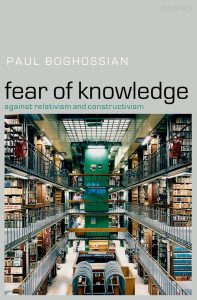
On Page 5 of the report is this statement: But with occasional exceptions, our conclusions about the overall state of humanistic scholarship, and in particular about the extent of the problems we have identified, are not yet supported by the kind of quantitative evidence that would be expected in a peer-reviewed study of these matters”. While this looks fine on the face of it, the report sort of reverses itself between page 19 and 24 when it took on ‘Underdetermination, Postmodernism and Relativism”. It is the section that seems to have been the real pursuit. At any rate, the section is what is being used to attack the report. A particular blog suggests that the section is, in one way or the other, a reproduction of Prof Boghossian, the Chair of the Committee’s 2006 book titled Fear of Knowledge: Against Relativism and Constructivism.
The reception of the report seems to just be warming up and those who have dismissed it might have acted too early. The truth though is as if the professors who wrote the report have just arrived from Mars and were probably not aware of the debates in the philosophy of science in the post-Cold War.
It is in that sense that it would be very interesting to read the reaction of a number of scholars who have been most involved in the philosophy of science debate especially in the period. As far as Intervention can see, such a list would include Alexander Wendt at Ohio State University; Patrick Thaddeus Jackson at the American University in Washington DC; David Howarth at the University of Essex in the UK and a leading force in that realm along with his friend, Jackson Glynos and wife, Aletta Norval; Colin Wight at the University of Sydney; Lene Hansen at the University of Copenhagen; Inanna Hamati-Ataya at the University of Groningen; Roland Bleiker at the University of Queensland; Charlotte Epstein at the University of Tokyo and Claudia Aradau at Kings College London. This list is far from exhaustive but they contain some of the most compulsive voices on the Philosophy of science recently.
It will be particularly interesting to hear Prof Patrick Thaddeus Jackson’s comment on the report, Jackson being the one who passed the verdict that science is much less about method and more about goal and that internal validity is therefore more crucial than technique as there is no universal consensus nor such a possibility anytime soon. He came by this conclusion after an exhaustive review of what he calls ‘the science question’. Although he did this in relation to International Relations, it is all about the philosophy of science dispute.
Probably, the authors had just the United States in mind but how would such a report escape Europe which is ultra-sensitive to the philosophy of science process within the context of continental philosophy and its conclusions about where Europe’s rough encounters with history – imperialism, Empire, two world wars, fascism and unbelievable human rights atrocities, the holocaust and totalitarianism – came from: the Enlightenment ontology.
Even as overburdened as Africa, it has a detachment of academics and a continental intellectual establishment that would be sensitive to many aspects of the report, having been the ones who have been at the receiving end of the empire, imperialism/neocolonialism, two world wars and fascism that Enlightenment provoked. And particularly that education in Africa reflect a lot of the neoliberalism that global centres of power and authority insist and impose on the continent. It means the report in question will not be seen in Abuja, Cairo, Pretoria, Nairobi, amongst others, and their leading universities as a mere academic move but as something with performative implications.
It is worth everyone reading it and ‘seeing’ for him or herself in terms of what weight to attach to it!