By Adagbo Onoja
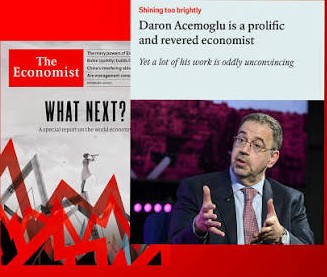
Typical of the fluid ways of popular culture sites, The Economist of London has set its deconstructive reportorial gaze on Prof Doran Acemoglu, ex-LSE economist currently based at the Massachusetts Institute of Technology (MIT) in the United States. Nothing can be more radically entertaining reading through the encounter. This is because Prof Acemoglu is one of those Western thinkers schematising the world in the way Prof Michael Heffernan (then at the University of Nottingham in the UK) categorised them in his review of Gerard O’Tuathail’s canonical text, Critical Geopolitics: The Politics of Writing the Global Space. Wrote Heffernan: “O’Tuathail argues that modern geopolitics emerged during the last fin de sie`cle as part of an imperial, Eurocentric planetary consciousness. This was a masculinist, ex-cathedra vision of a dangerous world viewed from the commanding heights of governmental and academic institutions”. There is no student of critical geopolitics who would not know who Heffernan was shooting at: Sir Halford Mackinder, the foremost British intellectual and practitioner of imperialist geopolitics and his likes.
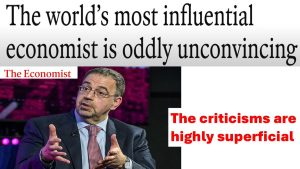 That is where the significance of what The Economist is doing (or has done) to Acemoglu lies. And it is a substantial attack for a magazine of the stature of The Economist to declare flatly in a cover story that “the world’s most influential economist is oddly unconvincing”.
Intervention is in no position to determine whose war The Economist might be fighting. Whoever’s war it is, the British weekly will hardly be doing anything objectionable to those who find Acemoglu’s scholarship insensitive to the cheated. Acemoglu has put many of his readers in a catch 22 situation: on the one hand, readers cannot hound an author for their interpretation of his or her book. This is simply because such interpretations are those of the readers, not of the author. Similarly, it is out of sync to push against a book readers interpret the content to be unacceptable because, by current consensus, that would amount to censorship which is close to the heinous. On the other hand, writing a book and circulating a particular argument constitutes a meaningful practice, with constitutive implications.
Hence the good development it is when a platform such as The Economist writes about him in these words: “No one accuses Mr Acemoglu of truly poor research, let alone academic malpractice. “He is obviously a genius,” says another economist, who adds that he is generous to phd students and junior colleagues. The question is whether his reputation at the very apex of the economics profession—and the intellectual influence that goes with it—is justified by his scholarship”.
Prof Acemoglu could not have seen this coming. He has not been used to such attacks. But the attack is substantial.
One of what The Economist pointed out is the problematic nature of the data underpinning the paper which fetched Acemoglu and his colleagues their Nobel award. The 2001 paper said to have been quoted 23, 000 times by researchers explains why some countries fail or succeed in terms of the kind of institutions which prevailed. The thesis is entertaining: In places where European settlers died in droves, perhaps because of disease, colonisers built “extractive” institutions, with power and resources concentrated in the hands of an elite few, to take out as many resources as possible. But in more agreeable climates, settlers survived. Colonists built more inclusive institutions, with proper roads, schools and medical services. Those institutions persisted, with the effect that places with lower settler mortality in colonial times are richer today”
According to The Economist, the Nobel committee’s report in 2024 conceded that the mortality data are “sometimes sketchy”. The magazine quoted other scholars who also picked quarrels with the data. For a magazine like The Economist, a dot with data for a positivist such as Acemoglu will normally invite interrogation which is most likely to be what the magazine is doing.
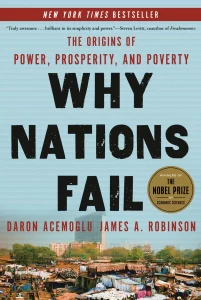
A more critical look at the thesis reveals the inclusive – exclusive matrix they use in this thesis of Why Nations Fail to be very classic of problem-solving theory. As defined by Robert Cox, a problem solving theorist is no better than an automobile mechanic who is an expert in fixing cars without any knowledge of the principles upon which a car is built. In other words, problem-solving theorists are technicians rather than philosophers. Not surprisingly, Acemoglu and colleagues’ matric is very strange to the rapid transformation that East Asian tigers and, above all, China have accomplished.
Lastly, the idea of inclusive institutions leading to transformation is like propounding a theory of developmental colonialism, something which will make Acemoglu and co to be in the same camp with Bruce Gilley, the scholar who wrote the essay, ‘The Case for Colonialism’, the publication of which almost crashed an established journal as Third World Quarterly in 2017. The article had to be withdrawn.
Controversial, insensitive thesis
On a broader theoretical realm, Acemoglu’s faith in institutions is even more perplexing. However, he does not do this in the rather appealing critical conservatism of a Robert Keohane, for example. With Keohane, you get empirical grounds justifying international institutionalism, how international institutions can hold the system, particularly should great powers fail. With Acemoglu, there is a take or leave it disposition in his posing of institutions even as everyone can see the constructedness of institutions, looking no farther than NATO for the evidence. NATO barely survived the end of the Cold War. One of the first options considered was to disband it. Those who thought that it should not be disbanded won the argument but NATO became a force for deepening security by adding climate change, peace pursuits and all that, much different from the original framing of collective security. Today, NATO is confronting another round of constructedness in what Donald Trump is up to. So, where might Acemoglu have got his idea that a complex realm such as development can be tied to institutional practices in colonial discourse?
It would have been thought that no scholar would parade the kind of distinction between failure and success of nations as Acemoglu and Robinson do. How could that be possible when both the successful and failing nations all operate within a structurally integrated international order such as the collapsing Liberal World Order if the distinction is not predicated on declaring the complicity of the successful in the fate of those failing?
So, when, almost from nowhere in the beginning of the third week in August, 2026, The Economist went after Prof Acemoglu, it was something that must have echoed in many quarters in Africa, for example. After all, long before he died, the late Thandika Mkandawire took the same position The Economist has just taken although Mkandawire did so in relation to Africa.
Intervention’s original intention was to reproduce Mkandawire’s critique of Acemoglu word for word. Unfortunately, Mkandawire’s quote didn’t materialise in Dr Yusuf Bangura’s tribute to him where One had thought the quote is. It is an on-going search but Dr. Bangura has graciously sent to Intervention the following reaction to the war The Economist has started and it is reproduced below as sent:
I’ve always been surprised at the stardom enjoyed by Acemoglu in international development studies and economics, especially when he and his co-authors received the 2024 Nobel prize in economics.
When I first read his seminal article in the subject in 2001, ‘’The Colonial Origins of Comparative Development’’, I thought it had interesting insights but glossed over many relevant facts. It argued that countries where Europeans settled with their institutions of private property rights, rule of law, and democracy are inclusive and developed; those which they governed but didn’t settle in are exclusive, extractive, and underdeveloped.
I thought the point about European settler colonialism promoting higher forms of ‘development’ was a good and obvious point—since they settled, they also invested in infrastructure and productive forces. The thesis however fails to account for the massive oppression and dispossession settler colonialism committed against native populations. Thandika, Samir Amin, and Mahmood Mamdani showed the ugly and exclusionary side of settler colonialism in their writings.
I found Acemoglu’s subsequent generalisation of the thesis in his book Why Nations Fail utterly simplistic. It read like an ideological justification of neoliberal development policies—which claimed that countries can only develop when they have sound private property rights institutions, rule of law and democracy.
The global inequality economist, Branco Milanovic, once described Acemoglu’s work as being like reading Wikipedia. It lacks nuance and depth.
The review Acemoglu is complaining about against The Economist
Acemoglu is lauded by the Nobel Committee and the international development establishment because 1) he makes settler colonialism—the worst form of colonialism in terms of its savagely extractive practices against the natives—look benign, and even progressive; ii) he celebrates the western model of development, which is claimed to be based on institutions of private property rights, the rule of law and democracy. Even the latter has been shown to be a partial reading of the full historical process of Western development, with its horrors of corruption, immiseration, and forced extractions—or what Marx called primitive accumulation.
That was Dr Yusuf Bangura in a response to Intervention. Well, Dr. Bangura also attended the London School of Economics and Political Science where Prof Acemoglu equally obtained his PhD. And Bangura had encountered Acemoglu, academically.
Predictably, Prof Acemoglu has replied The Economist in which he declares the piece on him to be more striking for the weakness of its claims than the hostility. While welcoming criticism because it is essential for progress in science, he kicks The Economist for assembling “loosely connected grievances into an insinuation of unreliable scholarship”.
He contends that the central verdict that he is “oddly unconvincing” rests on unnamed economists, though the main point, for him, seems to be the timing. He considers it curious in its coincidence with the publication of his new book, “What Happened to Liberal Democracy?”
Hear Acemoglu: “The Economist’s review of the book, published at the same time as the article, is dismissive and declares that it “grapple(s) with the question of how AI will shape the future” (“Man’s best frenemy”, August 17th). Acemoglu’s anger is that no more than half a chapter talks about AI and democracy. “It is hard not to interpret this as a strategic framing, intended to obfuscate the message of my book and bring it to The Economist’s favourite topic of defending and boosting AI”
And then he fires back: “If this is the best you can do with a body of work spanning 33 years, then it is your critique that is “oddly unconvincing.”
In his reply to The Economist, Acemoglu is, interestingly, confirming Yusuf Bangura’s point that he (Acemoglu) is a defender of neoliberal development strategy. As neoliberalism is the current strategy by which to account for the unspeakable misery across Africa, the animus against Acemoglu might just be the beginning on the continent. Fortunately for Acemoglu, the continent is not well served by the discursive space that can pick the signals in his scholarship and respond appropriately. There are not departments of Economics, History, Political Science, Geography, Sociology, International Relations and Sociology which can give his text the required situated reading. Journalists, civil society leaders and politicians do not, therefore, fire back. Yet, he and his fellow travellers are the intellectuals of statecraft formulating and framing the current models of recolonisation. For this, there is a basis for thanking The Economist!
The author is an Editorial Executive with Intervention