By Hassan A. Saliu
Events and personalities are mutually constitutive in historical narratives. While some individuals attain national prominence gradually, others are catapulted into public consciousness by critical conjunctures.
In this regard, Professor Sam Egite Oyovbaire’s participation in the Babangida military government significantly elevated the national visibility of this distinguished Professor of Comparative Politics.
The Scholar and the Academy
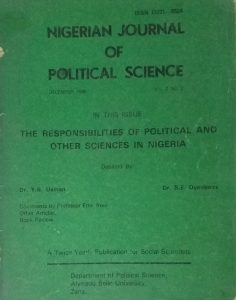
The debate that won’t go away!
Professor Oyovbaire earned his B.Sc. from the London School of Economics and Political Science, University of London, in 1969; his M.Sc. from SOAS, University of London, in 1970; and his Ph.D. from the University of Manchester in 1976.
He commenced his academic career at Ahmadu Bello University, Zaria, in 1971. Over twelve years, he rose to the rank of Reader. Two episodes, among others, defined his ABU years.
First, in 1977, following an accident involving the Head of Department, the late Professor A. D. Yahaya, Professor Oyovbaire served as Acting Head. It was during this period that Professor Ibrahim Gambari’s application to the department was processed.
Second, the 1978 intellectual engagement with Dr. Bala Usman over Oyovbaire’s NPSA conference paper, “The Responsibility of Political Science,” presented later at a faculty seminar in Zaria. The exchange, between a radical and a liberal-rigorous tradition, generated wide debate across the Faculty of Arts and Social Sciences and beyond.
Subsequent developments led Professor Oyovbaire to the University of Benin. He was conferred the rank of Professor at UNIBEN in 1983, during the Vice-Chancellorship of Professor Adamu Baike, concluding a process initiated earlier at ABU. After a decade of service at UNIBEN, he retired in 1993, having spent six of those years on secondment to the Presidency.
As a scholar, he has authored over 125 publications. He is a leading authority in Comparative Politics, and his intellectual lineage extends across Nigeria and the diaspora.
The Scholar in Government – The Babangida Years
With due respect to our celebrant, I approach this segment by reference to the Babangida administration. Professor Oyovbaire has rightly cautioned that the appellation ‘IBB Boys’ was a military colloquialism that did not extend to scholars in government. As he observed: “Some of the Professors who served the Babangida government are older than General Babangida himself. How then can they be called Babangida Boys?”
Professor Oyovbaire’s public service began in the Political Bureau in 1986. He subsequently served as Special Adviser and Minister of Information under the Babangida regime. During this period, he was a central intellectual architect and public voice of the Babangida transition programme, and he played a defining role in shaping public communication and policy direction throughout that era. His trajectory was foreshadowed by his engagement as a Guest Lecturer at the National Institute for Policy and Strategic Studies, NIPSS, Kuru, under three successive Directors-General of the Institute.
The Babangida regime remains notable for the unprecedented recruitment of academics into governance. Yet, despite this reservoir of expertise, the transition programme did not culminate as designed. The annulment of the June 12, 1993 presidential election, for example, came as a surprise even to members of the administration’s inner circle, including the late Professor Omo Omoruyi, who sought to explain it by reference to extraneous factors.
The structural dilemma confronting academics in government was succinctly articulated by Professor Ibrahim Gambari, drawing on his experience as Minister in the Buhari military government, 1984-1985. He posited a fundamental distinction: there is a world of difference between being in government and being in power. Thus, academics or technocrats who served under military and civilian administrations have not always been effective participants in either era, because a narrow stratum of actors and interests ultimately determines the direction of the state.
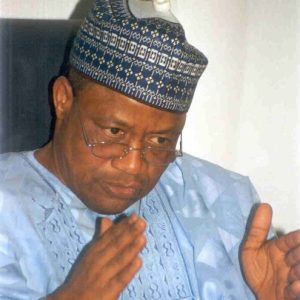
IBB, noted assembler of professors
Three illustrations suffice. First, in 1982, Nigeria’s delegation to the OAU Summit in Tripoli, including the Minister of External Affairs, Professor Ishaya Audu, proceeded to Tripoli on the assurance of presidential attendance that did not materialise. Second, the 1985 expulsion of so-called illegal aliens under the Buhari regime occurred without the knowledge of the Minister of External Affairs, Professor Gambari. Third, in 1995, while Nigeria’s Foreign Affairs Minister, Tom Ikimi, was in Auckland defending the state against international condemnation over the execution of the Ogoni Nine, he was unaware that the executions had already occurred.
It was against this backdrop that General Babangida asserted: “We are not only in government but also in power,” and” We do not know those who will succeed us, but we know those to whom we will not hand over power.” One may infer that the annulment of June 12, 1993 presidential election, reflected this logic of control, just as the earlier cancellation of primaries in the two state-created parties served as a precursor. On the annulment, while acknowledging that it is not a sustaining legacy, Professor Oyovbaire maintains that the totality of the transition process produced what was arguably the freest and fairest election in Nigeria’s political history. He thus cautions against a reductionist, single-story narrative.
Even in that turbulent period, Professor Oyovbaire retained his scholarly independence. He served, but he did not surrender his scholarship. Reserved in demeanour, his writings are incisive, wide-ranging, and uncompromising.
The Politician, Institution Builder and Mentor
Professor Oyovbaire later became a prominent figure in the People’s Democratic Party, PDP, in Delta State, and was closely associated with the administrations of Governor James Ibori and his successor, Governor Emmanuel Uduaghan. He also served on several policy think tanks convened by those governments. Yet, as our political economy demonstrates, ideas without capital face structural constraints. This reality constrained his political ambition of becoming Governor of Delta State.
In the university system, he served Delta State University, Abraka, for two years as a member of Council and for ten years as Chairman. His stewardship contributed to the institution’s stability, for which it conferred on him an honorary doctorate in 2024.
He is also deeply embedded in his community, bearing the titles: Ogbiroro of Okpe Kingdom; Oruese of Oghara Kingdom; Ogdigbo rebe of Olomu Kingdom; and Oruese Rovie of Effuruntor Kingdom. For over eight years he has chaired the 44-member Advisory and Peace-Building Council in Delta State.
Within the academy, he served as President of both the Nigerian Political Science Association, NPSA, and the Nigerian Society of International Affairs, NSIA — thus a “Double President.”
At the 1985 NPSA conference in Ilorin, his presidential address was interrupted when the then Governor of Kwara State, Group Captain Salawudeen Olatinwo, ordered the microphone withdrawn. Professor Oyovbaire received this with characteristic equanimity.
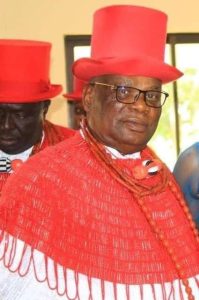
Prof Oyovbaire as a scholar – traditionalist
Legacy and Honour
Professor Oyovbaire remains a significant benefactor of the NPSA. In 2024, he donated the sum of ₦1 million to the Association and was conferred a Fellowship in Lokoja. He delivered the 2016 Billy Dudley Memorial Lecture in Abuja.
In recognition of his distinguished service and mentorship, the Interim Executive Committee of the revived NSIA has named its flagship programme after him. The maiden edition of the Prof. Sam Oyovbaire Roundtable Discussion Series was unveiled on July 23, 2026. In no distant future to come, a public service lecture being instituted in his name at the Southern Delta University will be delivered by Prof. Eghosa Osaghae, the Director-General of the Nigerian Institute of International Affairs, NIIA. I do not know which came first between the NSIA and the Delta University in honouring Prof. Oyovbaire. I assume it was the NSIA.
He is happily married with children and grandchildren.
Conclusion
At 85, Professor Sam Egite Oyovbaire embodies the synthesis of intellectual depth, public service, and principled leadership.
A scholar formed in the best traditions, tested over two decades in the classroom, and author of more than 125 works. A public servant who entered government with integrity and exited without compromising his intellectual autonomy.
An institution builder who stabilised a university, a politician who earned the trust of his people, and a leader of professional associations with dignity. A mentor whose ideas continue to shape new generations, and a statesman whose voice remains measured, firm, and committed to truth.
In naming our Roundtable after him, NSIA honours not only a person, but a set of values: intellectual courage, service with integrity, and fidelity to ideas over expediency.
On behalf of the Nigerian Society of International Affairs, I say: Congratulations, Sir. Happy 85th Birthday. Many happy returns. May your light continue to guide scholarship and nation-building.
The author is the Interim President, NSIA