
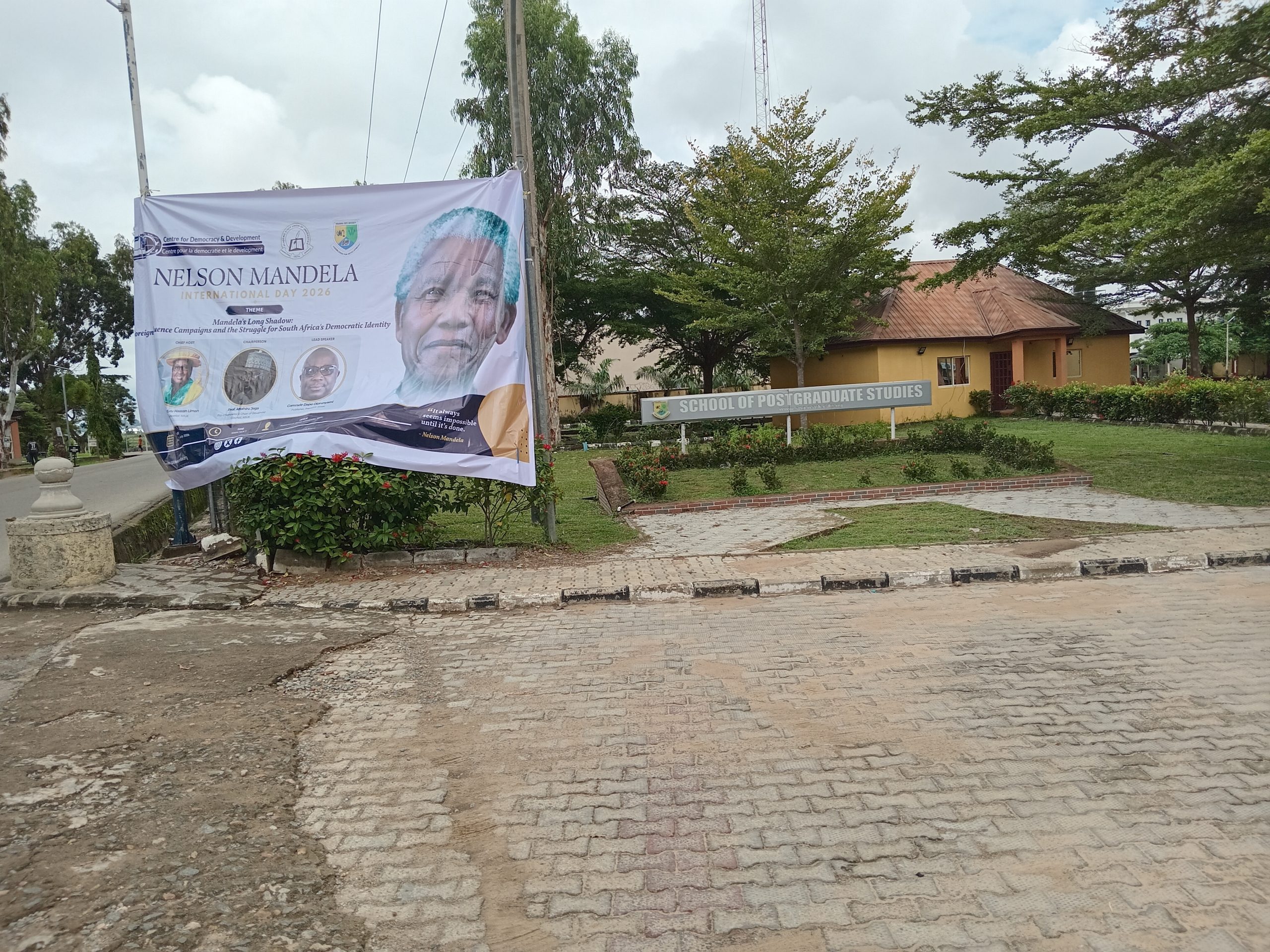
The 2026 Mandela Day in Nigeria turned into a clash site of two dominant but contending views on the anti-African immigrant violence in South Africa. A remarkably novel interpretation of the violence as the outcome of organised simulation by powers outside Africa clashed with the view that it is the ANC’s impoverished leadership and xenophobic temptations of South Africans. Both sides were, however, united in the coming together of progressive forces to save the situation in the reconciliatory rather than revenge approach of Nelson Mandela as the solution.
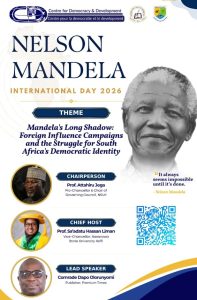 The CDD-West Africa has led a fairly elaborate 2026 Mandela Day memorial in Nigeria, some of it in collaboration with the Academic Staff Union of Universities (ASUU). It started Friday, July 17th, 2026 with handing over of a brand new water supply facility to a primary school in the Shadadi community in Kuje Area Council of Abuja FCT. Saturday, July 18th was for the Lecture component of the memorialisation at the Nasarawa State University, Keffi near Abuja. That was where the violence in South Africa took the centre stage in the nearly five hours an audience of university administrators, academics, activists, students and others on the ground and online spent in rumination.
The event had a smooth take-off although it was as if Prof Saádatu Hassan Liman, Nasarawa State University (NSUK)’s Vice-Chancellor foresaw the day ahead in her welcome address when she said, amongst others, that Mandela must be an unhappy soul in his grave over events in South Africa because his legacy is shattered for a name that unites the world not only Africa but the entire world on democracy and overall prosperity. But she too inaugurated the argument for a continent wide attempt at resolution of the immigration which is the trigger for the violence. In the welcome speech read by Prof K’tso Nghargbu, the Deputy Vice-Chancellor (Research, Innovation, Linkages and Alumni Affairs), the VC looks forward to when all African presidents would arrive in South Africa to practically give a borderless effect to the African Continental Free Trade Area (AfCFTA). She expressed gratitude to CDD for choosing the university for the Lecture.
Chair of the occasion, Prof Attahiru Jega said in an address read on his behalf by Comrade Thomas Ogiri Ari, a member of the Governing Council of the university that Mandela was a man of unwavering courage, resilience and transformation of a nation divided by apartheid. For Jega, Mandela was not just about South Africa beyond. Predictably, he was sure xenophobic violence does not reflect Mandela’s legacy, stressing how a corrective course is a shared responsibility.
Beginning from putting in perspective the United Nation’s action in declaring an International Day in honour of Mandela so that the undergraduate component of the audience would not be lost, Comrade John Odah, Chair of the International Governing Council of CDD, pointed out how this year’s memorial holds at a very difficult time in the life of South Africa which has been a theatre of violent xenophobic attacks against African migrants from neighbouring countries and others from the rest of the continent, with Nigeria prominently in the equation. Nobody, said Odah, can easily explain away images of migrants from South Africa repatriated by their countries of origin and the hurtful stories they tell of their maltreatment by certain elements of their host country.
While it is impossible to be unmindful of the damage this attack on black migrants by their black South Africa hosts has caused for the image and standing of the people and government of South Africa, Odah nevertheless noted awareness of the push back by thousands of South Africans in defense of their neighbours who are migrants from other countries. He took particular note of counter-marches by South African organizations against the March-March elements trying to forcefully drag non-South African black migrants out of the country, especially the decision of four National Trade Union Centers in South Africa, namely COSATU, SAFTU, NACTU and FEDUSA asking their members not to join the March-March.
Odah argues how the differing signals from South Africa compelled the CDD to take “the firm view that we must have a conversation to explore the root causes of xenophobia in South Africa, understand it and thus work with the people and organizations in South Africa to defeat this dark evil threatening to derail one of the pillars of the long sought for African unity”. The decision, as he also explained, did not suggest lack of concern for the anger of some other participants in the Youth Solidarity on Southern Africa (YUSSA), Youth Solidarity on Southern Africa in Nigeria (YUSSAN) and the Nigeria-ANC Friendship and Cultural Association (NAFCA) of yesteryears. Rather, it is located in the logic that “in this quest and task, we must remind ourselves that Europe fought two bitter wars this century which they dragged the rest of the world into and called it world war 1 and II and yet, today they are a united European Union with a single passport for 27 European countries”
 A mischievous reporter could go on to write that Odah wetted the grounds for two out of the subsequent interventions. In other words, I am isolating the message of solidarity from the Academic Staff Union of Universities (ASUU) and, of course, the analytical howitzer Comrade Dapo Olorunyomi deployed as the Lead Speaker. ASUU came as an even handed judge. ASUU President, Prof Piwuna in the message read on his behalf took a two-sided but coherent stance: it unequivocally condemns all forms of xenophobia and identity-based violence, accepting no justification for attacking fellow Africans seeking lawful livelihoods and sharing a common history of struggle against colonialism and racial oppression. “Africa’s strength lies not in division but in unity, mutual respect and shared prosperity”, said ASUU while recalling what it categorises as the immense sacrifices made by Nigeria and other African countries in support of South Africa’s liberation, an effort spanning governments, workers, students, academics and ordinary citizens across the continent and the mobilisation of political, diplomatic, material and moral support to defeat apartheid. “The dividends of that historic solidarity should never give way to suspicion, hostility or violence among Africans”.
For ASUU, however, the greatest tribute to Nelson Mandela is not merely to celebrate his memory but to continue his unfinished struggle for a just, peaceful, democratic, united and prosperous Africa—an Africa where no citizen is persecuted because of nationality, ethnicity or origin, and where the spirit of Ubuntu triumphs over fear, hatred and division.
Obviously in defence of that standpoint, ASUU declares the 2026 theme of Mandela Day as decided by CDD – Mandela’s Long Shadow, Foreign Influence Campaigns and the Struggle for South Africa’s Democratic Identity – as a theme that calls for sober reflection on the forces that continue to shape Africa’s political, economic, and ideological landscape. Explaining this stance, ASUU argues “While apartheid was defeated, new forms of domination have emerged through disinformation, external interference, economic dependency, digital manipulation, and divisive identity politics. These forces threaten democratic institutions, weaken national sovereignty, and undermine the collective aspirations of African peoples”. ASUU wasn’t done yet. It said Mandela’s legacy imposed an enduring obligation on African intellectuals, workers, students, and democratic movements to defend truth, challenge oppression in all its forms, and promote critical scholarship capable of exposing manipulation, injustice, and inequality. Still further, ASUU insists that universities must remain centres of independent thought, where knowledge serves the people rather than narrow political or foreign interests.
Stretching its standpoint still further, ASUU tells its listeners that no aspect of Mandela’s legacy spoke more powerfully to the present moment than his remarkable capacity for reconciliation. “After spending twenty-seven years in prison under the brutal apartheid regime, Mandela did not preach vengeance against his white jailers or the Boer establishment that denied him his freedom. Instead, he embraced forgiveness without forgetting justice, choosing nation-building over hatred, dialogue over revenge, and reconciliation over retribution. He understood that democracy could only flourish where human dignity transcends race, ethnicity, nationality and identity”
At this point, an atmosphere had built up in the hall enough to receive the Lead Speaker. Cde Dapo Olorunyomi made a remarkable entry on the theme of “Mandela’s Long Shadow: Foreign Influence Campaigns and the Struggle for South Africa’s Democratic Identity”. Before now, it was never thought an African intellectual had his level of mastery of that realm of knowledge, more so that what he offered is a replica of the classics in that domain but without any element of borrowing from them as he dealt with a completely new problematic. Students of postmodern war either start with Chris Gray’s Postmodern War: The New Politics of Conflict or James Der Derian’s Virtuous War. Now, if they are African, they will start with Olorunyomi’s paper, especially if CDD were to ask him to retouch it and then publish his presentation as a monograph. It will be no small fresh air to the literature on power and conflict in Nigerian/African universities. The debate at the moment does not show much awareness of ‘Virtuous War’ reality in our academic canvass yet. Yet, it has been definitive of our lives across Africa since 1991.
Taking both the accompanying notes to the lecture as well as the lecture itself as one text, Cde Olorunyomi could be said to argue that although it is black South Africans we see visiting violence on fellow Africans, the condition of possibility for that lies somewhere. The black actors were enacting a reality simulated by “actors who understand something Mandela understood better than almost anyone of his era: that the story a nation tells about itself is a form of power, and whoever shapes that story shapes the nation”
Let’s hear him in his own voice: “Call it what it is: foreign influence. Disinformation networks that inflame racial anxiety on both ends of the spectrum. State-linked media operations that flood the timeline with half-truths about who is to blame for load-shedding, crime, the currency’s fall. Foreign-funded think tanks and civil society vehicles, some genuine, some hollow, competing to define what “sovereignty” and “non-alignment” mean for a country still working out its place between old allegiances and new ones. This is not paranoia. It is documented, tracked by researchers, visible in coordinated accounts and the sudden fluency of talking points in the mouths of people who never used them before”.
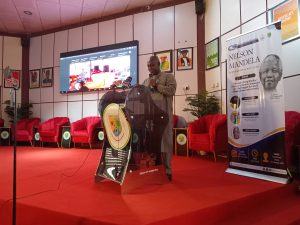
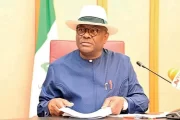
Cde John Odah making his speech
This sums up the thesis Olorunyomi uploaded for his audience to chew. But before they contemplate how the chewing would begin, he uploads another layer which is that Mandela is a discourse. As everyone knows, discourses are never complete. A discourse can go back and go front, a lot depends on who is manning the discursive gates. That is his own way of squaring up with the mess unfolding in South Africa, compelling him to ask: So what do we do with a shadow this long, in a fight this new?
He puts across an answer in his own words: We do what every generation after a founder must do, stop treating the shadow as shelter and start treating it as inheritance. An inheritance is not something you sit inside. It is something you build with. Mandela did not hand South Africa a finished democracy; he handed it an argument, unfinished, ongoing, about who gets to belong, who gets to speak, and who gets to be believed. That argument is now being fought in information ecosystems he never lived to see: in WhatsApp groups, in algorithmic feeds, in the quiet funding trails behind seemingly local voices.
At this point, Intervention felt how great it would be if Olorunyomi an expanded African IT squad undertake an African tour, making a presentation at the AU Headquarters. The AU is certain to have its own squad but it is one thing to have a squad but another to put it to a specific task.
At the risk of jumping the gun, Cde Mahmud Abdul, a former president of NANS and one of the panelists who didn’t quite accept Olorunyomi’s thesis at the event was pushing exactly the argument in the last paragraph by arguing that the problem rested not in foreign influence but in ANC’s failure to develop and canvass a myth that could fill the democratic imaginary of ordinary South Africans. That is something worth mentioning at this point even as we would meet it later in this report.
It is difficult not to keep quoting Olorunyomi as he wended his way. Said he, “South Africa’s founding generation gave the country a Constitution strong enough to survive apartheid’s collapse. Whether it is strong enough to survive a contest fought in bandwidth and bots is not yet decided. That is not a burden Mandela left behind for us to mourn. It is a responsibility he left behind for us to carry, the same way he carried it, out of that gate, into a future no one had written yet”.
In specific terms, what he argues is that digital platforms have rapidly transformed what began as isolated online conversations into coordinated campaigns in which legitimate socio-economic frustrations now assumed widespread xenophobic movements shaping national discourse and affecting social cohesion. “Foreign influence operations, coordinated disinformation campaigns, algorithmic amplification, and transnational propaganda have become central features of today’s
information environment”, he notes. These campaigns spanning elections, conflict situations, political crises, and foreign information operations do not rely on outright falsehoods alone but a combination of “genuine grievances with carefully selected narratives, emotional storytelling, selective facts, and coordinated amplification”. These believable narratives are not circulated just to convince audiences of a particular claim, but to reshape how societies interpret reality itself.
Much of the rest of the text are graphic demonstration of the thesis in relation to xenophobic violence in South Africa. That is, how those who did it went about it through slogans and other sign systems deployed to create the condition of possibility for targeting blacks as the causal mechanism for exclusion of the majority and how the marchers were convinced that violent enforcement of the departure of fellow Africans provides an answer.
It is a complex argument, indeed, but one which reminded everyone that imperialism has assumed an informational war dimension for which the continent is just about waking up to as what is happening in South Africa is exactly what is happening in Nigeria, for example.
The Lecture went up to where a panel of six attempted unpacking the thesis. What the panelists had to say and the questions which followed from the floor will form the second part of this reportage!














)