
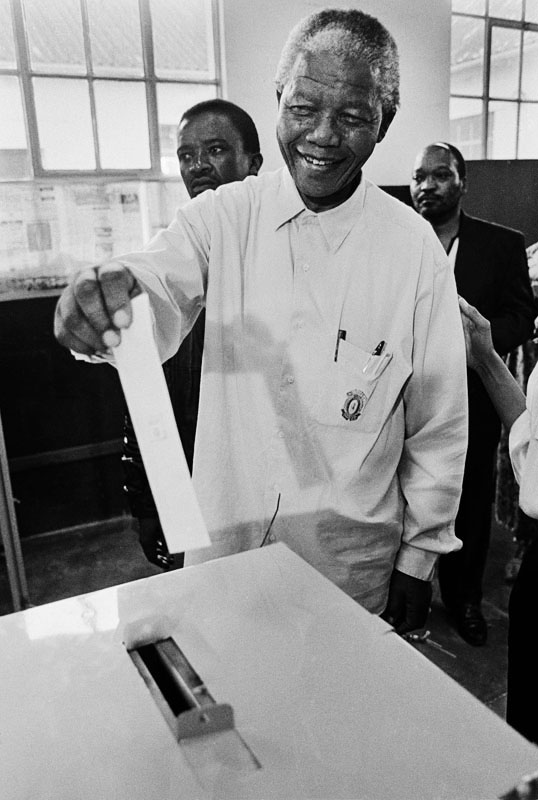
What Cde Dapo Olorunyomi unfolded in the Lecture delivered on his behalf by Mister Silas Jonathan, his staffer, (see first part of this report) is an exercise in reverse engineering in the domain of Military-Industrial-Media–Entertainment Complex (MIMEC). It is Der Derian’s reconceptualisation of what used to be the Military-Industrial Complex (MIC) following his study (as an embedded scholar) of post-Cold War American military operations and the role of media and the entertainment industry in the hands of military contractors, doctrine providers and core commanders. MIMEC is thus what, in American parlance, is Strategic Communications before Critical Security Studies became the preferred name for Strategic Studies (which itself lost centrality once security was reconceptualised from coercive power to its broadening and deepening sense at the end of the Cold War).
 It is in Olorunyomi’s domestication of all these that we find him offering something that overshoots the radius of the Steven Metzs, Chris Grays and Der Derians in critical International Relations, thereby making his an academic, ideological and professional handle at the same time. Ideologically, for instance, it is one thing to shout against imperialism all over the place but another to understand how imperialism now enacts itself under conditions of informationalised capitalism. Professionally, it speaks to what might be missing in the theory structure in a Bachelor’s Degree programme in Mass Communications, Geography, Political Science and so on in our universities, for example.
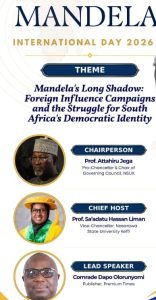
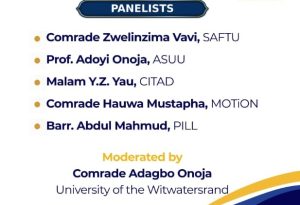
But the question in this leg of the reportage is the unpacking of the thesis of foreign influence in the explanation of Afrophobia in South Africa by the audience at the Mandela International Day last Saturday at Nasarawa State University, Keffi. That audience consisted of a panel of six (four-in-person and two online), the academics and students, many of whom raised interesting questions. It was an interesting panel in that while none disrupted the foreign influence thesis, none failed to insist on adding the domestic peg, particularly the ANC for blame.
For instance, Zwelinzima Vavi, the General Secretary of the South African Federation of Trade Unions (SAFTU) is a player in the mobilisation of the counter-marches. As a panelist and as someone on the ground there in South Africa, he was asked how the foreign influence thesis sits with him. Vavi responded with a long treatise in which he started with a quote from a February 25th, 1995 speech by Mandela in Alexandria viz
It saddens and angers me to see the rising hatred of foreigners. We had a legacy of unity and solidarity here. This great legacy has been undermined by recent attacks on foreigners, some of whom are naturalised citizens. We cannot blame other people for our troubles. We are not victims of the influx of foreign people into South Africa. We must remember that it was mainly due to the aggressive and hostile policies of the apartheid regime that the economic development of our neighbours was undermined. As a result, today they are unable to provide jobs to their own citizens. No one should blame these people for coming to South Africa. Let us never forget that many African countries accepted our people when they were exiles. They shared their limited resources and educated many of our children. They gave us food and shelter when we had nowhere else to go.”
Reading this as Mandela’s warning yesterday against what we are seeing today, Vavi went on to put the blame on failure of successive governments to manage democracy, asserting how wrong headed it is to seek solution in Afrophobia. “When the state fails to fulfil this responsibility, uncertainty grows, rumours replace facts, fear replaces confidence, and migrants themselves become more vulnerable to criminal syndicates and abuse”, he extends the argument before coming to agreement with the foreign influence thesis in an equally very interesting way.
 Characterising Afrophobia and xenophobia in South Africa as genres of a wider international trend, Vavi notes the resurgence of right-wing nationalism, racism, anti-immigrant politics and attacks on democratic institutions as currents which have been encouraged, financed and amplified by powerful political and economic interests that profit from fear, division and hatred. The world, he said, has paid a heavy price but he is hopeful that that the networks, organisations and institutions that have invested so heavily in promoting xenophobic and exclusionary politics across the world will gradually lose both their influence and their appeal.
The task before democrats, trade unionists, progressives and all defenders of human dignity is to ensure that the politics of hatred, division and xenophobia do not outlive the leaders who have popularised them, he says, concluding with a call for rejection of “tribalism, racism and every ideology that seeks to divide the African working class” because, as Nelson Mandela believed, “hatred is not part of our nature”
Cde Hauwa Mustapha, the gender face of the panel, did not differ from this track. Without contesting foreign influence argument, she asserts the case for recognition of diverse gender troubles for the South African woman, reeling out incredible rape statistics in Mandela’s country even with the end of apartheid. She also mentions the formal approval for LGBT practices in South Africa, about the only one to do so on a continent which has so far resisted multiple sexual practices.
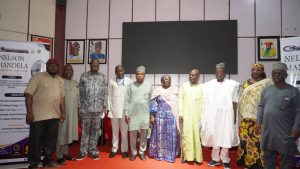
(L-R) Cde Loko (ASUU Chair, NSUK), Cde Odah, Cde Abdul Mahmud (panelist), Dr. Garuba (CDD Director), Cde Hauwa Mustapha (panelist), Adagbo Onoja (moderator of panel), Cde Thomas Ogiri Ari who represented Prof Attahiru Jega as Chair of occasion, Farida Salihu-Lukman (CDD & MC) and Prof. Lagi (NSUK).
Comrade Abdul Mahmud, the panelist who heaped the most blame on the ANC was also the one who advanced the analytically exciting contention that ANC’s most spectacular failure is failure to develop what Gramsci would call the ‘collective will’ that would have acted as a binder against xenophobic temptation as well as foreign influence. In saying so, he immediately rolls on the same coach with Olorunyomi who, as we saw in part one of this report earlier, argues that Mandela did not hand South Africa a finished democracy but an argument, something that should have been going on vigorously on WhatsApp groups, in algorithmic feeds, in the quiet funding trails behind seemingly local voices regarding “who gets to belong, who gets to speak, and who gets to be believed”. Both Olorunyomi and Mahmud would be right if they generalise this contention for nearly all of Africa. Nigeria that should set the example once bowed to commandism by submitting to the idea of ‘no go areas’. Today, the country itself is a ‘no go area’. But Mahmud is also right to hit the ANC in this respect, given the relative quality of the instruments of hegemonic articulation, particularly the universities and the media. The paradox of Cde Mahmud’s contribution is his complete agreement with Olorunyomi at the paradigm level even as Mahmud distances himself from the foreign influence analogy. Might CDD want to call a ‘reconciliation’ session in view of the needed ideological updating?
Prof Adoyi Onoja, the ASUU representative on the panel introduced an adjectival dimension against the ANC in his own take on Olorunyomi’s foreign influence submission. For him, the ANC could have blocked what is happening today if it did not choose to take the side of wealthy, wild, wheeler-dealers. For this reason, he sees the problem with South Africa as coming from within, specifically a failure of successors. And he would have been less pained if much of what are happening today had not been foreseen by Mandela. Prof Adoyi was probably the only one who did not make any concession to the foreign influence thesis. It must be that the Historian in Adoyi would not let him forgive those who, like the ANC, did not, as it were, learn from history.
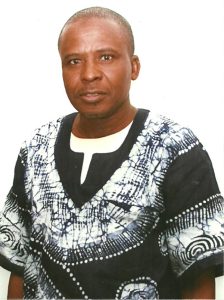
Mallam Y. Z Yáu (panelist but online)
Surprisingly, Mallam Y.Z. Y’au, the last to speak as a panelist, did not differ significantly from fellow panelists although the Junior Aminu Kano streak was there. It had been intended that he would set the ball rolling, being he a former academic and an information technology czar. Unfortunately, he was not available to do that. The question he was asked is how best might Africa confront foreign influence from the benefit of his knowledge of the technological dimension of it.
Prefacing his answer, YZ argues that the starting point is to acknowledge that blacks in South Africa had expectations but that apartheid has, so far, been no more than successfully dismantling the governance issues without, however, doing the same to economic apartheid. In other words, there is still the problem of poverty, the poor, the unemployed, healthcare delivery challenges for this category and so on. If we are going to confront what is happening in South Africa, we have to speak to a movement that unites people behind a common agenda”, said Mallam. But then, says he, this this is not an easy thing to do, partly because there are forces that are determined to entrench the existing order in addition to forces internal to the South African polity with capacity to manifest themselves especially when elections are at hand.
Done with the preface, Mallam offers the standpoint analysis that there are forces that activate trends that are invisible to the ordinary blackman. That was his language for agreeing with the foreign influence explanatory model. In his own language, there are forces with capacity to instigate saturation that can become the reality to which blacks can dance to without knowing it. But he quickly adds the qualifier that it is only when the ANC is concerned with fighting economic apartheid that Africans can turn attention to foreign attention. And he adds the corrective that when Africans fought apartheid, it was on the basis that apartheid was an assault on black dignity, not something for which South Africans should be expressing gratitude to fellow Africans. He is, therefore, cautioning against that tendency to expect South Africans to be grateful to the rest of the continent at every turn.
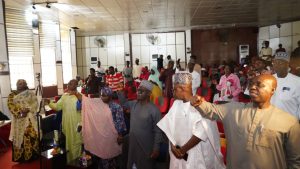
Back to the audience which sang ‘Solidarity’ at the beginning
Done with the panelists, the audience now had the floor. Intervention might have to correct some of the names below as they may not be the correct spellings. Dr Theophilus Lagi, an academic, wanted to know what the situation in South Africa would have been now if a radical restructuring rather than a Truth and Reconciliation process took place in 1994. He sees no difference between what is happening in South Africa and the situation in Nigeria. both are in crisis because the economy is in the hands of a minority. Dr Jibrin Danladi Adamu, an ASUU official asks if Nigerians let the South Africans know how much they collectively spent on the struggle against apartheid. Relying on Google, he puts the figure at 61billion US dollars. He suggests anger against our South African brothers for not being appreciative enough. Mr Obida, a graduate student is not sure how he would relate to South Africa. Is it the system or democracy that has gone astray in South Africa? A fellow graduate student, Onah Edoka Samuel from History asks what lessons Nigeria is learning from what is happening in South Africa. His question is an attack on the ‘big brother’ syndrome in Nigerian foreign policy. Comrade Olatunji, another academic and local ASUU official wonder what would stop other African countries from doing exactly what black South Africans are doing – brutalising other Africans. Dr. Usman Usman opines, more or less how the conflict in South Africa has an economic character while a lady student with the surname Ibrahim (from Political Science) asked a question Intervention did not get very clear. She seems to want to know if foreign influence is more threatening than corruption, polarisation, xenophobia and poor governance. If this was her question, then it is an enigmatic one from among the students. Musa Suleiman asked a question that was lost to this notetaker. Mr. Onyebuchi who introduced himself as a journalist shifts the focus to interrogation of the role of the Nigerian High Commission in South Africa vis-à-vis documenting Nigeria’s contributions to the struggle to dismantle apartheid.
The questions from the audience completed the interactive stretch. The diverse angles the questions brought into the Mandela International Day in general and the topic in particular points, at one level, the stuff NSUK is made of. Olorunyomi’s thesis was well received but also subjected to a lot of interrogation by its first audience and first hearing. To the extent that universities are about questions much less than answers, the questions show a sign of a potentially great campus.
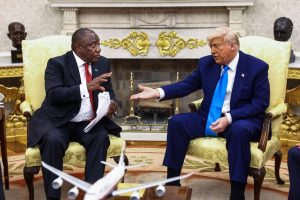
Could this be the earlier version of foreign influence that didn’t fly?
Meaning, we are told, is in what is unsaid. May be, what is unsaid in Olorunyomi’s thesis is that the African country which managed to become a founding member of the BRICS, participates in joint military exercises with great powers (China and Russia), took Israel to The Hague and, above all, assumed the presidency of the G-20 should expect foreign influence on its doors. Nigeria tried it with an ECOMOG operation in which a Third World military acquitted itself in containing an ethnic army to the envy of great powers but where is Nigeria today? Total disarray, enemy images, aggravated politics of difference and so on.
Unfortunately, the use of anthropological information for destabilisation campaign is not what most Africans have come to grips with. As far as Intervention can recall, awareness of that is not part of what comes up in the voices that predominate on local television interviews or what column writers glorify. What pops up more are homogenising concepts and simplistic answers based on unchanging ethnic, regional and religious categories that give credibility to the dark, stagnant Africa propaganda. This was the point Cde Akhator Joe Odigie, the Gen Secretary of the International Trade Union Confederation – Africa Region (ITUC-Africa) implied in asserting that continental unity is at crossroads and that Africa must begin to redefine by looking beyond xenophobia by coming together to build an industrialised Africa. It can hardly be better said.
Flashback to where CDD started the 2026 Mandela International Day from at a primary school in rural Abuja
There is the mystery to it that many African intellectuals in newspapers, universities and think tanks, to mention a few, cannot go beyond the religious and ethno-regional categories even when they can see how these categories are manufactured. In Zimbabwe, for example, ethnicity came to the fore when investments in state interventions were aborted and replaced with SAP. The potential beneficiaries of those interventions were the ones demonstrating in urban centres against the government. That is exactly what is happening in South Africa following the abortion of the original transformation document of the ANC and its replacement with a SAP document by foreign influence. In that sense, Dr Yusuf Bangura is right to suggest that Thabo Mbeki may need to ‘kool temper’ on the current crisis because he presided over the abortion, preferring to listen to Tony Blair and his ‘New Left’ vibes. In other words, foreign influence has never been far from the struggle for democratic identity in South Africa.
CDD Director, Dr Dauda Garba, summed up everything very well by calling it all a conversation. Conversations do not end. And no positions, he says, is wrong or right in it. That is why it is called a conversation. He is right and should be happy because reports from the 2026 Mandela International Day in New York (where Zohran Mamdani, Mayor of New York and a potential Mandela, spoke) and South Africa show the CDD outing to be comparatively in top form in terms of the quality of the conversation as well as the scale. Setting the agenda is what leadership is all about.













)