

By Adagbo Onoja
The current edition of the Centre for World University Ranking (CWUR) named South Africa’s University of the Witwatersrand (aka Wits) in Johannesburg as the number one university in Africa. And Wits proceeds to exemplify its pedigree in excellence by naming Prof Achille Mbembe as evidence of the caliber of its stock of scholars from its Humanities, for instance.
Said the university: “Our Faculty Rank of 87 further underscores the strength and distinction of our academic community who impact on society. Our researchers are at the forefront of tackling viruses and pandemics, leading AI initiatives, quantum computing and quantum technologies, and shaping global conversations on climate change and inequality, amongst other areas of impact. Our humanities scholars are of the highest caliber- take Prof. Achille Mbembe for example, who is a Holberg Prize Laureate, which is the equivalent of the Nobel Prize for the Humanities.”
 In a world which runs on symbolism, this matters a lot, not only to Prof Mbembe or Wits but also for Africa. It does because it speaks to the primacy of voice and power in the continent’s struggle for emancipation. For, in a world which runs on symbolism, those who can convert data to signs (as Mbembe would say) or build an ‘empire of signs’ will determine the direction/outcome of the hegemonic tussle between and among all manner of contenders. Because an ‘empire of signs’ is the condition of possibility for the hegemonic formation that has replaced the ‘mode of production’ in the structuration of reality to produce outcomes.
In that context, Wits is involved in opening an angle to public service in specifically naming Prof Mbembe, irrespective of the university’s intention in doing so. The specification can only be a text which the rest of Africa can interpret along the logic of hermeneutics. Interestingly, Wits’ move is coming at a time President John Mahama of Ghana has recorded successes in counter-geopolitics manoeuvres at the UN, much more than the stunning UN framing of the transatlantic slave trade as a crime against humanity.
How great it would be if African leaders would, in addition to assigning Mahama to the anti-slavery campaign, strengthen its narrative warfare by falling back on a selection of its top universities/research institutes/think tanks, the most promising civil society institutions, big name individuals, media houses and other players in the discursive space in this direction. It is not a case of searching for angels but taking from each what s/he has got so that Africa can hegemonise its self-understanding for once rather than waiting for benevolent hegemons.
It should now be clear that neither over-abundance of natural resources nor structural constitution can take Africa to the Promised Land outside of the discursive condition of emergence for that. A continent with Africa’s stock of the Mbembes, a good number of Nobel laureates, powerful literary establishment, some far-from compromised former leaders, rising global universities, an emergent ‘industrial bourgeoisie’ and sundry activists, amongst others, has no business being what it still is.
As the Idoma people in central Nigeria would say, it is a paradox for a man with well-located children to fall prey to the lion. In other words, how can a continent with powerful resource persons allover be what it is today?
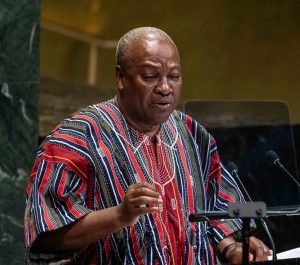
President Mahama of Ghana re-arranging power relations through discourse!
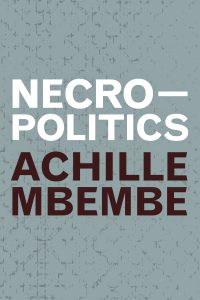
Since we are talking of Prof Achille, it may be proper to demonstrate this, using him. His profile by the European Graduate School from whose webpage the cover picture of this feature was extracted is considered adequate, though dated. Most readers will find Mbembe’s concept of necropolitics a good fit applicable to their reality in many African countries today. It goes like this:
Professor Achille Mbembe (b. 1957) is a philosopher, political scientist, and public intellectual. He obtained his doctoral degree at the Université Paris 1 (Panthéon-Sorbonne) in 1989 and subsequently obtained the D.E.A. in Political Science at the Institut d’études politiques, Paris. During his time in France, Jean-Marc Ela, Jean Leca and Jean-François Bayart had a profound influence on him. Mbembe is a Research Professor of History and Politics at the Wits Institute for Social and Economic Research in Johannesburg, South Africa and a Visiting Professor in the Department of Romance Studies at the Franklin Humanities Institute, Duke University. He has also held appointments at Columbia University, Berkeley, Yale University, and the University of California. In the spring of 2016, he will be a visiting professor at Harvard University.
Achille Mbembe’s research interests lie in the social sciences and African history and politics. More precisely, Mbembe investigates the “postcolony” that comes after decolonization. He is especially interested in the emergence of “Afro-cosmopolitan culture,” together with the artistic practices that are associated with it. However, he has also critically explored the notion of Johannesburg as a metropolitan city and the work of Frantz Fanon.
Mbembe’s most important works are: Les jeunes et l’ordre politique en Afrique noire (1985); La naissance du maquis dans le Sud-Cameroun (1920-1960); Histoire des usages de la raison en colonie (1996); De la postcolonie. Essai sur l’imagination politique dans l’Afrique contemporaine (2000); Sortir de la grande nuit : Essai sur l’Afrique décolonisée (2003); Critique de la raison nègre (2013). His seminal work De la postcolonie. Essai sur l’imagination politique dans l’Afrique contemporaine (On the Postcolony) was translated into English in 2001 and published by the University of California Press. This work has also been republished in an African edition by Wits University Press, and contains a new preface by Achille Mbembe.
In On the Postcolony, Mbembe attempts to renew and reinterpret our understanding of power and subjectivity in contemporary Africa and to subvert some key assumptions of postcolonial theory. He claims that Africa is no longer the “colony” that Frantz Fanon described in his work Wretched of the Earth.
 The central gesture of Mbembe’s work is to identify societies that recently emerged from the experience of colonization and the violence that is the main characteristic of this experience. The goal of his work is to change the perception of Africa and to move away from the dead-end of postcolonial theory to a more dynamic way of thinking that will take into account the complexities of post-colonial Africa.
In his interview with the French magazine Esprit, Achille Mbembe describes his book in the following way: “In many respects my book adopts a different approach from that of most postcolonial thinking, if only over the privileged position accorded by the latter to questions of identity and difference, and over the central role that the theme of resistance plays in it. There is a difference, to my mind, between thinking about the “postcolony” and “postcolonial” thought. The question running through my book is this: “What is ‘today’, and what are we, today?” What are the lines of fragility, the lines of precariousness, the fissures in contemporary African life? And, possibly, how could what is be no more, how could it give birth to something else? And so, if you like, it’s a way of reflecting on the fractures, on what remains of the promise of life when the enemy is no longer the colonist in a strict sense, but the “brother”? So the book is a critique of the African discourse on community and brotherhood.”
Mbembe is also a contributing editor of the journal, Public Culture, where he published the influential article “Necropolitics” (2003). In this article, he argues that the concept of biopower, as Foucault understands it, becomes incapable of addressing the contemporary forms of domination, subjugation, and violence. According to Foucault, biopower refers to the sovereign exercise of the power to determine who will live and die. The essential feature of biopower is its inherent racism because it aims to establish boundaries and divides people into categories and subcategories.
In “Necropolitics”, Mbembe examines sovereign exercise in cases where “the generalized instrumentalization of human existence and the material destruction of human bodies and populations is the central project of power, rather than autonomy.” Since we no longer inhabit the world where regimes govern bodies through the inscription of disciplinary technologies, necropower and necropolitics are presented as alternatives to biopower and biopolitics. This happens because, according to Mbembe: “Today, in many instances, the commandment (of disciplinary power) has been replaced by a new form of sovereign power: ‘necropower’.
Why necropower? Well, because the ultimate site of deployment of this new form of sovereignty is no longer the body as such, but the dead body of the ‘civilian’. Necropower is wielded both by states and by what, following Deleuze and Guattari, we should call ‘war machines’. War machines are made up of segments of armed men that split up, merge and superimpose each other depending on the circumstances.
Polymorphous and diffuse organizations, war machines are characterized by their capacity for metamorphosis. They combine a plurality of functions and operate through capture, looting and predation.” Discussing the examples of Palestine, Africa, and Kosovo, Mbembe shows how the power of sovereignty now becomes enacted through the creation of zones of death where death becomes the ultimate exercise of domination and the primary form of resistance.













1 Comments
Kisah Sukses
Why does Mbembe argue that Foucault’s concept of biopower is insufficient to explain contemporary forms of domination, subjugation, and violence?