By Adagbo Onoja
The 85th birthday and book presentation in honour of pioneer president of the Nigeria Labour Congress, (NLC), Comrade Hassan Summonu has come and gone with its many sides. All the sides point to a great event. What is great about it will depend on the individual as the event cannot have a same significance for every one there.
While some people there might have been happy or sad to hear former president disclose how great power intelligence services tried to husband the national labour movement, others would have left wondering how it went from routine infiltration of radical platforms to where the economy, culture and just about any other realms have been taken over, no more by secret services but openly through conditionalities, dictation, charity, domestic elite crassness and what have we?

Prof Asobie is 3rd from left at a previous Abuja function
Under this condition, it was, indeed, great for many to see Dr Dipo Fashina and Prof Asisi Asobie. It is simply because they were among the best of the best and brightest, in character and learning. We are not talking of stage managed or fabricated authenticity common all over the place today.
They have not been regular faces of recent. There is nothing saddening about that. They have shaken this country at one point or another in a style unique to them. Dipo, for example, is the unproclaimed best classroom teacher in this country as a Philosophy lecturer at Obafemi Awolowo University, Ile-Ife. He studied Philosophy in the best places and combination most advisable then: in the old Soviet Union and then the United States. By the time he returned to the country, his training in Logics (the formal type of logics) made him the sort of people who should have been handling Nigeria’s nuclear deterrence praxis. Interestingly, it was also when Ali Mazrui and Prof Bolaji Akinyemi were advancing the case for Nigeria’s nuclear arming.
Dipo settled down to academia, with hundreds passing through his hands by the time he retired from formal academia without blemish of any type. He was the activist’s activist, culminating in his leadership of the Academic Staff Union of Universities (ASUU) and being at the centre of controversy that it entailed.
At one point, an ASUU national strike had lasted more than six months or so and public opinion had turned against the union. The NTA hauled Dr Dipo, then ASUU president before its national audience of 30 million viewers (there is no knowing how many it is now). Your union is becoming a problem holding the nation to ransom, how do you justify that, the interviewers confronted Dipo. First, universities closing for over six months does not happen only due to an ASUU strike, said Dipo. There have been national emergencies during which universities have remained closed. He cited the June 12 paralysis. What the journalists should focus on is, under what condition(s) could the system be shut down and how can such situations be anticipated and averted. That was the end of the interview, a defeat for singularity. It is unlikely that his interviewers knew they were interviewing a specialist in formal logics. He was not an apologist in his academia. Just one of his journal articles proves that: Frantz Fanon and the Ethical Justification of Anti-Colonial Violence” a 1989 outing.

For example!
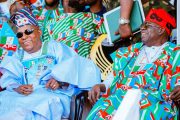
Unlike Dr Dipo who was picked by one of the photographers at the Hassan Summonu event when Cde John Odah, OTUWA Executive Secretary went to greet him, there are no pictures of Prof Asisi Asobie from the event.
Prof Asobie handed ASUU leadership to Dr Dipo. He was based at the Department of Political Science, University of Nigeria, Nsukka. He went there after tasting the discipline of International Relations at the London School of International Relations in the UK. Whatever it is, LSE certainly has the best structured International Relations in the world, subject though to the fact that it is teachers, not course outlines, who make the difference.
Prof Asobie was not a friend of anemic scholarship. The policy shots in his papers are always clear even as ideologically committed as they ever were. What made him stand out is his ethical standards. It is not common to find someone with radical commitments who maintain his ethical standards and public spiritedness. The pragmatism required to push through radical political commitments makes ethics outside that orbit difficult if not impossible. It may be very revealing to find out the kind of preparations in life that accounts for Asobie’s exceptionalism here.
Prof Asobie was ASUU president around 1995. Bayero University, Kano was a central site of ASUU politics during the time. Prof Attahiru Jega who handed over to Asobie came from BUK. Mallam M. T Liman, the Minister of Education under Abacha then came from BUK. One of the three closest philosophers to Mallam Aminu Kano, the minister had, however, taken a decidedly anti-union position to the surprise of those who knew as Mallam Aminu Kano three dependable aides, historically: the anti-Apartheid activist, Prof Dandatti Abdulkadir, former VC of BUK who became Nigeria’s Ambassador to Libya under Obasanjo; the trade union activist, Prof Ahmadu Jalingo and M T Liman. The local ASUU chapter in BUK was militant at the level of the leadership but the membership was divided between those who bought the idea that the strike was a June 12 project and those who were for it. Things were worse for a set of us who were scheduled to graduate that year. BUK was the secretariat for NANs, meaning the president and Secretary-General were all students in BUK. It turned out that both of Naseer Kura and myself were in Political Science. The NANS in BUK was controlled by a cohort in Political Science and Sociology. We wanted to graduate but we were also the enforcers of the strike. We were not academics but the cohort could make it impossible for any lecturer we didn’t want to teach. Usually, it was academically weak academics who were threatened to teach and thereby break strike. But it was those ones our cohort could easily subvert with a set of practices we had mastered and which they couldn’t handle.
It was in that tension that this reporter sat down one morning with Prof Asobie in the house of the local ASUU Chairman, the equally legendary MM Yusif. I was interviewing Asobie on a wide range of issues. The interview was eventually published by Community, the quarterly outreach of the defunct Community Action for Popular Action (CAPP) when I became the pioneer editor straight from the campus.
It was at the interview that the depth of Asobie’s concern with the collapse of knowledge came out. He stated categorically that he wasn’t going to last in academia because he couldn’t cope with the new creatures on campus. The new creatures who saw serious lecturers such as Asobie as wasting their time. Don’t worry, just give us the marks and let us go or words to that effect seems to be the emergent chorus. But Asobie couldn’t do that. What is the logic here: the crisis of standards today didn’t start today. It started many years ago.
If you ask Prof Jibrin Ibrahim, for example, he would say it is substantially due to massification. As nobody has interrogated that argument yet, not much can be said about its validity or otherwise in the explanation of the rottenness which the system is hiding by resorting to singularism: oh, one of our lecturers, if it is one of their students, has won an award or a grant or something like that when that should be a very routine thing for a relatively huge country such as Nigeria
Many must have felt great to see their role models again at a major gathering of the tribe!