As politicians consciously and unconsciously caress violent ruptures in Nigeria by the reality they constitute through what they say, it is perhaps the most important thing to get to grips w... Read more

It was a meta-babble of some sort today as top flight professors, Heads of Departments of Mass Communication, legal practitioners, diverse activists and funders ignited an attempt at arrivin... Read more

President Muhammadu Buhari of Nigeria has filled and submitted his application form for the presidential ticket of the All Progressives Congress, (APC). Under normal circumstances, that very... Read more

The murmuring against committing the huge sum of N242 Billion to conducting the 2019 General Elections in Nigeria has, at last, gotten the ears of the civil society in the country. A coaliti... Read more
Academia has a new entrant. Throughout this piece, the said entrant would be known and called Dr. Olu. No disrespect is intended in this naming system. It is for simplicity. It is avoidance... Read more

Nigerian youths seeking expansion of the scope of meaningful participation in politics have been told to learn from how their counterparts in Kenya went about it although there is still controversy on the meaning of youth participation. Is it for the youths to take over and enjoy the perquisites of office the way incumbents are doing or is it to take over and transform the Nigerian society? Notwithstanding the inconclusive debate for now, the argument is that the pathway to deepening youth participation is for Nigerian youths to organise and assert themselves electorally the same way their Kenyan counterparts have gone about it.
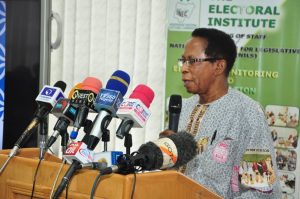
Prof Asobie delivering his lecture
Although a senior Nigerian politician at the occasion described the suggestion as exciting but inciting, Professor Humphrey Asisi Asobie, notable Political Scientist, former National President of the Academic Staff Union of Universities, (ASUU) and Guest Lecturer at The Electoral Institute, (TEI)’s First Abubakar Momoh Memorial lecture who is pushing this idea says that is why there are now Kenyan youths of 19, 24, 26 years who have been elected into parliament and other elective offices. But the model unfolded at the lecture attended by nearly a dozen high officials of Nigeria’s election management body – Independent National Electoral Commission, (INEC), diplomats, academics, civil society leaders, leaders of political parties, women and youth leaders as well as the late Prof Abubakar Momoh’s family, particularly his widow, came with a qualification: the youths cannot accomplish this alone, they need to align with platforms such as the Nigeria Labour Congress, (NLC).
Indirectly saying that the Nigerian State is so alienated and alienating, Asobie declared how low participation generally is in Nigeria and specifically the youths, a low scale participation he blames the Nigerian Constitution for sanctifying by its provisions which set the age for most of the crucial offices such as that of the president, governors and senators at youth exclusionary ages of figures of 35 and above when no upper ceiling exists for the oldies.
Prof Asobie said it is not a question of homogenising youth agency because he accepted that the youths have also been incorporated into the representation and practices of the power elite, especially the construction of crisis in ethno-religious terms by ethic warlords. It is in realisation of this that he said he qualified his idea of youths as those ideologically clear and can think of politics in terms of rapid social transformation.
Challenging the youths to reckon with democracy as “what you do for yourself, not what somebody does for you”, Asobie said youth exclusion in Nigeria is scandalous, ridiculous and undemocratic, adding that Nigerian youths are actually subjects, not citizens, deriding the impossibility of talking about democracy when youth participation is that low.
Arguing how youth participation in itself is functional to democracy, he concluded how important it is to say that youths cannot wait endlessly. They have got to use their numerical strength and alliance to present a new pattern of politics in favour of transformative rather than transactional leadership, said Asobie who asks of them to know that the majority in every society are the poor and the numerous and that, in choosing, “people who are unlike you cannot represent you. Those who should represent you are people who are like you”.
 He further argued the impossibility of youth participation without a financial level playing ground, noting how INEC could help; how the existing Constitution has provisions that could have resolved the problem. The constitution provides leeway by providing for a manner of managing the economy such that existing inequality level would not have arisen. Additionally, “If you take Section 16 and provide education, it would amount to youth empowerment because there is a positive correlation between high achievement in education and consciousness”.
The Guest Lecturer warned against how what he said has happened in China could happen here in which youths moved away from seeking participation into new technology in contrast to Norway where a much more organised response to youth participation produced a more participation-inducing system and outcome.
This is, however, not what he is expecting in Nigeria because Nigeria is in the category of a pseudo-democracy, notwithstanding a better election in 2015, recalling how late President Umaru Musa Yar’Adua was honest enough to admit this much in a documented manner.
Prof Asobie identified the state and social order context of youth participation in Nigeria in the fragmented, incoherent and very fragile state with which there is clearly something structurally wrong. Incoherence, insecurity and instability all go to show that something is wrong beyond just any particular regime even as he did not award the incumbent a pass mark, saying governance is very low. Nigeria had made some progress on her fragility status, it is still next to the worst in categorisation, said Asobie who put his fingers on what is wrong with the Nigerian State in the emphasis on sharing rather than production. “The state is a problem in itself”, he said, adding how the social order context of the Nigerian State is such that the leaders do not feel obliged beyond projectisation. The gap between the rich and the poor is also a point in this.

Prince Tony Momoh making his point
Prince Tony Momoh, a former Minister for Information and chieftain of Nigeria’s ruling party – All Progressives Congress, (APC) as well as a relation of late Prof Abubakar Momoh did not accept everything Prof Asobie said, arguing that the problem is that the Nigerian Constitution had privileged democracy over and above development. He called for decongestion of the political space because “we are spending much money on democracy”. He was basically saying that the Constitution put the rights to enjoy in Chapter 4 ahead of the duties to perform in Chapter 2, a contribution Professor Okey Ibeanu, another Political Scientist and an INEC Director who chaired the occasion subsequently framed as the “democracy – development’ debate in African politics. But, when given the floor again, Prof Asobie to whom the question was directed said it was not enough to say that democracy promotes development. For him, it is more important to ask what sort of democracy and what manner of development. He put it to the circumstance, saying Lee Kuan Yew of Singapore has been rated as such a success story in autocracy promoting development but that he worked with communists, itself a potential controversy.
Prof Ibeanu put some laughter to the conversation when he distinguished between a dead and a living constitution. One is the letter, the other is the practice of it. Those who wrote the Nigerian Constitution, said Ibeanu, “took everything that is important about our existence and put in Chapter 2 but tied it down with the justiciability/non-justiciability provisions. But, according to him, Section 14 of the Constitution is actually the basis on which Nigeria should be organised and that is Social Justice. For him, the point, however, is not whether the Constitution provides but the politics of enforcing certain provisions.
Another contestation came from Mohammed Baki Lecky, an INEC Resident Commissioner who did not accept a distinction between transformative and transactional leader, preferring to see a continuum there. Arguing that some of the points about youth participation were overstated, the REC maintained how youths do not necessarily have to be local government chairmen, governors or ministers in order to change things. They could do so using their votes to change things around. His worry is rather about the ideological level of Nigerian youths.

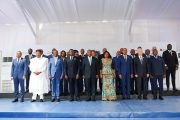
A group photograph which captured most of the attendees
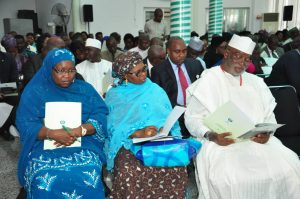
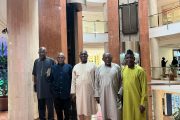
Another line of attendees
Prof Anthonia Okoo-Simbene, another INEC top official who responded to a question posed in her schedule of duty told the gathering howINEC cannot do anything about whether aspirants should pay or not pay for nomination forms that political parties ask for. What INEC can do is in respect of monitoring party expenditure. That is provided for, she said, but even then parties submit such statements sometimes three years after an election.
Professor Okey Ibeanu, the Chairman of the occasion had sort of wetted appetite of attendees at the memorial at the beginning of the occasion by relating what the man who delivered a homily at the 7th day prayer for Prof Momoh said. The man said a dead man’s grave is not the most important thing because many would no longer even be able to find it after some time. What is more important is the number of graves a person made in the heart and minds of other people and which makes life a question of how many graves one dug in others. Or, what impact did one make on the life of others! Abubakar Momoh’s life, he said, was in the graves he dug in the minds of many people, from CODESRIA in Dakar to the lecture halls of King’s College London to the slums of Lagos. “Momoh would have been very happy with the prospects of youth participation”, he maintained but that is participation beyond the statistical sense. Rather, participation in transformative, progressive sense, he said. He was sure Prof Asobie under whom the late Momoh served ASUU as treasurer was best placed to deliver the first of the memorial lectures, an event they in INEC hope to keep alive.
Dr Sa’ad Umar Idris, Acting DG of TEI had taken basically the same position earlier in his welcome address by saying youth participation was one of Professor Momoh’s best themes and on which he researched and wrote.

In a major move reminiscent or replicating of spreading the fields of contestation that marks its global counterpart, the civil society in Nigeria is massing up against what it sees as threa... Read more

So simple, yet so profound is the principle of Recall which allows the voters to withdraw their representative at anytime they discover that he or she no longer serves their interest or the... Read more

The recall of a Senator from the upper chamber of the Nigerian legislature by his constituency has failed. Senator Dino Melaye representing Kogi West Senatorial District in central Nigeria c... Read more
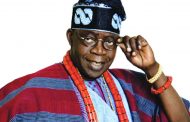
Africa Confidential is a staple of the elite in Nigeria. In this April 6th, 2018 piece titled “Nigeria: Return of the Jagaban”, the magazine offers its own flavour to the struggle for power... Read more