It was an Inaugural Lecture, a key rite of the university system. As the first of it to be delivered under its new Vice-Chancellor, Prof Suleiman Bala Mohammed, and the first too in the year... Read more
It was one of the questions Intervention tried to deal with very early in its formation. The puzzle is why more conflict and violence in Nigeria at a time there are more universities and think tanks dealing with formal study of peace and peace politics? The question came about following what was clearly a massive expansion in opportunities for formal study of Peace and Conflict in Nigeria, something that was available in scattered forms in International Relations, Sociology, Psychology, Political Science, Geopolitics, Linguistics and Religious Studies.
Whereas by 2003/4, it was just the University of Ibadan programme in Peace and Conflict Studies and the same university’s Centre for Peace and Conflict Studies, (CEPACS) as well as Programme on Ethnic and Federal Studies, (PEFS), there were over 20 universities, INGOs, independent think tanks and sundry centres offering one programme or another in Peace Studies by 2016. The correlation should be very clear and if that is not the case, then the question must be posed regarding what might be the intervening variable between the reality of more such centres without corresponding decrease in the quantum of violent intra and inter-group conflicts. Intervention interviewed academics and other stakeholders across the country in a two-part narrative. Each gave his or her own analyses, (See “Nigeria: Why the More Conflict Management Training, the More Conflict, Sept 5 & 6th, 2016/www.intervention.ng).

Pioneer Peace and Conflict Studies centre in the Nigerian university system
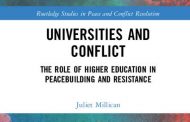
An expert from the Peace and Conflict programme at Ibadan who assessed the story post publication, however, interrogated the assumption entirely. He said the expansion under reference was overblown because many of the centres and Peace Studies programmes lacked the staff strength and the vibrancy to warrant a claim of lack of correlation between expansion in the number of study centres and decrease in (violent) conflicts. That was 2016. Now, this is 2018 and there is a book trying to account for the relationship between universities and conflict.
It is an interesting book because, for one, it has analysis from across different parts of the world – Middle East, Asia, Europe and Africa. It may not score an ‘A’ in inclusivity because there is just a chapter from (South) Africa, it is an improvement when compared to other such efforts.
Two, it basically agrees with the notion of universities as conflict managers in their own right because they are theatres of discourses of conflict, discourses which are reproductive of peace as well as conflict, depending on what the discourses are and how students of these discourses operationalise them.
The newness of this research agenda means that most readers would find the introductory chapter and Chapter Three interesting. Chapter Three is where Dr Sansom Milton of the Centre for Conflict and Humanitarian Studies at the Qatar based Doha Institute for graduate Studies reviewed the literature on universities and conflict. Those who are, however, more interested in practical issues might find the case studies chapters (4 – 11) more inviting. The case studies in university – conflict nexus cover some of the hottest conflict spaces or universities concerned with the discipline: Israel/Occupied Territory, Myanmar, Belfast, Bradford, Bosnia and Herzegovina, South Africa.

Dr Millican of the University of Brighton and editor of the new book
Edited by Dr Juliet Millican of the University of Brighton in the UK, this book contributes to closing the gap on scarcity of reading materials in a discipline still borrowing heavily from other disciplines and trying to resolve fundamental subject matter issues. Only last month, Professor John Gledhill of the University of Manchester published an article calling for an intellectual insurgency to put peace back into Peace Studies because much of the works in the discipline so far are concentrated on violence/war compared to peace and peacemaking. That could sound strange to students of Peace and Conflict in Nigeria, for example, given the strong distinction between Negative and Positive peace in Peace Studies on campuses across the country. However, Gledhill made his call based on a study he carried out last year with Jonathan Bright at the Oxford Internet Institute, Oxford University in which they described Peace Studies as a ‘divided discipline’ on the basis that “there is limited exchange between academic studies of war and research on peace”. It is possible because the quantum of Peace and Conflict Studies and publications coming out from Nigeria might be so minor of global percentage as for the two scholars to make their claim.
In all cases, this is an interesting time than any other to study and/or practice peace. This is simply because the world is still in the Interregnum: the old order is so discredited and going but the successor order is still nowhere to be seen, leaving not a void as such but an empty space upon which anyone could smartly write anything.

By Adagbo ONOJA The first part of this Special Report titled “Nigeria: Why the More Conflict Management Training, the More Conflicts? Part 1” featured Professor Oshita Oshita, the Director G... Read more
By Adagbo ONOJA After two insurgencies within a decade in addition to numerous scorched earth convulsions sparing none of its regions, Nigeria must be thinking of conflict management differe... Read more