Prof Hassan A. Saliu
This piece examines the diplomatic incident that followed the presentation of letters of credence to President Cyril Ramaphosa of South Africa in November 2026, during which the live transmission of the Nigerian High Commissioner’s presentation was interrupted. Drawing on deliberations within the Nigerian Society of International Affairs, the article interrogates the competing interpretations of the episode, the conduct of Nigeria’s High Commissioner, and the broader implications for Nigeria-South Africa relations. It argues that while the grievance was legitimate, its management exposed weaknesses in ambassadorial selection, training, and oversight. The article concludes with policy recommendations to strengthen Nigeria’s diplomatic practice in an era increasingly shaped by digital media and domestic political culture.
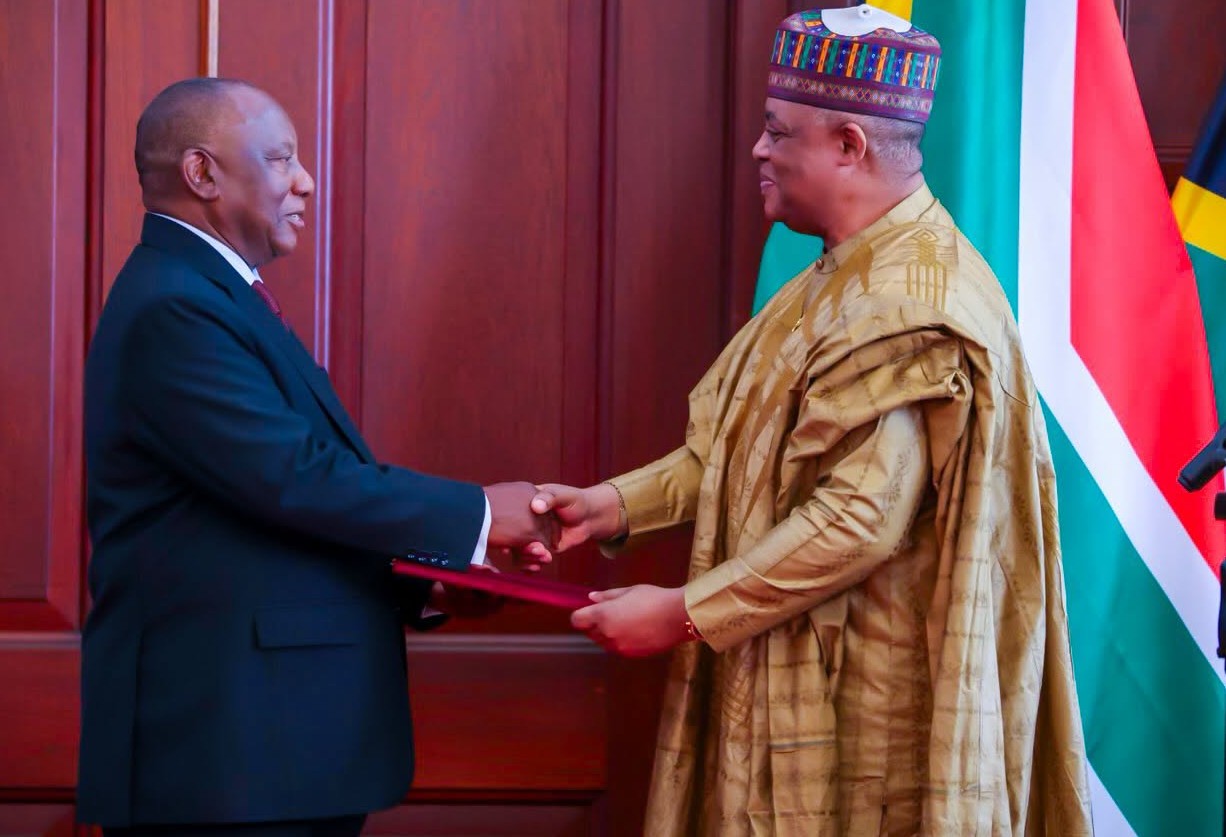
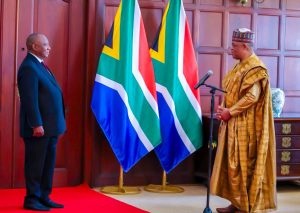
The presentation of letters of credence constitutes one of the most formal rituals in diplomatic practice. It signifies the formal acceptance of an envoy by a receiving state and affirms the continuity of bilateral relations. It is therefore unsurprising that any perceived irregularity in the ceremony attracts considerable attention. This was the case in Pretoria when the live transmission of the ceremony was interrupted at the point of Nigeria’s presentation, after thirteen other missions had been covered without incident.
The episode generated extensive debate on the platform of the Nigerian Society of International Affairs. The debate did not centre merely on the technical failure itself, but on its interpretation, the appropriate diplomatic response, and what it revealed about the state of Nigeria-South Africa relations and Nigeria’s diplomatic culture. This article systematises that debate, identifies three broad perspectives, and extracts lessons for Nigeria’s foreign policy.
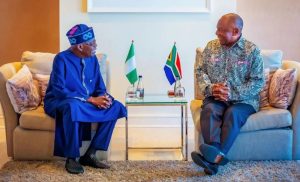
At the presidential level!
Background to the Incident
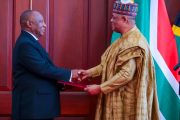
According to reports discussed on the platform, the proceedings had proceeded without interruption until it was Nigeria’s turn to present its letter. At that point, a glitch occurred in the live transmission. Nigeria’s High Commissioner designate, Femi Fani-Kayode, expressed his displeasure directly to President Ramaphosa, who promised a remedy that was subsequently implemented.
Notwithstanding the presidential intervention, the diplomat took his protest to social media. This elicited a response from a media aide in the South African presidency, couched in language which the Nigerian diplomat considered offensive. The exchange was followed by a measured reaction from Balewa House, which emphasised the primacy of diplomacy in resolving the matter, and by the South African government’s summoning of the Nigerian High Commissioner. The episode, though minor in itself, thus became a bilateral concern.
Perspectives on the Episode
Three perspectives emerged from the deliberations. The first is the nationalist perspective which held that South Africa had no justification for excluding the Nigerian session from live coverage, particularly given Nigeria’s status in Africa and its substantial contribution to the anti-apartheid struggle. From this standpoint, the High Commissioner’s reaction was legitimate, as defending Nigeria’s interests is central to his mandate.
Proponents of this view further contended that Nigeria, as a leading African State, deserves respect from other African countries, particularly South Africa. The strong objection raised by the High Commissioner was therefore interpreted as an assertion of Nigeria’s standing and a refusal to be treated with indifference.
This perspective was, however, subjected to critical interrogation. Contributors recalled instances in which South Africa had acted contrary to Nigeria’s expectations. These included Pretoria’s decision, under President Jacob Zuma, to present a South African candidate for Chairperson of the African Union Commission, contrary to the gentlemen’s agreement reached by Nigeria, Egypt, South Africa, and two other countries not to do so. The eventual election of Nkosazana Dlamini-Zuma, President Zuma’s former wife, at the expense of Nigeria’s preferred candidate, Jean Ping of Gabon, angered President Goodluck Jonathan, who threatened to review Nigeria’s African policy, although no significant review followed.
A further instance concerned the Côte d’Ivoire and Libya crises, in which South Africa marginalised Nigeria within the African Union, while its preferred positions prevailed. In the case of Côte d’Ivoire, the deployment of South African warships along the West African coast was interpreted as a demonstration of capacity and resolve. These episodes, it was argued, punctured the assumption that historical assistance would automatically guarantee deference in global affairs. This shift is also evident in Nigeria’s decision to report South Africa to the African Union over xenophobic attacks. While the decision was bold, its effectiveness would depend on sustained diplomatic engagement, particularly in West Africa, where, as the Côte d’Ivoire episode showed, solidarity is hard to sustain, and formal complaints alone yield limited results.
The second perspective, which may be termed realist, did not dispute the legitimacy of the grievance but questioned how it was articulated. It maintained that technical lapses are not uncommon in diplomatic practice and that established channels exist for registering protest.
From this standpoint, the High Commissioner should have lodged his protest with the Minister of Foreign Affairs in Pretoria or with the head of the state broadcasting organisation, rather than seeking immediate redress from the President and subsequently resorting to social media. The resort to social media was viewed as exporting Nigeria’s domestic political culture into a diplomatic environment governed by different norms.
The realist perspective further emphasised the importance of contextual understanding. A careful reading of the host environment would have revealed that while Pretoria publicly acknowledges Nigeria’s historical contributions, its practical disposition is shaped by competition for African leadership, recurring attacks on Nigerian interests, and complex domestic politics in which successive governments in Pretoria have been implicated. In such a context, the High Commissioner ought to have extended the benefit of the doubt to the host nation rather than transforming a minor technical incident into a public confrontation.
The point was not to exonerate South Africa. No contributor eulogised Pretoria’s handling of the matter. While some suspected deliberate embarrassment, the prevailing argument was that, given the uneven trajectory of Nigeria-South Africa relations, restraint and recourse to established diplomatic channels would have better served Nigeria’s interests. Although social media has acquired increased relevance in diplomacy, it has not replaced traditional diplomacy, and its injudicious use can obstruct subsequent diplomatic engagement.
The third group comprised members who offered no opinion for or against. Their silence may be interpreted as viewing the matter as a non-issue, unworthy of extensive deliberation.
 Analysis and Policy Implications
The deliberations point to broader structural issues in Nigeria’s diplomatic practice. Nine lessons are particularly salient. First, diplomacy is undergoing significant transformation. In relations marked by tension, Nigeria should deploy seasoned envoys capable of managing delicate situations without exacerbating disagreements. This is especially important in postings where historical rivalry, domestic pressures, and media scrutiny intersect. A seasoned envoy knows when to press a point, when to pause, and when to allow quiet channels work.
Second, political ambassadors require systematic training to socialise them into diplomatic norms and communication styles distinct from those of domestic politics. Political experience is valuable, but the language, timing, and restraint expected in diplomacy differ sharply from those rewarded in domestic campaigning. Without structured induction, political ambassadors learn on the job, often at considerable cost to the country they represent.
Third, the Ministry of Foreign Affairs should strengthen monitoring of ambassadorial conduct in mission areas. Appointing inexperienced envoys without effective oversight risks imposing avoidable costs on Nigeria. Monitoring here does not mean micromanagement, but regular reporting, early warnings when an envoy drifts from instructions, and timely guidance from headquarters.
Fourth, the Ministry must develop coping strategies for managing political ambassadors who perceive themselves as autonomous political actors and who may resist institutional control. Many such ambassadors emerged through processes in which the Ministry exercised limited influence. Clear lines of authority, written instructions, and consistent enforcement of discipline are therefore essential if the headquarters is to retain control of policy in the field.
Fifth, although the Ministry’s issuance of Station Charters is commendable, not all ambassadors can internalise them, given their varied backgrounds. Regional retreats, such as those organised on economic diplomacy under the late Olugbenga Ashiru as Minister of Foreign Affairs, should be revived. Retreats provide a forum for peer learning, for clarifying expectations, and for translating written charters into practical conduct.
Sixth, Nigeria’s foreign policy requires reform to restore its capacity to satisfy citizens and to command respect among African states. Reform must go beyond rhetoric. It should clarify priorities, link external engagement to concrete national interests, and provide measurable benchmarks against which performance can be assessed.
Seventh, a strong nexus exists between domestic governance and external influence. Disappointment with Nigeria’s foreign policy is rooted largely in domestic conditions. A more stable and well-governed domestic environment would enhance Nigeria’s international standing. When domestic institutions function credibly, Nigeria’s voice abroad carries greater weight.
Eighth, on Nigeria-South Africa relations specifically, the central problem is a wrong-headed approach attributable to what scholars have described as Nigeria’s carefree attitude towards external relations. Nigeria should not continue to invest political capital in assistance rendered to South Africa over three decades ago, disbursed in an unplanned and extravagant manner, without a coherent strategy for post-apartheid relations.
This point is illustrated by Nelson Mandela’s visit to Nigeria in 1990 under the Babangida regime, during which he reportedly received $50 million in cash. While Mandela expressed gratitude, he also questioned the prudence of such a disbursement from the national treasury without due process. This is the kind of assistance Nigerians expect Pretoria to remember eternally.
However, Nelson Mandela, his estranged wife Winnie Mandela, and President Ramaphosa have publicly acknowledged Nigeria’s support. The dynamics have nevertheless changed. Many young South Africans know little of this history, and Nigeria itself lacks documented evidence of its support for the liberation movements. The absence of institutional memory is exemplified by anecdotal accounts, such as that of a military officer who claimed to have participated in delivering weapons to Angola in a bush, without any verifiable record of the transaction or confirmation that the weapons were delivered as approved in Lagos.
Ninth, the High Commissioner in Pretoria is not a tourist but the official representative of Nigeria, obliged to demonstrate decorum at all times. The peculiar political style of the envoy that led him to prematurely declare victory for the People’s Democratic Party (PDP) before votes had been tallied in 2015 is incompatible with diplomatic practice if transferred to the diplomatic arena. Decorum in this context is not mere formality. It is the discipline that preserves room for negotiation after a disagreement.
Conclusion
The Pretoria episode, though minor, illuminates important challenges in Nigeria’s foreign policy. It underscores the need for careful ambassadorial selection, systematic training, institutional oversight, and a more strategic approach to Nigeria-South Africa relations. Above all, it shows that effectively pursuing national interests requires not only assertiveness but also discipline, contextual awareness, and adherence to diplomatic norms.
The author is of the Department of Political Science, University of Ilorin in Nigeria