By Abdul Mahmud
The reflections of my good friend and comrade in the students’ movement, Adagbo Onoja, on Festus Iyayi, Antonio Gramsci and Toye Olorode, raise questions that deserve considerably more attention than they often receive in Nigerian intellectual circles. His central proposition is that Marxism cannot remain intellectually imprisoned in the categories through which Marx and Lenin understood capitalism, particularly when the organisation of contemporary capitalism has changed so profoundly. He is right to insist that theoretical stagnation is a form of intellectual surrender, especially for those who regard Marxism as a method of understanding and transforming society rather than a collection of propositions requiring permanent allegiance. His celebration of Festus Iyayi, as is Comrade Professor Olorode’s tribute which appropriately restores this relationship between intellectual production and political engagement, is equally deserved. Iyayi belonged to a generation of Nigerian intellectuals for whom scholarship was inseparable from ideological commitment. His novels were not exercises in literary ornamentation but interventions in the broader struggles of our people. His leadership of the Academic Staff Union of Universities (ASUU) demonstrated that ideological and intellectual commitments could acquire organisational expression, even at considerable personal cost.
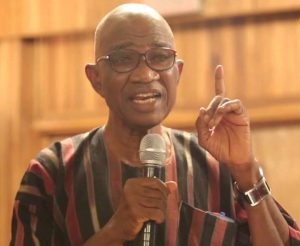
Prof Toye Olorode
However, some of Onoja’s theoretical propositions invite disagreements.
The first concerns his description of Gramsci as the global flagbearer of Marxism and Iyayi as his Nigerian equivalent. The comparison is attractive, but it risks confusing intellectual influence with theoretical and historical equivalence. Gramsci’s importance derives from his reconstruction of Marxist political analysis through the concepts of hegemony, civil society, the integral state and the war of position. The concept of hegemony did not abolish class politics; it demonstrated why class domination cannot be sustained through economic power alone. A ruling class must also secure the consent of those it governs by making its particular interests appear compatible with the general interests of society. It achieves this through institutions, education, religion, culture and the production of ideas that shape how people understand their social conditions and political possibilities. Domination, in Gramsci’s formulation, is therefore sustained through the combination of coercion and consent, with hegemony explaining how ruling classes secure political and moral leadership beyond the immediate exercise of state power. Iyayi’s significance, on the other hand, cannot be adequately captured by locating him within Gramscian categories. His contribution emerged from the particular historical experience of Nigerian capitalism, the contradictions of postcolonial state formation and the political struggles of organised labour. Iyayi was not simply a Nigerian Gramsci. He was an intellectual and activist whose importance must be understood on his own historical terms.
There is also a problem with Onoja’s characterisation of Gramsci as having turned historical materialism upside down while remaining faithful to Marxist orthodoxy. Gramsci did not simply harmonise the internal disagreements of Marxism. His intervention was itself a profound contestation of the belief that economic conditions alone determine how society changes, showing instead that politics, culture and people’s ideas also shape the course of history. Gramsci’s insistence on the relative autonomy of political and ideological struggles was a departure from the reduction of political outcomes to economic structures.
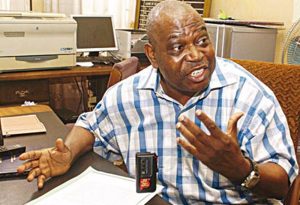
The late Prof Festus Iyayi
This brings us to Ernesto Laclau and Chantal Mouffe. Onoja correctly identifies Hegemony and Socialist Strategy as a significant intervention against classical Marxist assumptions about the historical privilege of the working class. However, describing their intervention principally as the removal of the primacy of the working class does not adequately capture its theoretical ambition. Their post-Marxism questions the very assumption that political identities and collective subjects possess predetermined foundations. Political identities are constructed through discourse and articulation, rather than simply inherited from economic locations. This is a much more fundamental challenge to Marxist ontology than a redistribution of political leadership among social groups. The question is whether this theoretical displacement can adequately account for the material relations of exploitation that continue to organise capitalist society. Abandoning class essentialism should not become an invitation to abandon class analysis.
Indeed, the contemporary transformation of capitalism makes this question particularly urgent. Onoja invokes Meta, Amazon, Apple, Netflix and Google as evidence that the capitalism confronting us is substantially different from the capitalism understood by Marx and Lenin. That observation is correct, but the theoretical conclusion requires qualification. Digital capitalism has not abolished the extraction of surplus value or the antagonism between capital and labour; it has only reorganised their relationship through platforms, algorithms, data extraction, surveillance and new forms of labour discipline. The worker who delivers goods for Amazon, moderates content for Meta, or supplies data through digital platforms remains situated within relations of production, even where the traditional factory has disappeared from view. So, the challenge is not to abandon Marx but to interrogate the changing forms through which capital reproduces itself. This is a concern that runs through the work of David Harvey, the British-born Marxist geographer and political economist, particularly his The Limits to Capital and The Enigma of Capital. Harvey demonstrates how capital negotiates its internal contradictions, reorganises the conditions of accumulation and finds new geographical and institutional spaces for its expansion. His concept of accumulation by dispossession further illuminates how contemporary capitalism extends its reach through privatisation, commodification and the appropriation of resources previously held outside the direct logic of market exchange. Contemporary capitalism has acquired new instruments of accumulation without escaping the contradictions that make Marx’s critique of political economy indispensable. My central point here is that platform economy does not represent the end of class relations; it reveals how those relations have become more dispersed, technologically mediated and difficult to organise politically.
Onoja’s discussion of Hardt and Negri’s Empire also deserves a qualification. Their argument was never that territorial empire had simply disappeared. They sought to explain the emergence of a networked form of sovereignty operating through supranational institutions, global capital and dispersed structures of power. One may disagree with their conclusions, but the title is theoretically deliberate rather than an unfortunate exercise in intellectual idiosyncrasy.
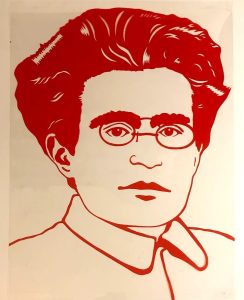
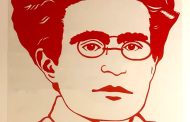
Antonio Gramsci
I am particularly persuaded by Onoja’s insistence that Nigerian Marxism requires theoretical renewal. His recollection of the 1996 Centre for Research and Documentation discussions raises an important question about the intellectual limitations of class-centrism. However, the history of Nigerian Marxist scholarship should not be reduced to a single failure of theoretical imagination. Its traditions contain important disagreements about class, ethnicity, nationalism, gender, imperialism and the postcolonial state. The task is to recover those disagreements rather than retrospectively impose a uniform orthodoxy upon them.
Onoja ends his piece with this question: “How do you fight correctly if your understanding of the dynamics are of capitalism in the era of Lenin when what is on the ground today is completely different?” My answer begins with recognising that fighting correctly requires more than acquiring new theoretical vocabulary. We must understand how contemporary capital organises production, controls information, disciplines labour and influences the state; and examine the political economy of artificial intelligence, platform monopolies, financialisation and the commodification of personal data. Above all, we must understand how these transformations affect the possibilities of collective political action.
The working class may no longer possess the social composition or organisational concentration that characterised its industrial formations, but its political relevance has not expired. Its boundaries have changed, and the task of radical politics is to understand those changes without substituting fashionable theoretical formulations for material analysis. Robert Cox’s proposition that every theory is for someone and for some purpose remains an indispensable starting point. But theory must also be judged by its explanatory power and its capacity to illuminate possibilities for transformation. The Nigerian crisis requires intellectual independence, certainly, but independence cannot be achieved through theoretical eclecticism without critical discrimination. Perhaps, the most important lesson to draw from Iyayi, Gramsci and Olorode is that intellectual work acquires its full political meaning when it engages the historical circumstances it seeks to change. Marxism must remain open to revision, criticism and reconstruction. Its continuing relevance will depend less on the fidelity of its adherents to inherited formulations than on their willingness to understand the world as it exists and organise politically to change it.
The author, a former President of the National Association of Nigerian Students (NANS) is an Abuja-based human rights lawyer