
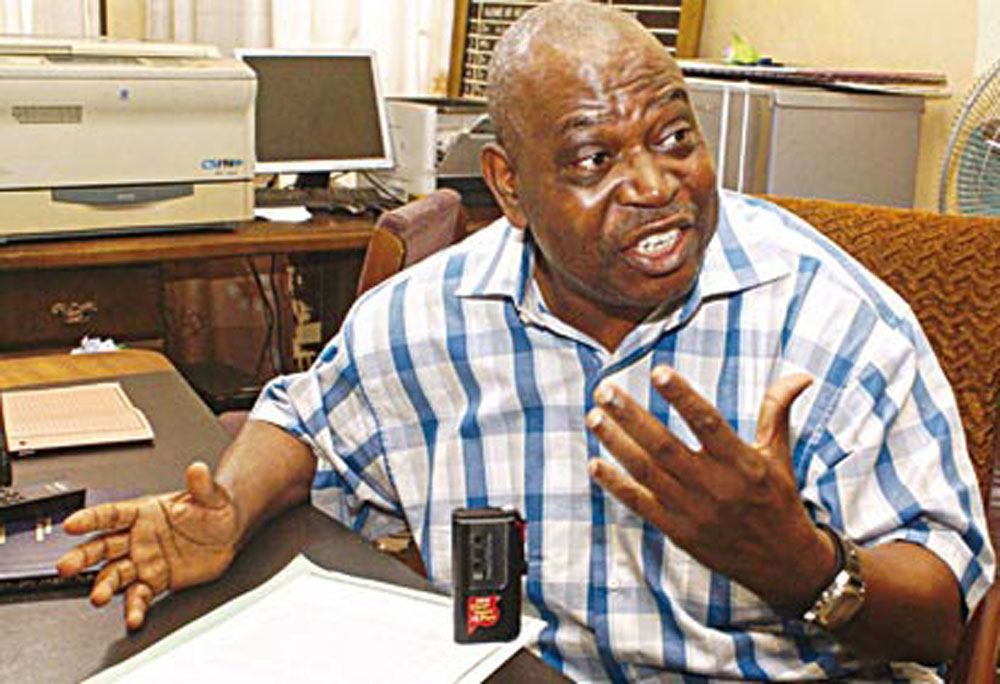
By Prof Omotoye Olorode
Comrade Festus Iyayi’s three novels: Violence, The Contract and Heroes, typifying other literary works by him, tell stories of commitment and hope at personal and collective levels. And the three novels told our story from colonial plunder to post-1960 neo-colonial and neo-liberal plunder. Our perspective of the story is the nature and the processes of the events that produced today’s crisis of Nigeria. Colonial violence and plunder by our colonial violators, their local middlemen and women, their cultural agents and trading outpost bled and underdeveloped our country directly through forced labour, unjust taxation, divide-and-rule tactics, and trade and commercial relations which were not only unjust but unequal. In Kwame Nkrumah’s sense, the neo-colonial and neo-liberal sequels of colonial plunder had been the continued custody of power in the hands of departed colonial masters and their fronts (IMF, World Bank, NATO etc) without responsibility.
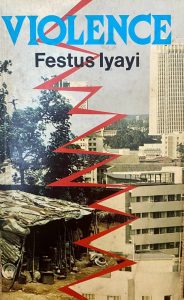
Prof Iyayi’s novel in which he demonstrates the structural violence typical of capitalism in the periphery
With state power in the hands of indigenous collaborators of the departed colonialists, private and primitive accumulation became the preoccupation of the ruling circles in the succeeding post-colonial governments. These collaborators were driven constantly by the illusion of becoming effective partners and even competitors of the international plunderers. The contractors (local and indigenous), and middle-men-and-women were the conduits from public treasures into private coffers. Beyond myths, smoke screens, and make-believe “anti-corruption” agencies, these are the foundations of what they call corruption and the operational sources of the commitment of the ruling circles to the sale of public properties (roads, PHCN, Ajaokuta, banks etc.) and privatisation of welfare and social services (education, healthcare delivery, drinking water supply, housing and even public security services).
Festus Iyayi’s intervention on the origins and evolution of the crisis captured above had two elements. One element was the vivid depiction and popularisation, through his literary and organisational work, of the bourgeoning crisis towards conscientising the victims of re-colonisation and their allies. The other element of Iyayi’s intervention was his direct involvement in organising the victims and their allies in the resistance against the Violence by the violators of our peoples. This resistance had produced and reproduced “heroes” across generations, across historical times, across nationalities, sub-nationalities and confessional boundaries across our country.
All heroisms spring from personal conviction and commitment. Some heroisms spring from megalomania and opportunism. Iyayi’s heroism, like those of many of our Comrades who had passed on, sprang from seeking the truth, from conviction, from altruism and from constant subjection of individual convictions to collective and self-criticism, and scrutiny, by the collective.
Iyayi’s life of intervention on the side of the oppressed of Nigeria coincided, to the very moment of his transition on November 12, 2013, with the entrenchment of the neo-liberal epoch of neo-colonialism in the last four decades or so.
This, of course, means that exploitation has been further entrenched and intensified. In this situation the committed intellectual, in contradistinction to the intellect worker, sensu Paul Baran, constantly addresses his/her mind to the morality of what ought to be; to the liberation project—liberation of Nigeria and her peoples from the conspiracy of imperialism (and its economic, political and cultural institutions) and its subalterns in Nigeria’s succession of ruling class governments, in the economic and cultural sectors and in the state apparatuses.
Festus Iyayi carried out his life-long and committed intervention in the Nigerian version of the modern habitat of most intellectuals—the Nigerian University System (NUS). Comrade Festus Iyayi was killed serving the organisation (ASUU) that discovered its mission about in the late 1970s when the first shots were being fired at the Nigerian working people by neo-liberalism and its succession of military, civilian and “civilianised” agents.
We have asserted several times that the economic and social-policy dispensations under the various governments that ran and ruined Nigeria between 1977 and 1999 (two full decades) had their roots in the vision of the military dictatorship headed by General Olusegun Obasanjo which, segment allegedly “handed over power to civilians” in 1979. That dictatorship returned in different mixes as military dictatorship (1984-1999) and military dictators turned “democrats” (1999-2023). What ran through these four tragic decades had been the dominance of the exploitative and violent forces of imperialism (IMF, the World Bank, WTO etc.) and their entrenchment as we have said, by their Nigerian agents who seized the Nigerian state.
The decades of 1978 to 1988 exposed the re-colonisation program which took the concrete form of the Structural Adjustment Programme (SAP). The decade also defined the programme of the resistance of Nigeria’s patriotic and democratic forces and clarified the class character of the contending forces in the Nigerian society. The resistance was led by the intellectuals (largely in ASUU—Academic Staff Union of Universities), the youth (in NANS—National Association of Nigerian Students), segments of the press (especially the print media) and the Labour Movement, (led by the NLC—Nigeria Labour Congress). By 1984 when this resistance was taking a coherent shape, Festus Iyayi was the Chairman of the University of Benin (UNIBEN) Branch of ASUU that anchored a major National Conference on the State of Nigeria’s Economy which produced the famous and prophetic Communique How to Save Nigeria which alerted Nigerians about the bourgeoning conspiracy against our country! Our illustrious compatriot, late Dr. Mahmoud Modibo Tukur was the President of ASUU at that time.
By 1984, it was also clear to ASUU that the struggle to rescue Nigeria from local and international robbers requires an organic link among all forces of patriots and organisations of working people. Dr. Festus Iyayi was one of those who gave everything to link ASUU with the students’ movement, with the labour movement (NLC, peasants, market people etc.) and with the professional organisations: Nigeria Medical Association (NMA), Nigerian Bar Association (NBA), etc.
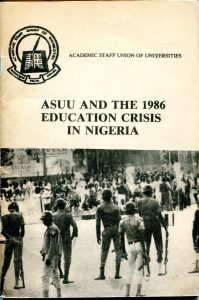 The 1980s was thus a defining decade for Nigeria’s future—a decade in which military dictatorship sought to perfect the foundations of recolonisation (SAP) which Obasanjo built between 1977 and 1979. Obasanjo indeed, described the Buhari-Abacha-Idiagbon-Babangida coupists of January 1984 as “off-shoots of our [Obasanjo] regime”!
As the decade of the 1980s advanced, it became clearer and clearer that the Nigerian University System represented the ultimate bastion of popular resistance that imperialism and its local agents had to assail! As a prelude to the draconian Decree 16 of July, 1985, which handed over University Senates to the National Universities Commission (NUC), the welfare of students and their organisations came under fierce attack as part of SAP’s cost- [of public welfare] recovery and “subsidy-removal” programme of IMF and the World Bank. As two important groups of intellectuals the relationship of ASUU and NANS was waxing strong, George Caffentzis (in The Scholar Vol.2, No.3; 2002: pp: 7-9) summarised the conjuncture as follows:
ASUU concludes that it is ultimately the desire [of the World Bank] to wrest control of the most populous and potentially wealthiest African nation from its people: “In every nation, the educational system is an expression of the national ideal…the World Bank knows that by the taking control of Nigerian Universities, it can control the pace and direction of Nigeria’s development.
The foundation for this control was already laid by USA’s State Department around 1978 (see Y.B. Usman’s For the Liberation of Nigeria. New Beacon Books, 1978: pp. 75-77) targeting the NUC (National Universities Commission) as its local collaborator; that was the origin of the complicity of the NUC in the orchestrated ruination of Nigeria’s public-funded higher education. The subsequent role of the NUC in the frenzied program of privatising university education in Nigeria in the 1990s and the 2000s arose from this history.
The period of Festus Iyayi’s tenure as the President of ASUU—1986-1988—was the zenith of the resistance of the Nigerian people against re-colonisation through the partnership of IMF/World Bank and the military wing of the Nigerian ruling class. This resistance involved intensification and sustenance of education, solidarity and organisation among the oppressed in Nigeria. Comrade Iyayi led, in our core organisations, to give substance to the so-called IMF Loan Debate and the Political Debate of 1986 which unmasked the conspiracy of military dictatorship and imperialism.
Specifically, Festus Iyayi led ASUU at a time that was turbulent, scary and dangerous for individual and organisational survival. Under General Ibrahim Babangida, the murder of our students by the Nigeria Police Force (NPF) on May 23rd, 1986 at ABU—Ahmadu Bello University (Zaria) provided an unprecedented opportunity for the Nigerian stooges of imperialism to frame ASUU, the NLC and NANS and nail them definitively through the instrumentality of the Justice Mustafa Akanbi Panel that inquired into the nationwide protests that followed the ABU massacre of Nigerian students. ASUU turned the table so completely against the Babangida junta that Akanbi Panel’s report could not be used against the intended targets—the intellectuals, the students and the labour movement generally!
The foregoing circumstances epitomise the crucible in which ASUU’s character was forged and advanced by the successive generations of ASUU leaders. In the circumstances, ASUU leaders, especially Comrade Festus Iyayi, gave everything, and at all times, to fulfil the mission of liberating our country—they were victimised and humiliated; they were detained without trial, they lost their jobs for long spans of time. Like many of the radical students, labour activists, journalists etc; some of them even lost their lives in the struggle for Nigeria’s liberation.
Like other genuine Heroes, Festus Iyayi pursued learning and the truth with studious and consummate passion. He was passionate about knowledge of society, of the environment in its totality, of people, of events and their dynamics, and of the human condition in all its ramifications! His love of, and passion for knowledge made him a pillar in all the organisations he worked for and had made his transition an irreplaceable loss for our movement. Festus could produce a profound policy or position paper on almost any matter within as little as six hours!
Comrade Iyayi was an organisation person, a bridge builder, a listener, an organiser, a cultured Nigerian. A long-distance runner, a long-view intellectual, Comrade Iyayi stays with his organisation and worked for its cohesion where other “Comrades” build factions in, and break ranks with, organisations. He always had faith in his Comrades!
Yes, he stayed with his organisation and lavished his monumental experience on building organisations at different levels; he thus got bestowed with authority without seeking power. Comrade Iyayi got invariably drafted into positions of leadership because he thought simply working for an organisation means providing leadership.
It was in the foregoing circumstances that Comrade Iyayi became the President of ASUU (1986-1988) and President of the Committee for the Defence of Human Rights—CDHR (1995-1997) and laboured for both of them at points that were arguably the most challenging, most creative most decisive and most assertive periods in the lives of the organisations and of our movement!
 Our illustrious Comrade Festus Iyayi conceived the arenas of our struggle as spaces without demarcations and the organisations that give life to the struggle as formations without boundaries. Every element interdigitates into others. Creative writing for him is art, culture, politics, resistance, economics and critical awareness. For him, the university teacher teaches hope, introspection, society and its interrogation. For him, economics, social organisation, industry and industrial relations are all about critical awareness.
In Festus Iyayi, teaching and researching social science are both in the faculty of a university and in the labour movement—in trade unions and in central labour organisations. Public service is about conscientisation of, and learning from, the organisations of the working people and their allies.
It was therefore, not a surprise that Comrade Iyayi spent a full sabbatical year with the Nigeria Labour Congress carrying out assignments in organisation and policy formulation and implementation. Specifically, Comrade Iyayi travelled widely in the world and researched in-depth to produce a monumental report towards political engagement of Nigeria’s labour movement. Comrade Iyayi also played a pivotal role in the workshops and research towards producing an NLC blue print on political economy to be titled Nigeria: Agenda for Development.
At the level of personal, private life, Comrade was a model—generous with his material and moral resources towards the family (nuclear and extended), to his home, community, to Comrades and friends and to our country; to Africa and to humanity.
With his wife, Grace, the Iyayi home in Benin City has always been a sanctuary, a place of rest, a location of assured refuge and ample hospitality to comrades, students and anyone in distress.
It is not always that the immediate family (spouses and children) give the sort of unconditional support (the kind that Comrade Iyayi recieved amply from Grace and their children and the extended family) to revolutionaries and their organisations! The lives of sacrifice and commitment of revolutionaries demand massive sacrifices from, and entail discomfort and threats of physical danger to, all those around the revolutionary. In unjust societies, those who defend good cause, Iyayi did, are often lonely, isolated, blackmailed, and hounded by the state and their agents; they lose their jobs, they are deprived of their freedom, their lives are constantly threatened and they often even lose their lives! The consequences of all these can be, and often actually are, more traumatic for members of the family and the friends of the revolutionary.
The actual experience of Festus Iyayi and many other Nigerian patriots under the succession of Nigeria’s military dictators and their collaborators and agencies were typical. In many cases the spouses, children and other relatives of our comrades were abducted, detained and held hostage, tortured, and variously humiliated by secrete state agencies like NSO (under Obasanjo and Buhari) and the SSS (under Babangida and Abacha). Further, in the case of Festus Iyayi, the authorities of the University of Benin under the Vice-Chancellorship of Grace Allele-Williams once locked the Iyayi family out of their official residence on campus and threw all the family’s belongings in the rain!
Our Comrade, Professor Festus Iyayi transited to the other side of eternity, on November 12, 2013, while on active duty to rescue our country and our people. He died on the mission to sustain our hope in the infinite possibilities of our ambience. He died organising.
We continue to accord Comrade Festus Iyayi the earned and well-deserved honour for his unforgettable and exemplary contributions towards the liberation of our country and our peoples. We will renew our movement with all our strength; and by all means necessary.
Rest in Power, Comrade Festus!
We are still here at the Barricades!
For and on behalf of Socialist Congress of Nigeria (SCON)
The author is a member, Secretariat Collective, Movement for Socialist Transformation (MOST)









)