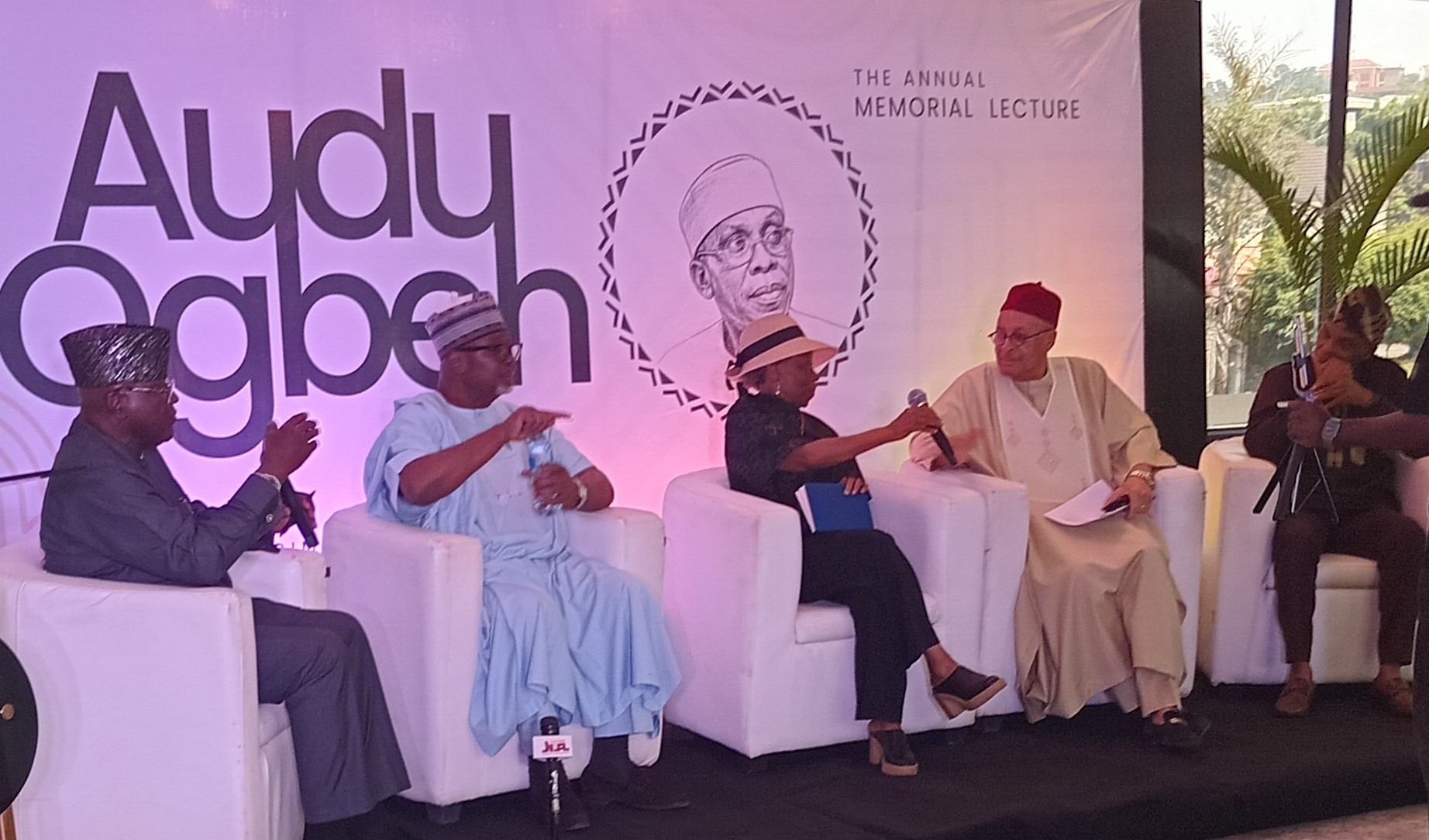
For many who attended the Inaugural Audu Ogbeh Memorial Lecture held on November 5th, 2026 in Abuja, the first striking element is most likely to be the venue. Simple and bare but yet elevated, it was what the chief would have himself approved if he were around for the event.
In any case, the event was purely of the intellectual, reflectivist rather than anything vulgar. The organisers wanted the first anniversary of his demise to be a moment for thinking about ‘Governance With Dignity: Food Security and Social Protection’. The reflectivist dimension was there for all to see in the event dominated by media managers, artistic philosophers, feminists and critical political economists. Even Chief Stephen Lawani who was the main politician and lead speaker started on a dense note of African philosophical point of departure to everybody’s admiration, if Pat Utomi’s summary is anything to go by.
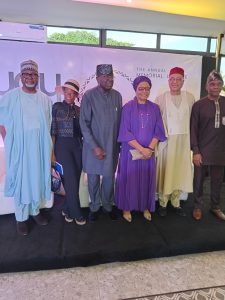
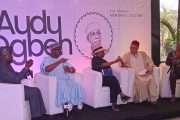
(L-R) Chief Stephen Lawani, Dr. Enyantu Ifenne, Dr Yemi Ogunbiyi, Mrs Ogbeh, Dr. Pat Utomi and Mister Muyiwa Adetiba, lecturer, moderator and discussants all!
The audience was a question mark on how an Audu Ogbeh was never a presidential candidate at any time of his life. Few politicians have the equal spread of his connections in both the North and South, among Christians and Muslims, men and women and acceptability in several other domains. It would seem that his deep knowledge of the heftiness of the presidential campaign budget frightened him as to rule out people like himself. It is a different matter if a country such as Nigeria would tolerate an independent minded soul such as Audu Ogbeh to become president.
But Nigerians graced the event in a very passionate manner. It was not one of these perfunctory, showy events typical of Abuja. Dr. Yemi Ogunbiyi, getting younger by the day, was in charge. He said many things, all of them positive about Chief Ogbeh. The most interesting is likely to be the story of the car gift he got in 1982 or so from Ogbeh. As Minister of Communications, Ogbeh had gone to deliver a lecture at what is now Obafemi Awolowo University, Ile-Ife where Ogunbiyi was a lecturer. There was accommodation appropriate for a minister but Ogbeh told his hosts he had a friend on the campus in whose house he would be happier. So, Mister minister ended up in Dr. Ogunbiyi’s 2-bedroom or so accommodation in the Staff Quarters. In the morning, the minister didn’t like the car Ogunbiyi was riding. He did something about it upon his return to Lagos. That was how Ogunbiyi got a 504 SR in those days and about which he is still happy (or is it grateful?) to Ogbeh, his friend from their days at King’s College, Lagos where Ogbeh moved for his HSC after WASC at Mt St Michael’s, Aliade in present day Benue State.
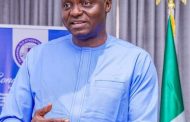
Before Ogunbiyi could tell more stories, Chief Stephen Lawani arrived and was invited to take the floor from a sitting position. Chief Lawani’s lecture is the sort of text that is difficult to summarise. For those who listened carefully, every paragraph was tied to the next one. It was a 2-in-1 text. The first part is what he calls the appetiser, where he offered a philosophical insight on the relationship between the living and the dead. He draws a contrast between Africa and other civilisations in that relationship. According to Chief Lawani who said he got his philosophical insights from the School of Life, the living and the dead are not the dreadful of each other in Africa. He was thus sure Audu Ogbeh was in the hall mingling but now as an ancestor.
He began the main meal with the core claim of characterising Chief Ogbeh as the quintessential intellectual of statecraft, hence his tension-free circulation from the legislature to the executive arm of government (in three ministries: communication, Steel Development and Agriculture) and, of course national party leadership.
Lawani argues that politics took the lion share of Ogbeh’s circulation in contrast to the academic, cultural or any other realms, citing Ogbeh’s National Chairmanship of the PDP as his utmost accomplishment in politics. One reason for this characterisation, in Lawani’s argument, is the very nature of the PDP.
There has been nothing like the PDP in the history of Nigeria as far as elite consensus is concerned, he said, basing his argument on elements of the old Unity Party of Nigeria (UPN), the PRP, the NPN, the People’s Front (PF) and, of course, the military establishment, led by the Babangida fraction – the IRA wing – all congregating in the PDP.
The cutting-edge in his thesis comes off thus: “As the elite are both the questions and the answers, no students or critical observers can ignore what they do or refuse to do as far as nation building is concerned. The PDP as a rare and successful statement in elite consensus in the aftermath of June 12 makes Chief Audu Ogbeh’s National Chairmanship of the PDP his utmost accomplishment in politics”.
He caps this up with ascribing to Chief Ogbeh a conception of national leadership of the PDP that stretched to being the most all-round adviser to the president. As far as Lawani is concerned, Ogbeh did this so well that it produced an irony: his falling out with then President Obasanjo. “It remains exciting as the fallout was not because he was greedy, corrupt or incompetent. Rather, he was raising the stakes too high to the discomfort of a president who saw himself on a mission and the chief guardian of orthodoxy. The rest is now history”.
Ogbeh’s history of impeccable circulation in power had been such that his emergence as Minister of Agriculture in 2015 is, for Lawani, a case of transiting from a quintessential intellectual of statecraft to a manager of a special operation in statecraft. He locates this in the special role of Agriculture in agro-industrial transformation of an agrarian economy and society such as Nigeria.
On the basis of empirical details assembled from diverse testimonies by columnists such as Sonala Olumhense, Dr. Aliyu Sabi Abdullahi, CON, one of Ogbeh’s successors, Daily Trust, Premium Times, late President Buhari and many others, Chief Lawani concluded that Ogbeh arrived the Ministry of Agriculture “with a manifesto for social transformation of Nigeria, something farther and deeper than just agrarian tinkering”. Recalling an August 29th, 2025 Daily Trust editorial, Lawani cited Nigeria overtaking Egypt as the number one rice producer in Africa as the most visible success story recorded under Chief Ogbeh.
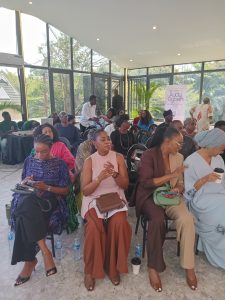
Some more faces
Also recalling a December 18th, 2018 report in Premium Times, the speaker show Nigeria reduced importation of five major food commodities: rice, wheat, sugar, tomatoes, and milk by 2017, with positive implications in terms of severe reduction of expenditure on the importation. This is more so that, according to the same newspaper rated by Lawani as well known for investigative reporting, Nigeria officially exported 72 metric tonnes of yams to China, the United Kingdom and the United States in 2017.
Chief Lawani could, therefore, assert that “something remarkable was going on in Nigerian agriculture under Chief Ogbeh. For the first time in the history of this country, ministerial agency overcame bureaucratic bottlenecks, initially overcame resistance from vested interests, successfully persuaded the national and international policy mill that agricultural transformation was in Nigeria’s national interest. There were no excuses about rain shortfall, quelea birds, about corruption, about lack of technology, about imperialism and neocolonialism, about North and South, about religion, about non-commitment of the farmers”
While noting that Ogbeh could not have done all these single handedly without presidential approvals, he argues they are still achievement to Ogbeh’s name name because if anything went awry, Ogbeh would have been the name on every lips as signifier for failure, ineptitude, corruption and lack of capacity.
Lawani therefore dared to declare that the agricultural revolution roundly testified to by all the evidence he had summoned as the hallmark of ‘governance with dignity’. “To push for guarantee of food availability to the populace is responsible and qualitative governance. To deliver same is the acme of ‘governance with dignity’ because food security is the very definition of dignity. It is dignity for the individual as well as for any community, whether it is a local, national or the international community”
Food is the master code of the social contract, he said, declaring that, in Nigeria where arable land is not a problem, food insecurity will always be a source of embarrassment.
Time, he added, is of the essence for a Nigeria projected to be the third most populous country in the world by 2050. “The fear is that Nigeria will be a miserable and embarrassing demographic power if it has not put its food security and social protection in order before then”, Lawani stated, adding that a giant which cannot feed itself would be no giant.
Predictably, he got a standing applause, followed by the calling in of the discussants. Somehow, the elite had been named into the nodal point of the Inaugural Lecture. Yemi Ogubiyi asked discussants where they thought the way out lies for Nigeria. Dr Pat Utomi said something Intervention didn’t get, something about whether Nigeria has an elite or so. For him, the first generation of Nigerian leaders was an elite. In spite of the ethnoregional competition between and among them, Nigeria was at 20 % manufacturing capacity at independence, said Utomi who offered the term ‘dangerous alchemy’ in terms of explaining how Nigeria lost it.
Although Utomi said the military is a wonderful institution, he traces the rupture to the meeting between soldiers and oil. He puts the danger in that alchemy in the commandist ideology undergirding the military which removed questioning of authority from the process. Without any scrutiny, it did not take long before Nigeria sank deep into the straight prebendal ocean. So, today, there are more private jets than any discussion about manufacturing. This is the context in which people like Audu Ogbeh who retained elite sanity got called all sorts of names such as idealist.
Dr. Enyantu Ifenne, former sole administrator of Okpokwu LGA of Benue State, for Commissioner for Education in Benue State, public health expert and civil society activist recalled what growing up with Ogbeh in Otukpo was like. He was a young man who never stopped talking. As a result, people thought he was going to be a lawyer. It didn’t happen. what happened instead was an Audu Ogbeh who remained permanently keen about agriculture, to the point of setting up Efugo Farms quite early. As for what to do about the elite crisis of mission in Nigeria, Dr. Ifenne turned fiery. Her answer is for “somebody to clear out our generation”. Interestingly, it was a consensus if the applause measures the popularity of that idea.
Dr. Ogunbiyi loved the passion Ifenne had brought into it but he is not sure if he would be happy to be cleared out by anybody. Anyway, he asked Mr Muyiwa Adetiba, a media guru. Adetiba argues that the way out is bringing back the sense of value that prevailed before.
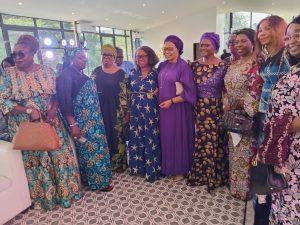
Some members of the ‘women squad’ around Mrs Ogbeh (in a shade of magenta) after the event!
Dr. Julius Jibrin Bala, a product of the ABU, Zaria experience of radical nationalism and who later specialised in privatisation in Japan, becoming DG of the Bureau of Public Enterprises (BPE) from 2003 to 2005 intervened from the floor to argue that his generation got the best education ever in this country and remain the generation with any transformative promise for Nigeria. He isn’t surprised that Audu Ogbeh turned out an impeccable, independent minded member of the elite. According to Dr. Bala, Ogbeh manifested that on the campus. As for how Nigeria can get off its elite burden, his bet is a vanguard formation.
Dr Ogunbiyi went back to Utomi who, this time, said the problem is that those who ought not to be leaders turned up as leaders because they hijacked power. Otherwise, there would not be collapse of culture because leaders set the tone of culture. A few correct leaders will set the correct cultural tone for society to revolve around.
Prof Onjefu Okidu who has written a book on Chief Ogbeh said Nigeria never listened to Ogbeh whom, he said, spoke at every moment.
Civil society cum gender activist, Dame Ene Ede took the floor to eulogise Audu Ogbeh never getting tempted by any woman. Ogunbiyi added that Audu Ogbeh also never got tempted by money because he was privy to attempts to bribe him to allow importation of rice. It didn’t work for the potential bribe givers.
Chief Stephen Lawani added his voice: Audu Ogbeh was always the best. Mrs Audu Ogbeh joined too, wondering how Nigeria moves forward. An unnamed elderly person said the answer is in what he calls appropriate leaders. Mrs Ori Okojokwu, a woman leader wondered if there is nothing worrisome about the followership in Nigeria. There were few more contributors whose comments either didn’t come out that clearly. There was an address by Dr. Sam Ode, the Deputy-Governor of Benue State. It was read on his behalf by a representative.
Pat Utomi was then asked to summarise the day. Obviously in love with it, he returned to Chief Lawani’s philosophical take on the relationship between the living and the dead in Africa but added a joke on how, in one culture, the practice of libation produce the unintended outcome of getting the ancestors drunk.
We are transcendental beings, said Utomi, an obvious reference to the coherence of being the Church teaches in the Church militant, Church suffering and Church triumphant. This is what he said is the hope of all for Chief Audu Ogbeh because Ogbeh has, in his view, already achieved material immortality. It had been a good outing, made more so with a witty rounding-off by Adegbe Ogbeh, Chief Audu’s son.
Ada Atama, the Idoma lyricist has a musical number on Audu Ogbeh. One of the things the pop singer has in that music is that whoever hates Audu Ogbeh is wasting his time. The Inaugural Audu Ogbeh Memoral Lecture just affirmed him!