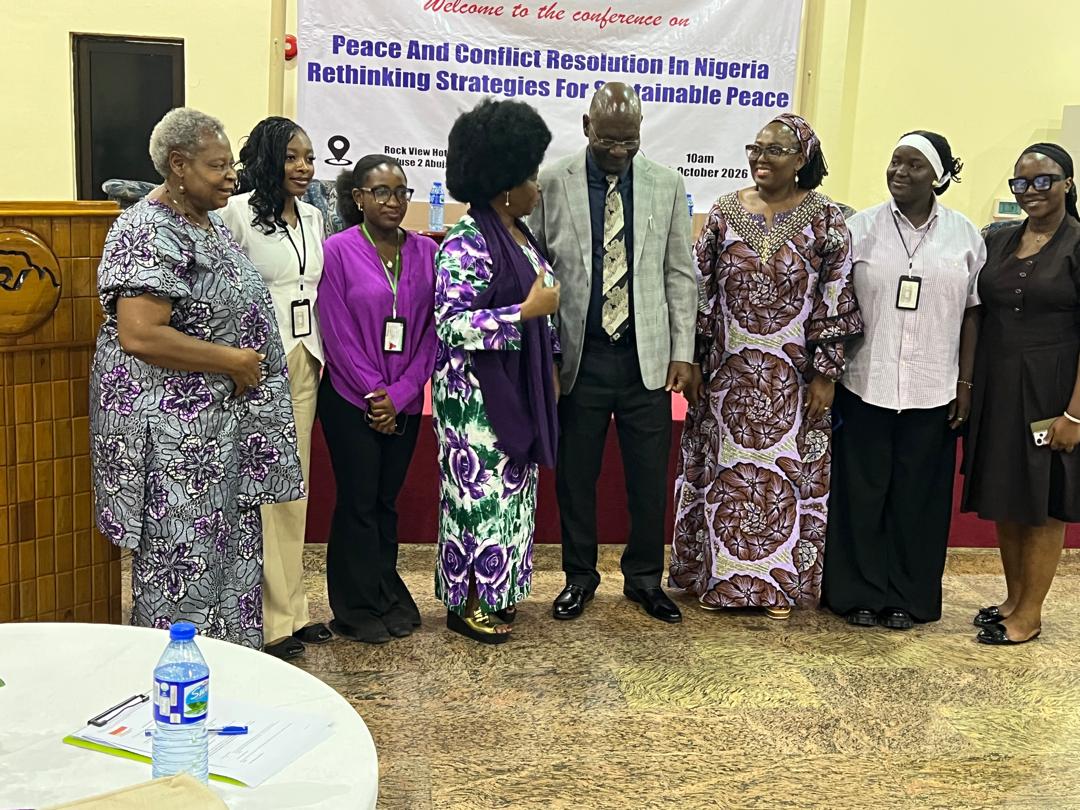
By Adagbo Onoja
Nigeria is now nearly two decades lost in one form of violence or another, from insurgency in the Niger Delta to Boko Haram terrorism in the Northeast before the onset of kidnapping, banditry and sundry concepts. The history of nation building in Nigeria has been a bloody one anyway, from the January 1966 coup to the civil war that followed, the series of coups and counter-coups, the resulting trial and executions as well as the so-called ethnic and religious killings. Thus enveloped in violence for much of its post-independence history, Nigeria has become a question of who and why this violent trajectory.
This is more so that the violence in Nigeria goes against the grains. The received wisdom in these matters is that there is no fire without smoke. In Nigeria, there is fire without smoke in that neither the Nigerian State, academia nor the media has any critical enough explanation for the phenomenon. For sure, no one would dismiss ethnicity or religion frequently cited as the underlying conflict value frames. But how did religion or ethno-regional politics become so feisty as to overwhelm a strong central authority such as the Nigerian State and for this culture of violence to persist? Is it local, national or international politics? If it is all of these, how do they combine?
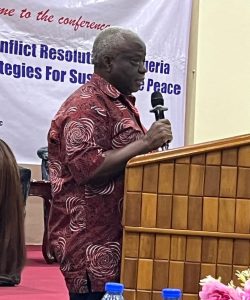
Prof Etanibi Alemika
To the extent that these are rarely the questions posed in the media, the much of academic engagement and in what comes from the policy mill is what made Rosa Luxembourg Foundation West Africa’s October 29th, 2026 Conference on Peace worth tagging as exceptional. Not only the broad framework, the resource persons were fit as much as the sub-divisions, especially the panels on rural banditry and the emotionally draining session on testimonies from the IDP. It is one thing for terrible things to happen, it is completely another for those who suffer such terrible things to have the opportunity to tell their stories. The hope is that those who make things happen in and about Nigeria will correctly read the symbolism of the breakdown of testimony givers at such sessions. The breakdown of one of the testimony givers at this particular session has its own significance because, but for Rosa Luxembourg approach, how would the world ever hear testimonies of agony and helplessness of a victim from Igama, a village in Benue State of Nigeria unknown to the official map, bare of government and on its own still waiting for independence to happen.
But the story of this conference must begin from the beginning. Angela Odah, Rosa Luxembourg’s Country representative in Nigeria, set the context of the conference in her welcome statement. In the past twelve years or more, she said, the simple pleasures of road travel which enable travellers buy cheaper and fresh vegetable, fruits and food stuff sold on the roadsides has become a dangerous adventure across Nigeria, what with kidnappers, bandits and all kinds of gangs on the prowl to capture Nigerians and demand ransoms. No geopolitical zone of Nigeria has escaped this struggle with insecurity of lives and property at varying degrees.
In her own words, “For the poor rural dwellers, across Northern Nigeria, sleep has become a luxury they cannot afford, with incessant attacks by gangs which has made many rural dwellers residents of Internally Displaced Persons camps for over a decade. We have fashioned different names for these gangs, from herders to bandits, to kidnappers, to unknown gun men. Interestingly we have not yet added unknown gun women to the mix”
The October 29th, 2026 conference in Nigeria was the country step down dialogue by which to enact Rosa Luxembourg Foundation West Africa’s recognition of the imperative for peace in relation to sustainable development. It is something the German political foundation hopes to sustain annually for the next three years of its programme cycle in relation to the state of peace and security in Nigeria and proffer recommendations for sustainable peace.
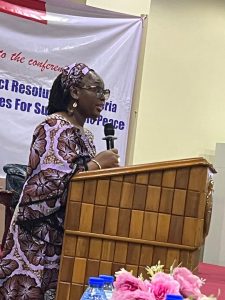
RLF Country representative, Mrs Odah, speaking
According to Mrs Odah, the foundation has already been supporting initiatives, studies and dialogues to promote democratic culture and peaceful coexistence of citizens at community, state, national and regional levels. Some previous regional dialogues earlier this year being the regional conference on ‘Political crisis in West Africa: Rethinking Strategies for Consolidating Democratic Gains’ held on the September 23rd and 24th to mark the world peace day 2026, in Abidjan, Cote d Ivoire; the collaboration with the Johannesburg Holocaust and Genocide Centre and the Change Makers Programme, ‘Reclaiming Peace: African-Centred Train the-Trainers Workshops for West Africa’ at the University of Ghana in Accra from October 5th – 7th, with participants from selected west African countries.
Prof Etanibi Alemika, one of Nigeria’s most established experts on conflict took the floor to dismiss the notion that conflict is necessarily or inherently evil. Conflict cannot be evil when there can hardly be any development without conflict, he says. In other words, there is the element of the transformative in every conflict, be it a quarrel, disagreement or split. But any such disharmony becomes dysfunctional as well as soon as “a country lacks either the capacity or the will to develop and apply effective means of resolving conflicts”, said Prof Alemika.
In his view, conflicts in Nigeria are often complex as protagonists most often times hide the motives behind violent conflicts under ethnic and religious identities and this, according to Alemika, “makes negotiation and mediation very difficult.” The other complexifying variable Alemika pointed at is Nigeria’s rich harvest of “entrepreneurs whose trade is conceiving, inciting, planning, financing and executing violence between and among ethnic, religious and communal groups. In doing so, they become negotiators with government; gained recognition among government, civil society, and their primordial group as well as benefits from resources disbursed for managing violent conflicts”
The matter is compounded by the dominant approach to conflict management which is reactive rather than proactive, notwithstanding Nigeria’s huge reservoir of expertise in the public service and civil society organisations such as the National Institute for Peace and Conflict Resolution (NIPCR) as well as academic research and institutes within the universities. His last point is the government’s preference for pursuit of negative peace through reactive ad-hoc responses and interventions rather than development of policies and responses for sustainable positive peace.
Interestingly, Dr. Joseph Ochogwu, the Director-General of the National Institute for Peace and Conflict Resolution (NIPCR) was listening to his former lecturer. The torch passed on to him to speak.
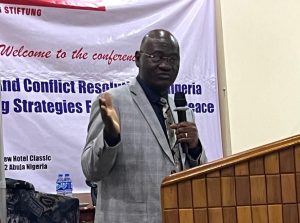
Dr Ochogwu of the NIPCR, Abuja
Fortunately, Dr. Ochogwu came with a central argument: Nigeria’s peace and security challenges cannot be understood exclusively as failures of military or policing capacity. They are also connected to the country’s political structure, the distribution of economic opportunities, the management of diversity, the quality of governance and the capacity of institutions to resolve grievances peacefully. For him, sustainable peace requires Nigeria moving beyond managing the symptoms of violence to addressing the structural conditions that reproduce insecurity.
This broad context was what he spent time breaking down, starting with the fault lines such as the federalist ideology reigning in Nigeria; the citizenship, identity and belonging; economic inequality and uneven development (how poverty, unemployment, inadequate infrastructure, high living costs and weak public services could undermine confidence in governance and intensify competition over scarce resources) and institutional weakness (which unfolds via the connection between policing, justice delivery, land administration and public accountability on the one hand and temptation to resort to informal authorities, self-help arrangements or armed actorness).
Next to fault lines is existential realities and contemporary threats to peace as manifests in the Northeast, Southeast, climate change and displacement. His third structural insight are what Nigeria’s conflict experience teaches. Here, he exemplifies with the June 2025 Yelewata violence in Benue State; the communal violence series in Plateau State, the Boko Haram insurgency in the Northeast and the Niger Delta and resource governance.
The next section of his paper concentrated on policy responses of the Nigerian State to the peacebuilding challenge. Among these are the state police instrument, local government autonomy and grassroots governance, electricity-sector decentralization, devolution of power and the wider federalism debate and, lastly, economic reform and social stability.
His fifth thematic focused on other stakeholders: state governments, traditional authority, civil society, the private sector, women, young people, persons with disabilities and displaced populations as a collectivity and development partners.
Finally, he spent time on what the NIPCR is doing. On the list are conflict research and early warning; policy research and advisory engagement; dialogue, mediation and reconciliation and conflict-sensitive governance and development.
One paragraph in the DG’s speech which did not attract the acclaim it should have attracted goes like this: We must nevertheless avoid treating poverty, religion, ethnicity, climate change or youth unemployment as automatic causes of violence. Their consequences depend significantly on how political institutions, security agencies and community structures manage the resulting pressures”. Many would consider the first sentence of the quotation from an official adviser to the Federal Government on conflict to be very apt. That level of analysis doesn’t come out forcefully enough among pundits on radio, television and newspapers casually calling conflicts ethnic, religious or climate change induced as if Nigeria is the only country with ethno-religious diversity or climate change impacts. The question is rarely ever asked how religion, ethnic difference or climate change impacts are framed as to make one ethnic or religious group threatening to another. This is the point Prof Alemika made earlier about additional complexity of conflicts in Nigeria due to smart protagonists skillfully provoking violent conflicts under ethnic and religious identities. As Alemika put it, it makes negotiation and mediation very difficult because their discourses may be someone’s fears dressed up as ethnic fears, leading somewhere else while investigators are made to believe it is ethnic or religious. So, next year, the violence re-occurs and the newspaper headlines declare the re-occurrence as ethnic or religious.
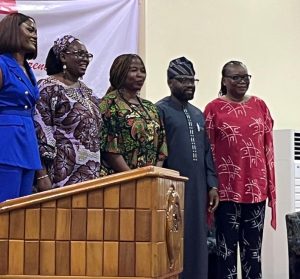
The panelists on herder-farmer violence
The three speeches prepared the ground for the three panels that followed. The first of these was the one on ‘Farmer-Herder Conflicts in North Central Nigeria: What Hope for Peace’ The three resource persons were Prof Plangshak Suchi, Mrs Kemi Okenyodo and Ms Josephine Alabi. The very fragmentary notes on this section means skipping it even as Intervention took note, for example, of Mrs Okenyodo’s versatility and informed insights into the dynamics of this variation of the conflict spree. It was a well composed panel.
The panel on ‘Rural Banditry and the Search for Peace’ was no less an engaging one, what with the insights into their current dynamics as churned out by Comrade Ene Obi of the Ene Obi Centre for Development, Abuja; Dr Dauda Garuba, the Director of the Centre for Democracy and Development (CDD) and Comrade Jide Ojo, the ace columnist. A highlight of the panel discussion was on how rural banditry still happened in Nigeria in spite of the prediction about it and the elaborate discussion of that prediction in 2016 in Abuja, a discussion attended by elements who went on to become ministers and so on. That sends a signal that rural banditry in Nigeria could be something more than meets the eye. Political will of the elite was interrogated in terms of containing the phenomenon. Attention was drawn to capture of the rural space as a never failing signal of state collapse and hence the need to do something quickly enough.
Lastly, the last panel on ‘Resettling Internally Displaced Persons: Challenges and Prospects’. It had just two panelists, Ene Ede, a veteran of gender struggle and Omada Agbo who came from the IDP at Ojapo where the victims of the raid on Igama Village introduced earlier on are staying. Ene Ede gave a run down on a pilot project RLF is running on after effects of these numerous violent conflicts. From the way she spoke, her own participation has been enriching for her, with particular reference to management of trauma. Undergirded with her own personal convictions about helping others, the project across a number of Nigerian states enabled her listen to details of how victims lost limbs or how they got caught up in a particular case of violence or were born in an IDP camp and have no idea of what life outside is like.
The second panelist was who unleashed the emotional storm which brought the conference to a temporary halt. Omada Agbo was telling the audience the story of how she, children in the family and her elderly father survived a militia raid on Igama Village on June 12th, 2022. It was at the point her father died that she broke down. The hall went quiet with her either in an undramatic sympathy with her case and/or a symbolic mourning of Nigeria’s nation building, all of which should be disturbing. It was a Sunday morning. They were preparing for the Church when suddenly a voice rang out to all villagers to run from Fulani invaders. That is how these raids are called. The voice came with the advisory to all not to turn back because the invaders came with some young girls with no clothes on and believed to be carrying something on their heads capable of some effects on potential victims.
For Omada, the message she was hearing presented the challenge of running to safety with an elderly father and children of her relations aged between 12 and 4. The invading force was a large army, she said and the shooting was relentless. Without much ado, they set out in flight. The forest at the edge of their own house provided the starting point but there was no destination in mind. The big relief was that when she asked the father if, at his age, he could run with them, he said yes. If he had said no, there would have been a big problem of deciding whether to abandon him or stay and die together.
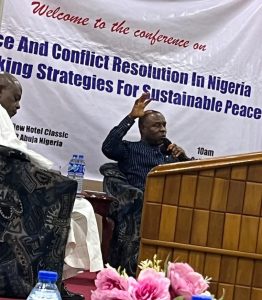
Dr Dauda Garuba, Director of the CDD West Africa speaking
For the rest of the day, they were on the move. By the time they found another village considered far enough from theirs, the old man in particular had wounds all over the legs. The children were worn out. There was no question of food yet nor of medical attention. And the father was gradually losing his memory to trauma. In the entire lower part of the district, the nearest medical facilities would be either Utonkon or Okpoga which are the extreme ends on either side. Going to Saint Mary Catholic Hospital at Okpoga was decided. There, the doctor said the father would be fine even though he could no longer recognise even the daughter, the grandchildren later brought into Okpoga with the help of motorcyclists.
In April 2025, the father died. To bury the old man was a different kettle of trouble, starting with identifying their compound in Igama Village which no longer has a single house standing. They had all been razed down. One half of the village is at a hurriedly improvised IDP camp at Utonkon while the other is at Ojapo, the most of the semi-commercial of the settlements in lower Edumoga District. This reporter had visited the IDP at Ojapo in late 2022 but had no idea it is still there until this testimony.
When she broke down, the moderator asked for any intervention from the floor. A former academic told a story of how trauma could be overpowering. He was teaching a class at the University of Jos in September 2001 when he was made to know that the town was in a violence related turmoil. The news presented an immediate challenge to him. If he told the students, there will be chaos immediately as everyone would be running helter-skelter. So, he kept teaching, pretending that all was well. At a point, he found a way out of orderly discharging of the students. At the university gate, the place had been deserted. He managed to get home but only to confront his own storm: his daughter was nowhere to be found. It was not the days of GSM yet. So, he could only contact a few top security men he knew on Thuraya but who were not immediately helpful. Only on the fourth day of the suspense did a young man bring her daughter home on a motorcycle.
It was a pure case of God’s intervention. His daughter who found safety in a friend’s house in the three days since the outbreak of violence decided that day she must get home before someone dies thinking she was dead. But, how was she to go home in the circumstance that follow such madness in Jos? At one of the barricades, the young man who brought her home identified her. He knew her parents and other members of the family although the young girl who came back from the US did not know the young man. But his description of her family members was so precise. In any case, without that young man, she could not be allowed to proceed anywhere beyond that barricade by the barricade managers. In Kaduna and Jos, unending violent eruptions has structured the city spatiality according to ethno-religious identity. So sad!.
Omada Agbo returned to complete her story but the professor’s story had shifted the session’s centre of gravity to the question: do we have state response to trauma in Nigeria? Even if there is a policy, what happens at the level of implementation? If every other policies meet their waterloo at implementation, how would it be otherwise with a Nigerian State policy response to individual and collective trauma? And, aren’t IDP camps just too numerous across Nigeria as to rule out if they can ever be well managed? Generally, IDP camps is a Nigerian State managed process. Even if state and local governments or private organisations are involved, they do so with assumed permission of the Nigerian State.
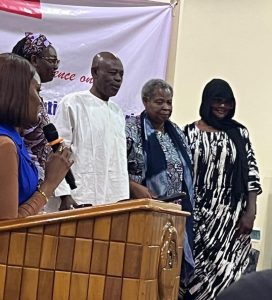
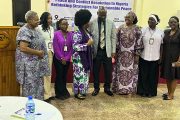
With Omada Agbo, first from the right
All the stories told speaks to the same scenario in the case of managing IDP camps. If water supply to citizens who are not in IDP camps is unsteady, how can it be steady for people in IDP camps. This is particularly so for gender sensitive structuring of the supplies. One persistent pattern is a conscious forgetting that young girls and women in IDP camps would need sanitary pads. One testimony at this conference is that young girls are turning to prostitution to fill the many gaps. The testimony came from a nurse working at one of the IDP camps inside Abuja. Yes, religious minded individuals and organisations are contributing but mainly Indomie and other food related items to IDP camps. That is great on their part but there is more than food items in IDP camps featuring children without fathers or people running extremely high blood pressure readings. In one instance, he wondered to a woman inmate how she could still be alive with a blood pressure reading over 200/160.
The scale of trauma across Nigeria deserves a trauma sector. Idu Benita Onize, a Political Science student of the University of Abuja could not be wrong to argue that she was sure every face in the room carried a story. And then told one herself. Her mother had a son. After several attempts, the son got admitted to read Pharmacy at the University of Jos. One afternoon years ago, the mother got a phone call that her son had not been seen for days. Up till today, it has not been verified if the son is alive somewhere or dead. He is presumed dead. And this is a woman who lost another son previously.
The question whether the Nigerian State has a response to trauma forced itself back again when Momoh Hajarat Hamid, another student from Veritas University’s Political Science Department asked: how else can government intervene? In other words, how more creative can the intervention assume in view of the immensity of the challenge.
In what looks like Fanon’s problematisation of the relationship between the colonialiser and the colonised, Ene Ede told the story of Fulanis somewhere in Jos approaching the team on the Rosa Luxembourg pilot project. They were complaining about their loss of their Christian friends and how this could be reversed. It is a scenario Fanon captured when colonisers met those they tortured in his clinic. In that story is the vacuity in homogenising Fulanis or the reductionism in that. While doing so is inevitable for victims, it is doubtful how far it is helpful for those like Rosa Luxembourg Foundation seeking strategies for sustainable peace. Hence the beauty in Rosa Luxembourg’s selection of conceptually more critical resource persons.
In particular, there is a problem with analysis of instability in Nigeria without any reference to the global context of it. Or to General Abacha’s thesis that when terrorism exceeds 24 hours, the complicity of the nation-state cannot be ruled out. Why the analysis of Nigeria’s own share of turmoil never touch these two layers is part of the mystery. It is doubtful if genuine seekers of sustainable peace can be grateful enough to Rosa Luxembourg Foundation not just for its works across the domains but for its topic framing and selection of resource persons. There should be nothing ridiculous if others borrow its leaves!