By Adagbo Onoja
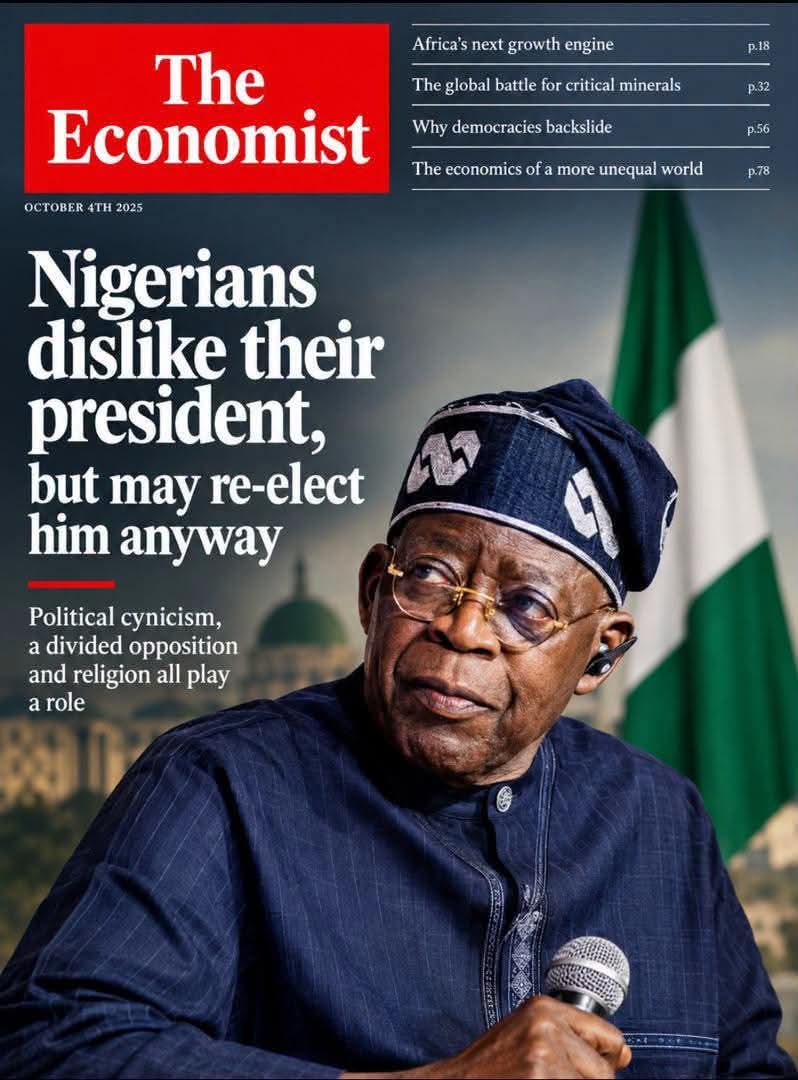
The Economist has put out a report on the possible outcome of the impending presidential election in Nigeria. Predictably, the hints there have become a subject of contending responses within Nigeria. No such report will escape reinterpretation from the diverse standpoint of stakeholders in Nigeria a few months to a presidential election.
Supporters of the Tinubu regime think it is an informed insight from afar. Supporters of opposition think it is one instance of The Economist trying to influence outcomes through the backdoor.
It’s an inevitable but needless controversy. It is inevitable because The Economist is a strong, global voice, stronger than most of its competitors. In fact, it is debatable if The Economist has competitors. It is not necessarily how many people read, an area which it is not a weakling either. Rather, it still has an advantage over almost all others except perhaps East Asia where sales figures are still in millions even in the digital age. As far as Intervention can recall, every journal article about the British weekly in the past decade attested to its power. A particular one in 2024 went very far in naming names and the power that comes from the sort of people who write for The Economist as well as its readers. While many of its writers are also the most politically located power holders in the Western world, its readership is who is who in power politics across the world. So, its reports are informed, given the location of the people who write some of its stories.
Given, therefore, the kind of people who write the stuff The Economist publishes or the ideological consciousness of those who decide its content in the last instance, there is basis for joy in Tinubu’s camp with the surface meaning of the report. But no such text has a single meaning. An aporetic reading of the same report will show thousands of its plausible meanings. That doesn’t depend on who is reading it. The impossibility of that report having just a single meaning lies more in the very nature of language or the text. As words or signifiers have no fixed meaning, so does such a report lack the possibility of a single, permanent meaning. Therefore, instead of grumbling and disagreeing or labelling the magazine, seize the text and rearticulate it to show where even The Economist which wrote it doesn’t know what it is talking about.
As if in anticipation of this, the weekly makes a lot of rooms for multivocal engagement by indicating that the Tinubu regime has a problem of popular disapproval. For Intervention, that is a sentence which can be interpreted to mean that, ordinarily, the president should lose the election. Surprisingly, no one appears to be reading the report from that perspective so far. But The Economist granted that much before overinvesting in the contradictions of the Nigerian polity to overturn itself. No writing is free of this sort of somersaults, not even what The Economist writes. It is, therefore, the interpretive hookup to positivism and rationalism of the typical Nigerian reader rather than The Economist as such that is constraining the meaning making around the report.
Otherwise, the magazine’s attention to the regime’s unpopularity is its own conscious or unconscious manner of signifying that the type and location of the people who write its content is also its weakness. That’s because there’s a limit to which the orientation of the writers will not structure the reports they write. No claims to objectivity resolves that. It is not a problem for The Economist alone but for every other players in the world, every other player who uses language.
To the extent that The Economist uses language to communicate, to that extent does what it communicate escapes a fixed, universal meaning. None of the interpretations of the British weekly’s report on the possible outcome of the impending presidential election in Nigeria is right or wrong. None. And none of them is of any use to anyone parading his or her own interpretation as victory.
It is not any group’s interpretation of the report that matters. What matters is which group hegemonises that report. That is, which group makes a particular interpretation of the report most convincing to the generality of the audience through additional reworking of it. From where Intervention stands, the recontextualisation is what the information managers of both the APC and the opposition candidates are not doing or not doing enough but that’s where the battle is.
And that’s the hegemonising or the art of making a particular interpretation of what The Economist wrote to predominate over other interpretations. In other words, what The Economist wrote does not have a single, universal meaning for everyone reading it across the world or even throughout Nigeria. Meaning is not what is communicated but what a particular reader makes of it at a particular time and place. Only holy books resist this contextuality and that’s why there is so much bloodshed over them.
Hitting back at The Economist or shouting endorsement of its report is subjective and political. The challenge is thus for the different parties to further rearticulate the report in terms of its strengths or weaknesses, depending on where each group stands with it. Calling it a bad or good report and stopping there is a weak response to it because meaning cannot be stabilised. Doing so is the same as assuming that those who wrote the report have a full grasp of it. That’s not possible because language has no master. Language is its own lord. It uses people rather than people using it.
The unhappy reaction from opposition parties is understandable but the reaction would have been different if The Economist had speculated that the incumbent would lose the election. That’s where and why no one should assume that the report has an iron cast meaning.
Nothing said so far suggests that the report is not a powerful prompter. Intervention is ready to grant that it is but that depends completely on which side rearticulates it to its own advantages. What might be missing is expert knowledge of the tactic of articulatory practice because whenever articulation is mentioned, most people think it is grandiloquence, languaging or capacity to string words together beautifully. No. Articulation or articulatory practice is a meaning-making practice. Meaning making is beyond words.
The author writes for Intervention