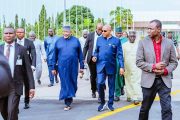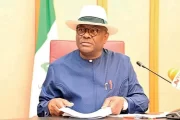
A concerned, angry but defiant ensemble of radical activists has declared Nigeria a dying entity. Speaker after speaker at the Second symposium marking the burial of Dr. Segun Samuel Osoba, the ex-Obafemi Awolowo University, Ile-Ife Historian in Abuja July 28th, 2026 drew from history to show how this is the case.
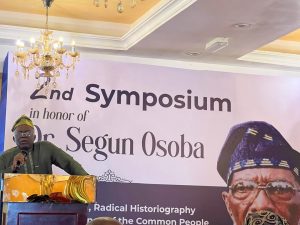 In one striking example, it was recalled how the country where a military Head of State tore an irritating letter from an American president into pieces is now where a letter from another American president “hated all over the world” is serving as a mark of approval. Femi Falana, Lagos lawyer and human rights czar who chaired the event says Donald Trump is only popular in Nigeria’s Presidential Villa, contrasting the United States with Cuba which, along with Nigeria, was considered a frontline state in the struggle against apartheid.
A Cuban diplomat and her Saharawi Arab Democratic Republic counterpart were part of the attendees at the symposium, with the Cuban diplomat garnering rounds of applause for her statement detailing the heroic resilience and struggle of Cubans against US blockade of the Island under the Trump administration. Veterans of the radical struggle in the seventies and eighties, politicians, former student leaders, labour activists and sundry radicals attended the one day symposium which, surprisingly drew representative elements from every class, gender, region and religion.
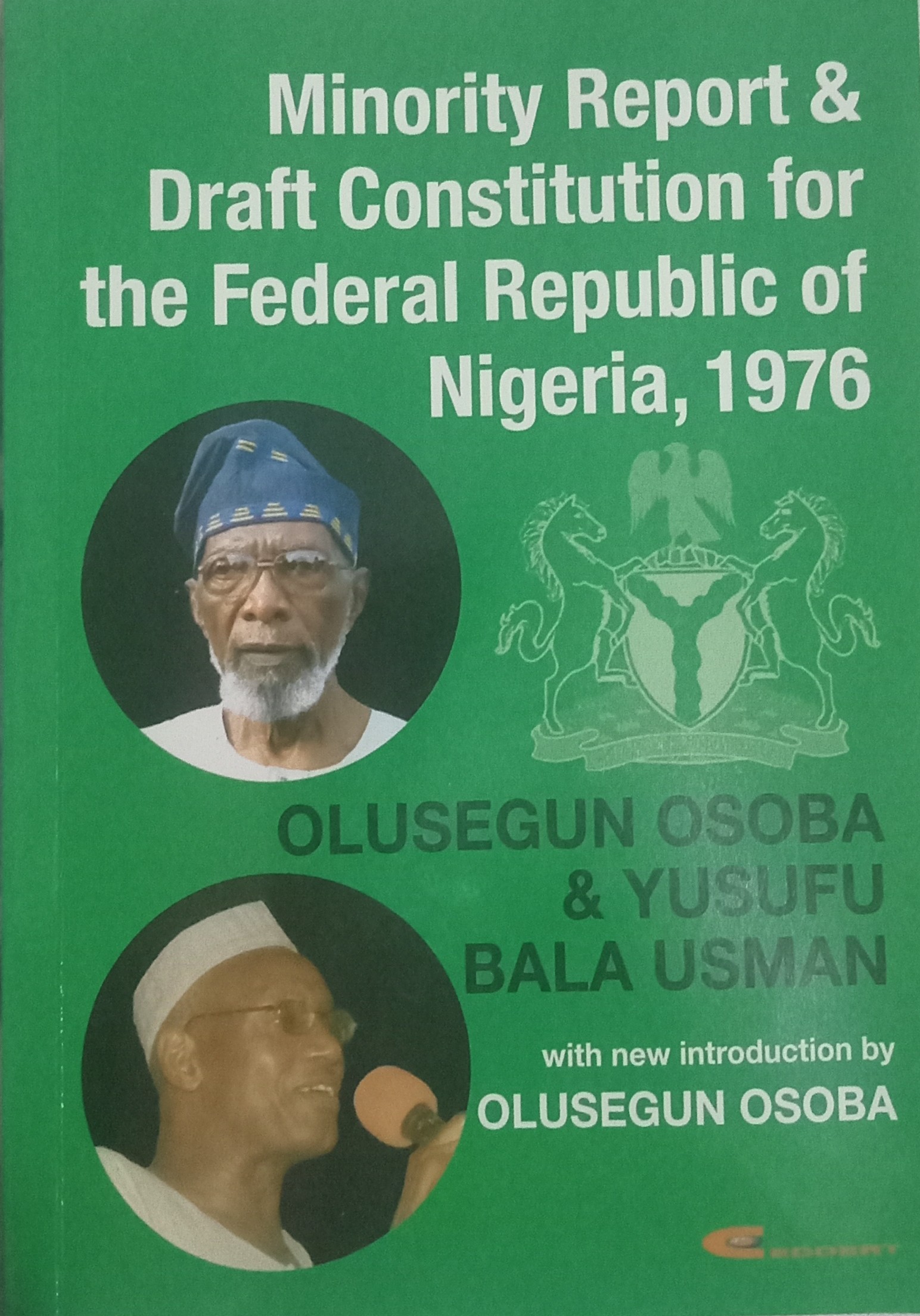
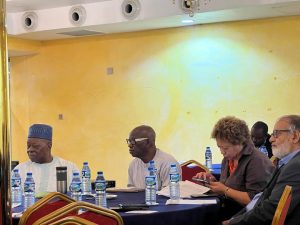 Falana kickstarted the symposium by situating Dr. Osoba in the legacy of the Minority Report he and fellow Historian, Bala Usman, wrote in 1977 as members of the Constitution Drafting Committee (CDC) instituted by the late Gen Murtala Mohammed Administration. The two Historians not only disagreed with the 47 other members of the CDC but also went ahead to submit a minority report which the Federal Military Government headed by General Olusegun Obasanjo rejected. However, the CDC made a concession to the duo by taking from the Minority Report what is today the Chapter Two of the existing Nigerian Constitution. But they did so after defanging it by making the provisions of the Chapter non-justiciable, meaning that, although the egalitarian provisions are enshrined in the Constitution, citizens cannot go to court to enforce them. The CDC’s argument is that the FG could not have the resources to provide those free this and free that. In other words, they rejected the argument that if a serious government wants to fund those provisions, money would not be its problem.
Falana’s argument is that the National Assembly has made many laws which operationalise Chapter Two somehow if only the labour movement of today had defined the workers struggle beyond asking for salary increase to more fundamental issue-areas as seeking for housing for workers, for example. He cites a number of such laws as the Child Rights Act which insists on free, compulsory, basic education for every child and two others in the health sector, especially the National Pension Commission where 30 trillion Naira (from contributions of workers) has accumulated and from which the Federal Government is now awarding itself loans, with state governments also angling for the pie. It is similar to the UBEC Account where 100billion is lying fallow because many state governments have not prioritised basic education.
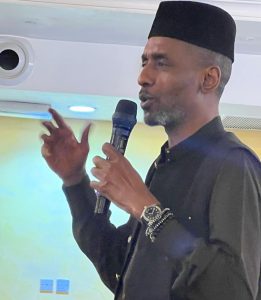
Attahiru Bala Usman
Prof Julius Ihonvbere, the federal lawmaker from Edo State spoke next. More important than what he said at this event is how he in himself illustrates the claim of Nigeria as a dying entity. Anybody who listened to him framing the gender issue at the Kano Constitutional Review Conference in 2025 would think that is the sort of resource person the system will ensure is retained to do the intellectual work and give credibility to the system. The news now is that, by the APC electoral arithmetic, he did not win the party’s ticket to return to the House of Representatives in 2027. A system survival minded observer would say that the NASS needs an Ihonvbere more than an Ihonvbere needs the NASS.
Mallam Y.Z. Y’au, a leader of the Planning Committee made up of the Osoba family, the Academic Staff Union of Universities (ASUU) and the Bala Usman Institute in Zaria and which worked on the symposium said Dr. Osoba symbolised beyond any locality as for a symposium not to be held in Abuja for him. That is why, he said, beyond the earlier one in Ijebu-Ode, the July 28th, 2026 version in Abuja became inevitable so that Osoba’s body of ideas would circulate beyond academics and academia. The Osoba family, he said, had widened to a pan-African family.
These set of interventions set the ground for the symposium proper which began with Prof Jibrin Ibrahim. Jibo recalled the joy of learning from Osoba’s culture of hosting academics at the OAU Ile Ife Staff Club, specifically from his exegesis on the Nigerian establishment. Of course, the Ife Collective – the collective of socialists based in the university – was an additional attraction for Jibo in going to Ife but it was from Osoba he learnt characterising the Nigerian State and the sort of elements who people it. Jibo’s testimony is that Osoba whom he said was well read showed such people to be ignorant, shallow, selfish and lacking in critical perspective of their role in power.
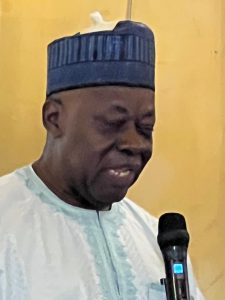
Prof Jibrin Ibrahim
The Minority Report Osoba co-authored with Bala Usman is, for Jibo, beyond its specific provisions but more about questions such as who actually own the Nigerian State or what purpose it exists for. He ties that to the larger conclusion that, since the French Revolution, the state has only made sense when it belonged to the people. He says this is Osoba’s message to the progressive community, adding that as a historian, “he (Osoba) got us to understand where and when the Nigerian State got it wrong”.
The first point in this, for Jibo, came in what led to the COLA (Cost-of-Living-Allowance) mobilisation between 1945 and 1952, it involved the conscientisation tour by pro-people activists such as Michael Imoudu, Hebert Macaulay and Zik of Africa across Nigerian communities. What this cost of living crisis exposed was that colonialism had led Nigerians to misery because colonialism was all about taking away the resources and freedom of Nigerians to develop the mother country. The positive side of it was that the COLA nationalists found in that reality the basis for agitation for independence. But the point is that the crisis of instrumentalising the state for the benefit of others instead of the people did not start at Independence in 1960 but much, much earlier. The difference today is that unlike before the oil boom when government had to persuade peasant producers to produce, to pay tax and so on, the oil boom has made any such interaction completely unnecessary. Oil rents are taken by those running the government on behalf of a few oil multinationals and the loot is used for personal aggrandisement. And it is such that, in the worst COLA experience since 2023, there is no replica of COLA nationalism anywhere.
So, Prof Jibo’s point is that mobilising and resisting these category of forces requires understanding history, his own sense of what or how Osoba had used radical historiography in defence of commoners: defining purpose of life beyond accumulation for self-aggrandisement.
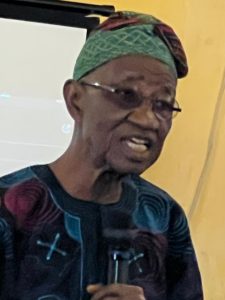
Prof Olorode
The baton moved to Prof Toye Olorode, the veteran’s veteran, still too nice to be the typically rugged socialist but even more socialist as to be called the youth leader at nearly 85. For something like a reward, God gave him the physique to remain the way he has almost ever been. Based in the same OAU, Ile-Ife and very close to Osoba in age, Olorode is one of the best witness to the great Historian. He could thus cite so many quotations of Osoba to illustrate one point or the other.
Prof Olorode is generally happy about what they did. “Our struggle was an inter-generational struggle”, he said, naming one activist or the other from each of such generation in the hall to demonstrate this thesis. It was also international as, from Ile-Ife, they could connect in solidaristic ties to points of struggle on the continent in those days: Angola, the ANC in South Africa, Eritrea, Western Sahara, Cuba and so on.
He fingers exploitation and unending elite submission to external forces as the key factors which shaped the crisis in countries such as Nigeria. Unfortunately, said Olorode, nothing has changed in that respect. “They still come here every February to assert themselves over the Nigerian elite on Article IV Consultation”, maintained Olorode, a reference to the IMF’s monetary credo’s on subsidies, taxation, revenue controls and budgetary pegs. It is for this reason that he doesn’t think progressives should waste too much time on seeming progressive laws because he doesn’t think the ruling class in Nigeria has the capacity to supervise even the most mundane welfare package. “The law belongs to them and they decide which one to obey”, he declares, citing how Obasanjo ran Nigeria with ministers appointed and posted from the IMF and the World Bank.
But then he moves to the crucial and sensitive question: shouldn’t this be an opportunity to restrategise? He doesn’t think the Left in Nigeria is caught in any Sisyphean trap of rolling the boulder up the hill only for the boulder to slip down each time. “Osoba is an example we can copy” and he is not exempting himself because his statement actually starts with himself or their category: “we who have experience of mobilisation should not be tired”.
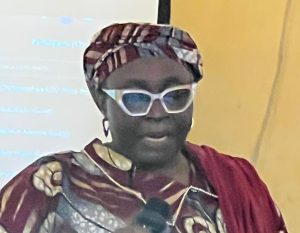
Cde Hauwa Mustapha
Comrade Hauwa Mustapha connected with the topic very well, arguing that Osoba’s historiography made feminist and the radical project complementary. The result is that unlike masculinist historiography, Osoba gave agency, voice and, therefore, power to peasants, traders, women and other marginalized categories. It is a heavy claim to make but Hauwa moves to prove by asserting, for example, that colonial archives, notorious for any and everything, gave the impression that women were no more than appendages or supporters of males, mainly chiefs, warlords, business leaders. Osoba thus emerges as the hero here as the challenger of the historical absence of women in historiography, something Hauwa (and most feminists) consider to be crucial because women have aspirations and strategic concerns that men cannot privilege because men are not women.
Prof Olutayo Adesina attended the symposium from the University of Geneva (not from somewhere in Germany as incorrectly reported earlier on). He is a tutee of a tutee of Osoba and should have been a veritable source of contextualised self-interpretations of Osoba. That will, however, not happen in this report because, somehow, technology denied good flow of what he was saying. At one point, he was heard saying that Osoba made Philosophy of History class such an exciting adventure but the next sentence was not what this reporter got well.
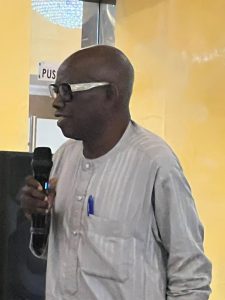
Prof Adele Junaid
It was an interesting symposium, if only for bringing in such a diverse signifiers of the tendencies, from Baba Aye to Chief Wole Olaoye (a former president of OAU Students Union Government before the days of NANS), Omoyole Sowore (ex-president of UNILAG Students Union Government, publisher of Sahara Reporters and a presidential candidate who told the story of being put inside people suffering from Tuberculosis recently in Kuje Prison for 11 days, amongst others), Attahiru Bala Usman (a son of the late Yusufu Bala Usman), Ene Obi (the chief protagonist of ‘Nigeria is dying’) and above all, Prof Adele Junaid, the elderly political scientist but who raised what seemed to be the question of the day. The question is: what exactly happened to the Left in Nigeria? And he wants to know how going forward may look like.
His question has extra significance in the context of the current disarray in Nigeria. Chief Olusegun Obasanjo shocked the nation recently by warning of another possible civil war, showing a surprisingly dated sense of where Nigeria currently is. Where it is has gone past a civil war and a more informed military assessment should have been talking of the different strategic possibilities by now. That sort of assessment is not featuring in current discussions of the disarray mostly because many are still lost in unproblematic territorial excusing of themselves from Nigeria should things come to that. In military terms, they may be dreaming.
When plausible strategic possibilities are considered, Prof Junaid’s question is indirectly about whether a Left that can re-emerge and craft a unifying narrative for incommensurable identities and interests committed to retaking and remaking Nigeria is still possible? He implies, by implication, that such a Left has a few things to unlearn and still a few more things to learn in its grammar of practice. It may seem that his question makes today’s symposium something for everyone, even more important for those who are not Leftists.