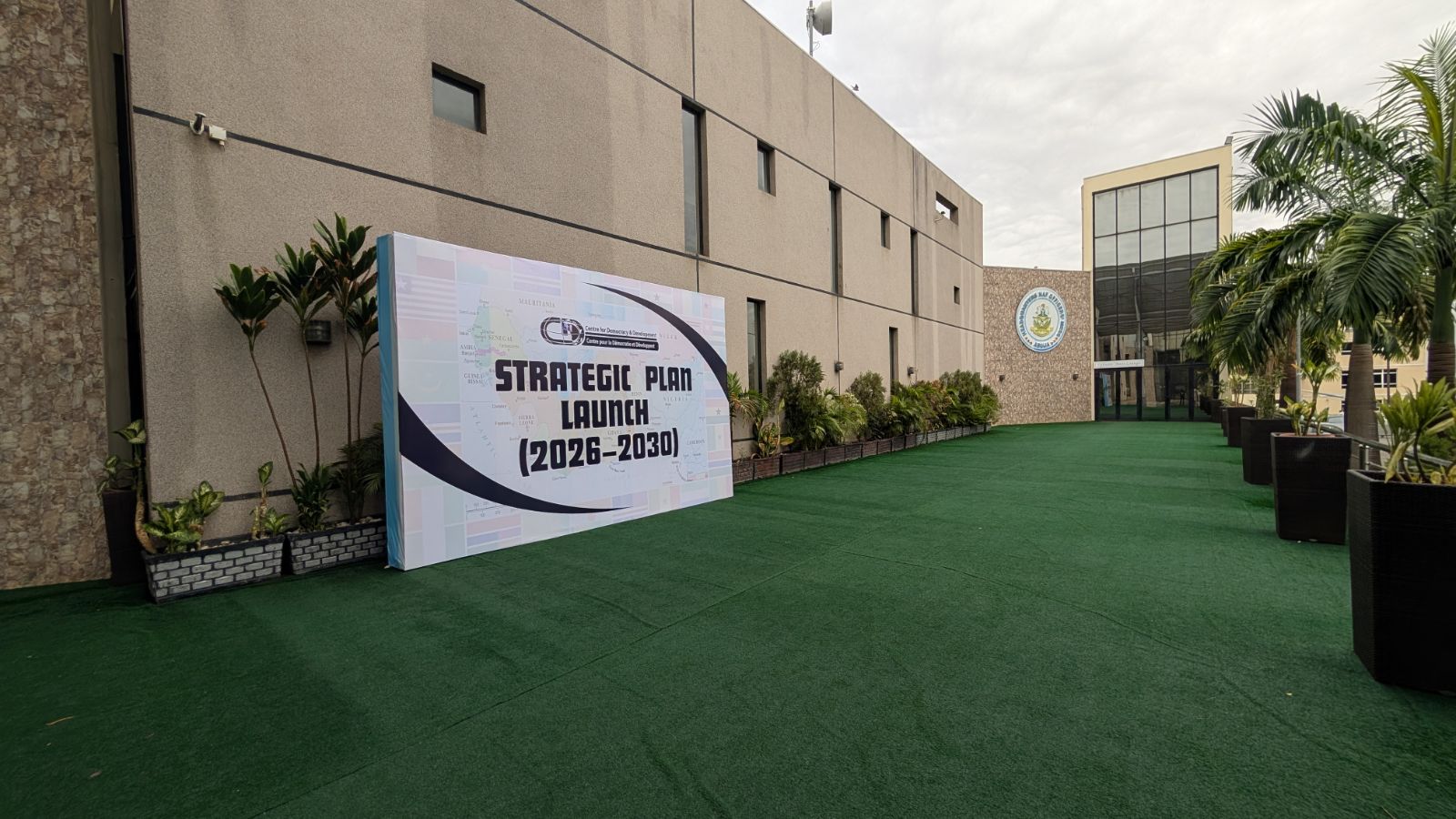
Democracy and development, the two explosive variables behind the Centre for Democracy and Development, aka CDD-West Africa each got hopelessly tattered scorecard earlier today (March, 31st, 2026) in Abuja, Nigeria at the high profile public presentation of the centre’s 2026-2030 Strategic Plan. But the CDD is assuring the sub-region and the continent of its retooling with the aim of contributing to reversing the ugly trends. This aim is what the 2026-2030 Strategic Plan will help CDD accomplish, said.
Leading players in the CDD-sphere at the event expressed confidence in CDD on the basis of track record but also brought to the fore a paradox around CDD: worrying about the same type of conditions such as authoritarian breakdown in Nigeria (June 12) and collapse of central authority in Sierra Leone which provoked it into existence nearly 30 years ago, this time a flux at the global, sub-regional and the national (Nigeria) levels.
CDD Director, Dr. Dauda Garuba who opened the page on the largely regressive dive for democracy as well as development in the sub-region took note of the mixture of progress and setbacks West Africa confronts: While countries like Senegal and Ghana show signs of democracy, others struggle with growing authoritarianism. Peace is fragile, especially in the Sahel, and many people still face poverty and inequality.
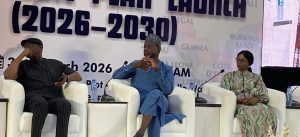
Prof Okey Ibeanu, moderator and two of the six panelists, Dr. Husseini Abdu and Dr. Nana Tanko
He did not forget to mention recent threats to democratic progress in the form of military coups, “changes to constitutions by civilian leaders (as in Cote d’Ivoire, Guinea, Republic, and Togo), less trust in elections, poor governance linked to corruption, and the rise of military-led populism in countries like Guinea, Mali, Burkina Faso, Niger, and Guinea-Bissau”.
Development, the second concept driving the CDD pathway did not fare better either as poverty and inequality have worsened in West Africa, according to the Director who quotes the 2024 Global Report on Food Crisis’ estimate of 44.3 million people in West Africa and the Sahel facing acute food insecurity, 9.7 million forcibly displaced by food crises in 13 countries and 14 million children acutely malnourished in 14 countries.
But it was the Chairperson of the International Governing Council of the CDD, Comrade John Oda who led the way on how CDD would fulfil its recommitment to arresting democratic decay. It is by unleashing the outcomes of CDD research based interventions. “As we all know, research outcomes are lame if they remain on shelves and in cupboards. Making research outcomes to inform policy action requires simultaneously addressing the gap between research outcomes and research users, as well as improving the actual update of research outcomes by actors”, said Comrade Odah who declared this to be the central concern of the Strategic Plan.
To enhance its strategy of instrumentalising research, CDD-West Africa will, according to Odah, actively foster partnerships with African universities, research institutions, and think tanks across the region, with the intention of enriching its research capacity, encouraging intellectual exchange, and amplifying collective impact on democratic governance and development. “By working closely with academic and research partners, the Centre aims to ensure its policy recommendations are grounded in rigorous scholarship and reflective of diverse perspectives throughout West Africa”, declared Odah.
That, as he put it, is how CDD would generate robust evidence and pioneering policy initiatives and land in influencing agendas as well as stimulating meaningful discussion at national, regional and on a continental scale. That way, it would be possible for it to strengthen collaboration with national governments and forming strategic alliances with regional and continental bodies such as the Economic Community of West African States and the African Union, thereby “establishing CDD-West Africa as a respected authority and thought leader in the sector”. In other words, Odah anticipated the flurry of very poor scoring for the democratic idea which followed his speech.
Democracy is at an inflection point in Africa, said Dr. Kuti Ango Dada who represented the Head of the Conference of Speakers of African legislatures. The challenges to constitutional order require collective institutionalism, a requirement she finds the CDD good fit to raise the stake.
 Former governor of Ekiti State and an ex-Director of CDD, Dr. Kayode Fayemi who was more elaborate on the paradox drew attention to how, 30 years after the events leading up to the formation of CDD, nearly the same set of problems persist. While noting few cases such as Senegal and Ghana where civil engagement seems to have prevailed in reinforcing the democratic aspiration, Dr Kayode, however, declared “We are at a critical junction in the sub-region”. The ground, he said, is shifting around the globe in which West Africa is not an Island, declaring that there is paralysis on the continent as to require mission rejig of a CDD.
The former governor scored the CDD high in coalition building on a continental scale, a claim he reeled out a long list of institutions or coalitions that resulted viz the Institute of Security Studies in South Africa; the Centre for Conflict Resolution in Cape Town, South Africa; Citizen Forum for Constitutional Reform; West African Democracy Network; International Criminal Court Coalition; the West African Civil Society Forum (WACSOF) and so on. So, CDD has been there, a prime catalyst”, he said in obvious agreement with Dr Dada who had said that the Strategic Plan is not just another document but CDD’s declaration of where it stands to those it works with.
A leading figure in the policy mill, Waziri Adio, endorsed the idea of the world, West Africa and Nigeria all going through a flux. But he sees CDD-West Africa as an important institution, saying institutions which endure are those which develop strategic view of things. Dr, Dayo Kusa, the independent conflict transformation expert credits CDD with critical perspectives on governance (as different from government). Dr Danjuma Aku who stood for ECOWAS Commissioner for Political Affairs, Peace and Security thinks CDD can develop an applicable version of the African Peer Review Mechanism (APRM) and should take that as a challenge.
Returning to the crisis of uninspiring performance of democracy, Prof Jibrin Ibrahim asserted the inevitability of crisis once Africa was stopped from planning and could hardly have escaped crisis. Only countries such as India, Brazil, China and the South Asian performers which planned have had anything to show, he said.
Who stopped Africa from planning? Prof Jibo put it to the IMF and the World Bank for whom, he said, the ideology of the market as the pathway to progress had remained sacrosanct, irrespective of the facts of the matter until this month when the two are reversing themselves. He gave the example of Nigeria whose Tafawa Balewa regime went ahead to endorse central planning, a tradition the military continued very much against Western patrons and the IMF/World Bank, especially the development of iron and steel.
Thus only the defunct Soviet Union was able to take up building the Ajaokuta Steel Company but which was still successfully stalled by the same influences
Chapter Two of the current Constitution of Nigeria which insists on the Nigerian State controlling commanding heights of the economy was aggressively dismantled by the Obasanjo administration between 1999 and 2003 as Obasanjo said he had been advised by the Bretton Woods institutions (IMF/World Bank) that Nigeria could not develop through that way. Prof Jibo further added that, unfortunately, civil society protestation of Obasanjo’s development strategy framework called NEEDS (1 and 11) never focused on that breach.
For him, the way forward is conscientising the individual citizen as a guarantor of democracy in him or herself rather than relying on leading crusaders for democracy. His assessment of them is that they end up betraying and not being different from those regarded as the opposite. He drew his inference on four examples: Abdoulaye Wade of Senegal; Alpha Conde of Guinea; Obasanjo of Nigeria and Mamadou Tandja of Niger Republic.
Prof Victor Adetula who served as intellectual coordinator of the Strategic Plan process said it was a case of realigning vision and mission with emerging realities without CDD losing its continental vision. He listed gender, climate change, youth and sustainability as the strategic objectives.
The big question was what a panelist of five took up. Moderated by Prof Okey Ibeanu, the panel was challenged to unpack the topic: “Failing the People or the People Failing? Reflections on Democracy and Development in West Africa”.
That will come as part two of this report although the interesting gist from there is the way the first round of answers from the panelists disrupted the consensual sense of democracy across Nigeria. There is an observable unproblematic engagement with the concept of democracy as if democracy is a settled concept. The attitude, observers note, is the same, from the civil society to politicians, journalists, academics and just about everyone! And the question is whether that essentialism is not where the problem lies!