
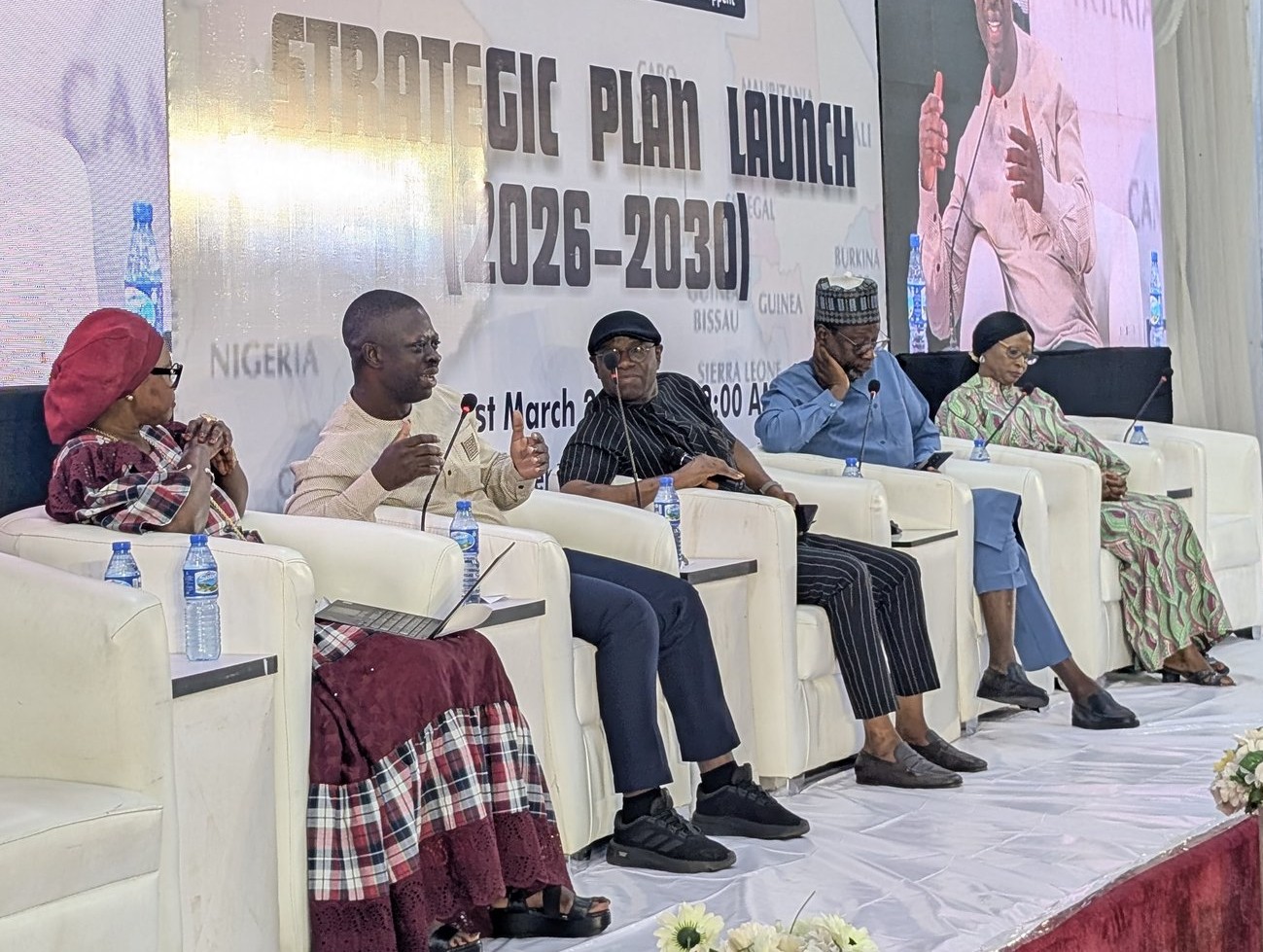
On March 31st, 2026, the Centre for Democracy and Development (CDD-West Africa) launched its Strategic Plan for 2026 – 2030 in Abuja, Nigeria. This is the second and concluding part of Intervention’s coverage of the event. The first instalment came under the title CDD-West Africa Unfolds 2026 – 2030 Strategic Plan, Vows Cracking Democratic Deficits in the Region.
Every reality, we are told, must have its discursive condition of emergence. In apparent agreement with this powerful premise, CDD-West Africa threw in a blast from the past into the ongoing struggle for, with and over democracy across the world. The blast was titled: ‘Failing the People Or the People Failing?’: Reflections on the State of Democracy and Development in West Africa”.
Two Nigerians, a Senegalese and a Ghanaian made up the panel, almost equally shared between the genders. It turned out a loaded frame game, engaging with which revealed the messy nature of the contestation around democracy and development on the continent.
 Prof Okey Ibeanu who moderated the discussion gave an inkling of what was to come when he summoned to memory a poetic lens on the elite – mass dichotomy puzzle in development politics in Africa. He recalled the poetic reinscription of an encounter between a peasant and a politician. According to his recollection, the peasant citizen was asking an elite politician troubling questions about what and when of democratic dividends consequently upon independence. What was in it for his children, when would his children get whatever is there and would what they get be of the same quality as the house, car and so on that were the politician’s? The sum of it all is that it didn’t take long before the politician got to the saturation point and asked the curious peasant to be locked up.
Quite an interesting recollection, made more so by a similar text which the poetic lens dialogues with on the permanent tension enveloping the independence-democracy-development nexus in Africa in one of Achebe’s novels. Achebe was saying the politicians had found a way out of the puzzle. And it is in asking the masses to learn to be patient because if they chose the path of vigorously asserting themselves, they ran the risk of bringing down the temple and messing up the independence. After over 60 years of independence, the masses are still waiting.
Anyway, Prof Okey’s panel got off to a turbulent take-off. Dr. Marie Soumare, the first panelist to speak started by asking: which people are we talking about? It is not me. It is men. Women, she said in her own vocabulary, occupy a subject position that leaves them with no time to organise to even be part of anything politics, what with all the burden of always managing one man or another: father, husband or son. It is a process which leads to the death of many women across the world, a trend worse in (West) Africa.
In few words, she problematised democracy in terms of patriarchy, meaning that, for her, the democratic backsliding everyone is talking about is traceable to the exclusionary outcomes of patriarchy. In other words, she was invoking the feminist protest in a very specific, spatial sense: patriarchy in Africa and its organisation of politics in a manner deleterious to women.
The significance of her contribution is the way she took the problem from politics to the political: how men outsmarted women by constructing an order of meaning that was performative of women through citationality: a woman should not eat this, a woman should not dress like this, a woman should not be out so late, and so on. Men have constituted the space by always calling on ‘our culture’ or religion or tradition to find justification and authority for why women should not do this or that.
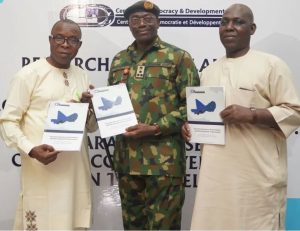
(l-r) CDD war leaders: the Director, Dr. Dauda Garuba and Comrade Odah, Chair of the CDD International Governing Council, @ a previous event
A lot of these have been deconstructed but a lot remain to be deconstructed and her point is that much of what remains to be radically deconstructed are in Africa, complicating democracy. Her position finds empirical demonstration in CDD Director’s figures of poverty and maternal mortality.
Dr. Nana Tanko who spoke next did not disagree with Dr Soumare although, in her, we came across a shift from patriarchy to orientation crisis around the independence – democracy – development continuum as the problem. She was keener on the point that the expectation index or what she called the definition of success (of the independence cum democracy) was too automatic and immediate. This became a problem once it was a democratic movement led by individuals who found themselves having or willing to manipulate. So, she could see both the people and democracy in a co-constitutive contribution to the crisis of democracy and development in (West) Africa. But she added the encouraging line against getting frustrated. Rather, there is no alternative to the option of restrategising, going back to the drawing board.
Dr Husseini Abdu had his own point of departure in the straightforward formulation: what do we expect to see if the definition of democracy did not include the people at the founding moment? He wondered what the role of the people was in the politics of defining democracy. If the people were absent at the founding moment, then it should not be surprising to find them edged out in the practice of democracy. He argues how, in most cases, the governance structures diverge diametrically from the popular structures. In framing the gap that way, Husseini lands the discussion back into the elite-mass dichotomy binary in its African context.
Intervention did not listen to the entirety of the panel discussion. Nevertheless, it can infer from the three different standpoints (Intervention didn’t get Dr Paul Osei-Kuffor’s contribution) that there is a conceptual disarray over democracy in West Africa. This inference may not need much justification if two huge collectivities such as the women and the people (or the masses) that ought to be the biggest centres of power in the democratic field of play are not central. The third should be the youth category and then the working class and the elite as the fourth and fifth. If that is not the case, for whatever reason(s), then something is wrong somewhere.
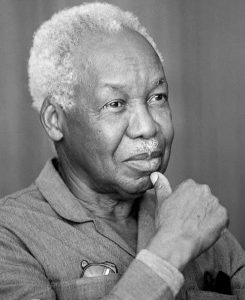
Nyerere, for example, did not accept elections for the same reason!
Could this then be the moment those who have been querying democracy anticipated? Claude Ake declared liberal democracy to be an inferior variant of it in a paper he delivered in 1992 in Uganda. Archie Mafeje asked the question in 1992: what is the substantive meaning of democracy in Africa?’ Around that time, Bjorn Beckman spent considerable time articulating popular democracy. As the post-Cold War progressed, the black box called liberal democracy attracted more queries beyond Africa. The longest and the most surprising must be the December 21st, 1996 survey in The Economist where electoral democracy was described and dismissed as but part-time democracy. The writer went further to submit that “democracy in the 20th century has been a half-finished thing”. “In the 21st century, democracy”, said The Economist, “may realise that it has so far been living, for understandable reasons, in a state of arrested development”.
The standpoint divergence in the position of the three panelists may thus have not come to critical observers as a surprise. Democracy has been in a state of flux as for platforms associated with conservatism such as The Economist to deliver the upper cut it delivered in 1996. Not surprising too is the question some observers are asking: why is it still the case that democracy is discussed in much of Nigeria as if no dislocation has occurred? They ask for where this culture of trembling before democracy in Africa might be coming from. Trembling before the concept can be alleged because of the consensual manner people talk about democracy. It has largely been such that much of what comes out of the discursive space in Nigeria is echoing of taken for granted meaning of democracy.
One result of that consensual engagement with democracy is that other variants such as social democracy, socialist democracy, popular democracy, African democracy, council democracy, deliberative democracy, communitarian democracy have all disappeared in favour of just liberal or multi-party democracy. Yet, that is the very variant that has received the most scornful rating by the boldest of African intellectuals of power as already mentioned.
Thus the March 31st debate on which, between democracy and the people, is failing the other has a contextual significance beyond the routine. There is a reminder in that panel about what has been lost and how CDD appears determined to reclaim the loss. And the loss has been the culture of going beyond received wisdom in engaging whatever was being engaged then, no matter which quarter it came from.
Nigeria’s concentration of not just radical activists but well educated elements makes the observable magnitude of deterioration since 1999 incomprehensible. That should not be the case because it means the knowledge/power paradigm is an absent category in Nigeria. And such could only have been possible if the discursive space (concentrated in academia, civil society and the media) experienced a strange loss of “cabin pressure” that never happened to our predecessors. Otherwise, the past was qualitative beyond the radical circuit.
Imagine Mallam Adamu Ciroma saying at the onset of IBB’s auctioning of the Naira (SFEM) that if Nigerians should be careful or they risked becoming the fools of the market. That is exactly what has happened to Nigerians today. Intervention is not sure immediately but Ciroma’s interview must be in one edition of Chris Okolie’s magazine (the business version, not Newbreed). That should be the interview where Ciroma said he was “in danger of making money” shortly after becoming Governor of the Central Bank. Flashback to Prof Sam Aluko saying at some point that it is only when you want a different currency in the United States that you know that American capitalism is not the same as capitalism elsewhere. For that reason, he insisted and had his way with Abacha that Nigeria could not go with a consensual meaning of deregulation. It must be what he called ‘Guided Deregulation’ because, as he explained, while the companies being privatized by Thatcher in the UK were actually seized from the owners by the British State, the privatisation dictated to Nigeria was about selling what the people’s money was used to build. So, his notion of ‘guided deregulation’ had a strong, statist ideological connotation.
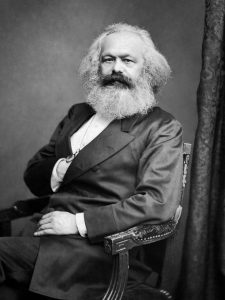
No social theory can explain everything timelessly.
When we move to elements such as Dr. Tajudeen Abdulraheem, we could see him juggling Marxism, postcolonial theory, feminism and a variant of socialism all at once. Reading his Postcard stuff was always about encountering a merger of gender, race, class and even religion effortlessly, escaping the points of tension in every such attempt. He demonstrated that he had transcended the ossified Marxism paraded in many quarters in 21st century Nigeria by hopelessly irredeemable essentialists for whom the debates, tendential tension and splits in the history of Marxism did not occur or occurred but left no lessons for anyone. Theories do not expire. On certain issues, the world would have no alternatives to Marxism. But, like every other social theory, it is not flaw-free. It is the challenge of living Marxists to spot and subject epistemological and theoretical flaws in Marxism to critical reformulation. Of course, Marxism can be such a fascinating realm but, as has been pungently pointed out, “Marxism inherited the linear causality of the Enlightenment and suffers from the incompleteness of that dualism”. That remains a major problem for it. That is, however, not something to hide but something to confront and, by doing so, add value to that body of knowledge. That is why Marxism needs more of its critics rather than the idol worshippers. Its critics are, unlike the years of debate in Zaria, what is missing in Nigeria.
Intervention has always wondered why Swedish Marxist scholar, Goran Therborn, listed the United States and Nigeria as the only two countries where Marxism-informed socialism made no impact in terms of a mass party in the 20th century. That is what he said in the longer version of his 2006 article “After dialectics: postmodernity, post-Marxism, and other posts and positions”. Could he have been providing empirical evidence for the instructive joke in Wale Adebanwi and Ebenezer Obadare’s Introduction to Nigeria at Fifty: The Nation in Narration? The joke goes as follows:
There is absolute higgledy – piggledy – economic collapse, political commotion, wars, social dislocation, tsunamis, etc, etc – in the world and all nations of the world decide to meet God in Heaven to ask for when their great tribulations would come to an end. Every single country that comes before God does so in sublime supplication and with torrents of tears, pleading for knowledge of when its problems would end. The Almighty obliged each country, telling it when all would be well. Some got 10 years, others were promised 25 years, others about 50 years. When Nigeria staggers before the Almighty to ask God for when her problems would be over, God burst into tears …
For Intervention, one plausible inference could be that Nigeria may not only be sick at the level of historical misgovernance, it may even be sicker in many of the arteries of the society and God might have burst into tears in pondering on the magnitude of the ill-luck of one of His creations. How would Almighty God not burst into tears when the cottage industry crusading against corruption in Nigeria is yet to flashback to the quiet alternatives to dramatic arrest of corruption suspects after the fact of the matter that were suggested but disregarded by the Buhari administration in 2016? Is that not worth a civil society campaign subject matter? And how is it that Nigeria’s discursive space and its crusaders against corruption don’t see that it is too much to expect from governors and presidents and other chief executives signing big contracts enriching their school mates, neighbours, tribesmen and women who became businessmen and women but go home poor. How is it that intellectuals whose job is to identify paradoxes haven’t paid attention to this?
Similarly, Chief Olusegun Obasanjo has let it be known that the word opposition cannot be found in any African language, meaning it is strange to Africans. Yet, we have a democratic order in which opposition is a pillar. And we expect the democratic order to work! If it is not part of our self-understanding, why doesn’t that call for democratic innovation, towards what Nyerere was contemplating and for which Museveni argued much later? Is it not researching puzzles and disseminating them into sedimentation that ought to translate into the knowledge/power praxis? Or, are we waiting till someone arrives here from Europe to research this before we start complaining?
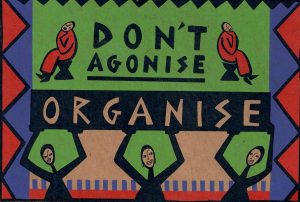
Discursive warfare through imaginatively applied Marxism
Nigeria today cannot rule out a large scale ethnic violence. Marxists constitute the only collectivity that could prevent that possibility because they had moral authority in popular psyche as a result of their vocal investment. Today, however, there is no Marxists collective that can force state action through conceptual warfare or Gramsci’s ‘war of position’. Having dismissed ethno-religious identity as secondary contradictions, they lack a framework for understanding the constitutive force of ethno-religious mobilisation. Above all, they are too divided in their explanation of chaos. It is all there on display on Facebook. The implication is that, by disabling themselves into a do-nothing position, they are, indirectly, partaking in the possibility of such violence. And one wonders if they will be able to sleep in the event of large scale number of women carrying children and paltry belongings in flight from anarchy, the sort of embarrassing scenes that have become the nightmare across Africa. The list of everyday failures of Marxists and intellectuals across Africa arising from complicity by inaction can go on and on and because Nigeria is the most populous, the guilt index is highest for Nigerian radicals and intellectuals. In the past, they spoke out and with persuasive force.
It is not the exclusive responsibility of CDD to undo the loss of critical stamina. Other actors in the discursive space have their own share of ending conceptual trembling before received wisdom, whether the concept is reform, democracy, Capitalism, Socialism, Deregulation, Marxism, market economy and what have you. But a CDD point of departure is always welcome as a minimum requirement. That way, it would not only be paying homage to the praxis universe of its founders, particularly Tajudeen Abdulraheem, and his gung-ho approach to African cause positions, CDD would also be providing a guarantee against a repeat of the paradox around CDD which Dr Kayode Fayemi drew attention to: the plenitude today of some of the types of crises in the sub-region which provoked CDD into existence in the first case some 30 years ago.
This is more so that CDD has declared cracking democracy and development deficits in the sub-region as a key task as CDD Director did last Tuesday, followed by Comrade John Odah, the Chair of the International Governing Council of CDD’s checklist of how CDD would accomplish the mission: research, collaboration and advocacy. All that is left in leading a return to the tradition of critical reflections in a sub-region whose discursive space has suffered decapitation from conditionalities and extraversion is to think about how CDD’s research and advocacy are going to prevail on whichever subject matter anyone can think of in a world overflowing with abundance of think tanks, many of them richer, more entrenched and more powerful at both the global and national levels than CDD. That is the challenge of the discursive politics for discursive players in Africa, a challenge which calls for abandonment of essentialism and positivism and their circuitousness in favour of mastery of democracy as an open, pluralistic, radical and agonistic process.
It is a realm in which feminists (of the thoroughly radical hue) will be most helpful to CDD than any other sets of resource persons. Having led the most successful revolution in human history through discursive change, radical feminists have so much to teach the current phase of the struggle for, with and over democracy in the sub-region, be it in the realm of theory, methodology or tactics. (Radical) feminists’ operationalisation of positionality is ever inviting of homage in its conquest of static comprehension of concepts, theories, methods, paradigms and practices.














 Africa)