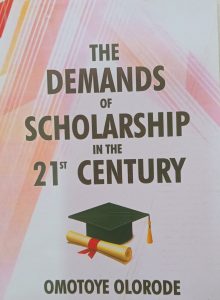
Published below is Prof Omotoye Olorode’s tribute to Prof BJ. Written from the Odoje Biodiversity Centre. Ogbómọṣọ in Oyo State of Nigeria’ where he currently is, this is not just a tribute but a generational testimony by one of the few who has seen it all from the beginning to the present day. Given that background and in the light of a more recent book he has also written (pictured below), it seems Prof Olorode has a duty to kickstart the last but one paragraph of this tribute by writing a quick, fresh treatise around which a more productive debate towards a rebirth can take place.

The author
Prof Omotoye Olorode
I would want to contextualise this tribute to Comrade Biodun Jeifo, also known as B.J., in what I want to characterise as the “Great Ife Mystique” and the proliferation of similar and contemporaneous radical academic “mystiques” across the Nigerian University System, especially after the Nigerian Civil War, i.e. post-1970.
In view of the foregoing, I consider that the radical academic movement in the Nigerian university system took a definitive trajectory and form immediately after the Nigerian Civil War. The Great Ifẹ Mystique, historicized more broadly elsewhere, took root especially around 1970, 1971, 1972, and with the University of Ifẹ academics in the Faculty of Agriculture, Faculty of Science, Faculty of Arts, Faculty of Health Sciences, and Faculty of Law, coming together to launch a committee then known as the Ifẹ Dialogue Committee and its sequels, including the Socialist Forum Collective. It was around the mid-1970s that Biodun Jeyifo, Yemi Ogunbiyi, and Kole Omotosho moved from the University of Ibadan to the University of Ifẹ.
My first encounter with Biodun Jeyifo was in Comrade Ola Oni’s office at the University of Ibadan Faculty of Social Sciences. The radical socialist academics were trying to, with the University of Ibadan socialists Ibadan anchored by Ola Oni, Bade Onimode, Akin Ojo, and others, link up. Comrade Ola Oni was already a well-known teacher of economics and socialist at the University of Ibadan Faculty of Social Sciences. I don’t remember clearly whether Dr. Edwin Madunagu (at that time, a Mathematics lecturer at the University of Lagos) was there, but Biodun Jeyifo, Segun Oṣoba (Ife History Department), and late Kayode Adetugbo (who just came to Ife from the UK) were all there at the Ibadan meeting trying to forge a socialist alliance across the board. I think Tony Engurube of blessed memory and very forward-looking, very courageous Comrade, was also at the Ibadan meeting. That Ibadan meeting was our rather conspiratorial response to what has to be done. And I say that without any equivocation, and I’m not saying it with any derogation about the needs of, and for, the Nigerian revolution.
That effort didn’t go very far; it occurred almost immediately before Biodun Jeyifo, Yemi Ogunbiyi, and Kole Omotosho moved to the University of Ifẹ from the University of Ibadan.
Once Comrade BJ was in Ife, our working relationship got closer and closer. By that time, the Ife Dialogue Committee, was already transformed into the Socialist Forum, which was also known as the Ife Collective, BJ was fully part of the “Ifẹ Mystique”. Among other main actors in the Ifẹ Socialist Forum, we must mention Segun Adewoye, Bayonile Ademodi, Omotoṣọ Eluyemi, Idowu Awopetu, and Emanuel Esiemokhai GG Dara, Olasope Oyelaran. It was in the process, of course, that the student movement also grew and developed militantly and independently.
The Obasanjo regime, in 1977/1978, was already preparing Nigeria for full takeover by international finance capital (via the IMF and the World Bank “Adjustment Program”) via reduction of public service, a reduction of public investment in education, withdrawal of a lot of subsidy to education, increasing feeding and school fees in the Nigerian university system. That was what precipitated the “Ali Must Go” Uprising by the National Union of Nigerian Students (NUNS).
 The Nigerian academics gave full support to NUNS during, and after the Uprising and I think, in fact, BJ was detained briefly in 1978 or so over the student protests of “Ali Must Go”. Segun Okẹowo (President of NUNS during the Alli Must Go uprising) who was expelled from the University of Lagos, was readmitted at the University of Ife. He couldn’t have been readmitted anywhere else in Nigeria! And then there was the Mayfair murder of our students in Ife by the Nigeria Police Force. At the time, BJ was already the president of the Academic Staff Union, which is another story totally.
BJ’s becoming the National President of the Academic Staff Union of Universities (ASUU) was pivotal to how ASUU then developed. And the epicenter of the development was the Socialist Forum Collective in Ife. And BJ, as many other people have testified in their tributes in the last several days, became really legendary in terms of commitment, organising energy, and courage.
BJ led ASUU for just about a year or a year and a half before he then had this health challenge, which made it necessary for him to emigrate to the United States. Those four or five years were a period of very intense radical intellectual work, complete with immersion of comrades in the struggles of Nigeria’s working people. This also coincided with the development of the very interesting experiment at Odẹ-Omu, led by the late Dr. Seinde Arigbede, in which BJ and many of us got involved at one point or another.
So, the very first assignment of the BJ presidency of ASUU was to mobilize the student movement, and the academic staff union to bring about the reinstatement of the victims of Obasanjo’s response to the 1978 protest of NUNS, and of the Nigerian people, against the increases in school fees and so on and so forth. So, our Comrades like Edwin Madunagu, Benedicta Madunagu, Ebenezer Babatope (all of University of Lagos), Laoye Sanda (Ibadan Polytechnic) Ola Oni, Akin Ojo, Omafume Onoge in Ibadan were sacked by Obasanjo over their support for the student movement.
Our first assignment, then, of BJ’s presidency of ASUU, was to mobilize ASUU for the reinstatement of lecturers sacked by Obasanjo’ military dictatorship. The other achievement of ASUU under BJ’s executive was the institutionalisation of the collective bargaining process in the Nigerian university system industrial relations.
BJ’s brief period of leadership of ASUU was also a grand period, especially for the joint actions and reciprocal relationship and support among the student movement, the Nigeria Labour Congress, and ASUU. A lot of very courageous, independent working class political action took place. An example was when one of our students at Ifẹ, Bukola Arogundade, was murdered in Ife, and our students were going to protest in Ifẹ town, when the police authorities, as usual, compounded the whole tragedy by killing four of the students in front of the Mayfair Hotel in Ife.
It was such a shock to everybody in Ife and especially in the university system and across Nigeria. But we decided, again under Biodun BJ’s presidency of ASUU, that we were going to challenge the Nigerian state, that we were going to challenge the police authorities by carrying out an independent investigation of the police killings in front of Mayfair Hotel in that year, I think 1981 or 1982. ASUU put together an independent committee of enquiry into the death of our students. The committee chaired by late Chief Gani Fawehinmi, also included late veteran journalist Mr Labanji Bolaji.
An independent public-sponsored report of that event, indicting the police and indicting the Nigerian authorities for the brutality against citizens was available perhaps for the first time ever in Nigeria’s history!
And again, the triad–the Nigerian Labour Congress, ASUU, the student movement—stood up like one man to defend our students in ABU. The Babangida regime that killed the students in ABU, I mean the regime, under which the police killed the students in ABU, of course wanted to use, or actually used the event to try to nail ASUU, nail the Nigerian Labour Congress and nail the student movement. Indeed, following the ABU police killings of our students, the dictatorship used the crisis as the pretext to remove ASUU from the Nigerian Labour Congress, an affiliation which already took place around 1982, 1983.
Of course, BJ’s professional colleagues in literature and literary criticism have also told us the very important, courageous, and militant contributions that BJ had made to literature and literary criticism, which were not just academic; literary criticism but that is rooted in the struggles of ordinary people and the defence, of the defenceless, and the combative response to imperialism in the post-colonial period. We were told, and we know, actually, although peripherally, being non-professionals, about Biodun Jeyifo’s incredible contributions in this general regard.
 And, again, the ascension of Comrade Dr. Mahmoud Moddibo Tukur to the presidency of ASUU, also was part and parcel of the comprehensive ASUU response to the Nigerian crisis, and especially the bourgeoning War, which started around 1979 against the Nigerian university system under General Obasanjo’s military dictatorship–a war that was orchestrated by the World Bank and the IMF, a war which transformed concretely into SAP in 1982, 1983, and which Nigeria’s ruling class have been carrying on against the masses till today. Everything that is happening to us now, ASUU, already saw in 1984.
It was in Kano in 1982 that, again in response to an attempted clamp down on the students’ movement and their ASUU supporters, during a major crisis that was happening at Ahmadu Bello University, Zaria where Comrade Moddibo Tukur wrote a Minority Report supporting the students. ASUU decided to then unanimously elect as Mahmoud Moddibo Tukur to elect him the Vice-President of ASUU to strengthen the ABU Zaria struggle.
That was how, when BJ left in 1982 or so, Moddibo Tukur became the President of the union. This was the foundation of the strategic posture of ASUU that the patriotic and fighting spirit of ASUU under the committed leaderships of late Comrade Festus Ikhuoria Iyayi and Comrade Attahiru Jega came to bolster. This is the foundation of what became the very important patriotic militant response of ASUU to the growing Nigerian crisis, arising from imperialist control and the attempt by the subsequent generations of the ruling classes, under military and civilian rule, to just kill our universities.
And that is what had been going on till today. Perhaps the most important surmise to make about the current situation in our country, and in Nigeria’s university system, is that the barricade that our people have been building since the mid-1970s at least, the barricade manned by Nigeria’s working people, the radical academics, the Nigerian labour movement and the student movements, this barricade is getting denuded and our heroes are passing on; one-by-one as exemplified by BJ’s transition.
The barricade is getting rather weak, but we are there; we must remain there. And we hope we will be able to maintain the barricade in spite of the fact that our heroes are leaving one by one. We need to regenerate the personnel at the barricade and strengthen the ideological commitment of the personnel at the barricade.
In this regard, we also must lament that a lot of our erstwhile comrades have abandoned the barricade. In fact, the celebration of the life and courage of people like Biodun Jeyifo is becoming more and more occasions for many of our erstwhile comrades who are on the other side, who have abandoned us, to come back and posture that they are really part of us; and in my honest opinion, this is weakening our organization and diluting our ideological resolve. However, while we cannot prevent people who want to ride on the heroism and the commitment of exemplars like BJ, especially when they pass on, we need to recognize the problems of the revisionist responses that occur when our heroes leave the barricade.
And we shouldn’t forget that the task of strengthening that barricade is there, stark, and urgent. We need to really begin to interrogate, and struggle against, political advocacies that repudiate our ideological commitments and the praxis which underpin those commitments.
We don’t have a choice but to re-invent the very militant, steadfast, courageous, and unequivocal commitment of the socialist movement to the struggles of our people. Because the enemies of our peoples are getting stronger and more audacious, they are incorporating some of our comrades into their ranks! And we need to remain unabashed, as it were, to be able to maintain the legacy of the courage, the intellectual commitment, and the optimism that Comrade Professor Biodun Jeyifo represented.
And we commiserate deeply with the family–with the immediate family; and we commiserate with the family of the socialist movement, and the labour movement. We emphasize that we need to renew our struggle and renew our faith in that struggle. Because if the oppression does not reduce, our struggle must increase in strength, in faith, and in support of the movement.
In Solidarity. And for Ever!