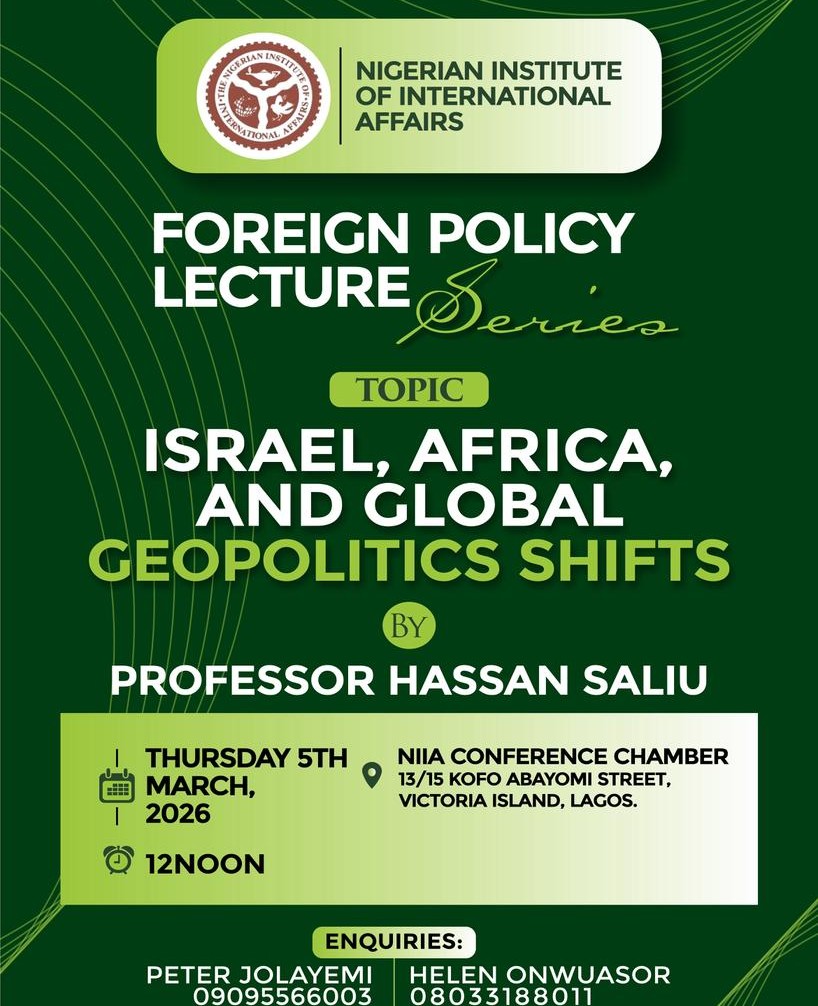
The Nigerian Institute of International Affairs (NIIA) might be plumbing into raising the stakes in think tanking the international. For its impending Lecture Series, it is not only aggregating some of the most controversial concepts in contemporary world politics, it is also handing the subject matter to a resource person with symbolism.
Professor Hassan Saliu, the incumbent president of the Nigerian Political Science Association (NPSA) is delivering the lecture titled “Israel, Africa and the Global Geopolitical Shifts”. No matter what, the NPSA and whoever leads it embody a symbolism, with particular reference to analytical leadership, voice and power.
More importantly, the lecture carries with it the unintended consequence of rupturing or confirming the perception that Political Science in much of Africa is about restating received theoretical wisdom rather than creating theories reflective of or sensitive to culture, spatiality and temporality. Remember the classic journal article “Overcoming the Backwardness of Political Science in Africa.”
Intervention has, however, always argued that Prof Bolaji Akinyemi is the exception to this assumption because he has always created and operationalised theories, one example of which is why Mark Carney, the Canadian Prime Minister, should have been respectfully asked to reference Akinyemi and Nigeria in his recent usage of the concept of ‘medium powers’. That is what he (Carney) should do because, by the logic of sequence, Akinyemi came up with the theory and practice much, much earlier, differences in details notwithstanding.
The lecture which comes up Thursday, March 5th, 2026 at NIIA Conference Chambers, according to the graphics available to Intervention, rings a contextual alarm. A war involving a great power (the USA) and a regional/ideological hegemon (Iran) is raging, with implications no one can foretell, particularly for a great power that has become too used to having its ways through the use of force. But the war in question is highly believed to be a product of Israeli influence on the US. Such a situation immediately throws up a conceptual ripple: if a small state such as Israel can wrap its hands around a great power, by whatever methods or means, to do what the great power would, otherwise, not do, then the concept of great power in International Relations is due for re-examination. That is the sense in which this topic is a plumbing into think tanking, being so unusually well timed and conceptually loaded.
Intervention has not forgotten that Africa is another concept there too. Interestingly, Africa is a big time concept in contemporary IRs more than ever before, beginning with the contention propagated mainly from Queen Mary University of London that it is not true that Africa is a case of absent agency in international politics. More than a decade after that position, Africa’s intervention in Russia-Ukraine war; South Africa’s brinkmanship in BRICS, South Africa’s agency in China – Russia – South Africa military drills and action in taking Israel to The Hague have seemed to be validifying the contention. Debate remains why it is only South Africa out of over 50 African countries that is being seen and why Africa/AU is not chasing away the Kite (or, is it the Hawk?) trying to claw at South Africa before cautioning a careless mother-hen, if necessary. Of course, the contrary position is that Africa remains a prized playground for great and not so great powers.
All these variables make just one topic pack so much in it as to make it, arguably, more likely to be attended than previously. Intervention is not betting on that but even if it doesn’t happen exactly, things might still never be the same.