
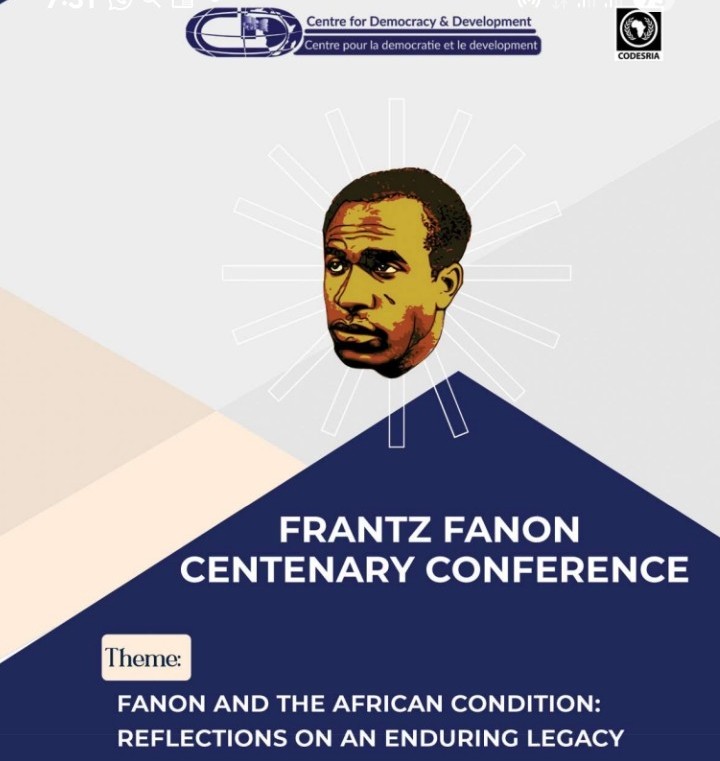
By Adagbo Onoja
There were none of the overtly stormy sessions which define the 1983 ‘Marx and Africa’ Centenary with which the November 2025 Fanon Centenary compares in recent Nigerian history of such events. But, as discourse theorists assert, it is only in its construction in discourse that an earthquake, for instance, can become known either as ‘movements of tectonic plates’ or manifestations of ‘the wrath of the gods’. So also is it the case that only in discourse can the November 27th and 28th, 2025 centenary of Fanon at Nigeria’s University of Jos acquire its meaning, not necessarily from overtly stormy sessions. Privileging what Fanon ended up saying on the ‘African condition’ in the struggle over meaning in Jos is thus in order since the centenary could never have been about excavating but re-interpreting Fanon. It was a point taken seriously by the Centenary Planning Committee which perceptibly thematised the centenary in terms of ‘Fanon and the African Condition’. In doing so, the Committee left no one in any doubts about what was at stake in the conversation in Jos: it was the inviting theme of ‘Fanon and the African Condition: Reflections on an Enduring Legacy’. Debatable as it is regarding whether the sub-title should have been a conclusion that his legacy is enduring when how the legacy speaks or doesn’t speak to the ‘African Condition’ was what the centenary was to find out, it is the case that text producers do run ahead of themselves in framing puzzles, a tendency for which there seems to be no cure for now.
Whether a consensus exists among Fanon interpreters in Jos regarding what the totality of Fanon’s works amount to in relation to the ‘African Condition’ is open to debate. What appears more attractive at this point while we are waiting for the organisers to publish the proceedings of the centenary would be insights from the progression of the event in Jos. That is what I have attempted below but not necessarily in any sequential order.

Cde Vavi, Prof Jinadu, Cde Odah and Prof Jibrin Ibrahim
The opening ceremony had glided along a unanimous, postcolonial hailing of Fanon. John Odah, former General Secretary of the Nigeria Labour Congress (NLC) and incumbent Chairperson of the International Governing Council of the Centre for Democracy and Development (CDD-West Africa) told his audience that Fanon offered Africa a different way of reading and understanding the dynamics of colonialism and therefore how to resist it more effectively, including the psychological impact it created in the minds of Africans and overcoming decades of dehumanisation by colonialism. For Odah, there is nothing nostalgic about the centenary. Rather, it is what he calls a forward-looking exercise by which to infuse into the discourse about Africa the critical contributions that Fanon has made. Fanon’s analyses, he argues, have become so prescient or prophetic and more boldly relevant, that being why the organisers decided to convene the centenary “not only to celebrate him but also to draw attention to the knowledge and legacy he has left us to rethink African development”.
He could not resist firing two quick shots. One, agreeing with Fanon’s diagnostic conclusion in his ‘pitfalls of National Consciousness’ about a postcolonial elite all too happy to take over the state structure left behind by the departing colonialists in its total lack of any capacity for creativity or even the commitment to transform the continent. His second shot which flows from the first is the consequential failure of this ruling elite to reject as opposed to remaking the inherited colonial structures and relations. As such, said Odah, it is not democracy, for instance, that has failed but the African elite and its lack of capacity to create newness.
South African trade union activist, Comrade Zwelinzima Vavi, who delivered a message of solidarity to the centenary did not depart from Odah’s track. He even went further to restate the combat summons of Fanon such as Fanon’s insistence on not paying tribute to the European imagination by creating states, institutions, and societies which draw their inspiration from that imagination; Fanon’s endorsement of the dispossessed/de-classé/lumpen proletariat or the masses, broadly, rather than ‘the working class of the towns’ whose partial assimilation into colonial privilege he claimed; the narcissism driving the ruling elite in Africa to the point of envying and desiring the privileges former colonial operatives reserved for themselves just like the lower classes entangled into absurdity in Fanon’s metaphor of the masks in his book Black Skin, White Masks and, lastly, Fanon’s visualisation of a new human being and new world which is “for Europe, for ourselves, and for humanity”.

Chair of Planning Committee, Prof Pam Dung Sha welcomes all to the conversation
Prof Ishaya Tanko, the Vice-Chancellor of the University of Jos and even Barrister Caleb Mutfwang, the governor of the host state of Plateau in central Nigeria followed in that direction. The governor sent so apt an address that many wondered why he didn’t think of the advantage of personally presenting the address instead of sending a representative. But the non-appearance of Prof Chris Piwuna, the president of the Academic Staff Union of Universities (ASUU) – the foremost platform of Nigerian academics – remains the most incomprehensible. That seemed to some observers to be an irredeemable miscalculation that a sitting president of ASUU missed the opening session of the centenary which was his most strategic platform to rearticulate the ASUU project at this moment in Nigeria, more so that ASUU is one of the organisers and UNIJOS is the ASUU president’s own base.
Prof Georges Nzongola-Ntalaja delivered a comprehensive statement as chairperson of the opening session. It has a superrich portion on the tragedy of the DRC, starting with the assassination of Prime Minister Patrice Lumumba, the same fate which fell on Nkrumah of Ghana. Each time Prof Nzongola spoke at the centenary, he said something profound, details of which again we may have to await in further publications on the event because this reviewer doesn’t trust his jottings on the professor.
In the midst of these appearances, non-appearances and numbing silences came Prof Adele Jinadu, the 82 – year old veteran academic who was not only a moving force in the planning of the event but was able to deliver the keynote address. His acceptance and actual delivery of the address has a history worth telling. The original idea was to have a woman academic/activist deliver the keynote address. There was, in fact, a woman academic cum activist nearly everyone in the Planning Committee voted for but she could not make it. When this happened, the idea was still to find a non-Nigerian because it wouldn’t be a good ethical signal to hold a centenary of Fanon in Nigeria and give the keynote speaker role to a Nigerian. This one too failed as everyone else on the list had committed to something else. There was a third reason: having undertaken his doctorate on Fanon decades back, Jinadu was the resource person best placed to handle the crucial sub-theme titled ‘Encountering Fanon’ scheduled for the first plenary session. In the end and very close to the D-Day, only Prof Jinadu was available to take up the task. When the decision was communicated to him, he accepted the task. In doing so, he saved the organisers from unrealised but civilised gestures to gender in the first case and Africa in the second. Those who read the keynote address now might have noticed something of a merger of ‘encountering Fanon’ and the typical keynote style section. It wasn’t just that he was able to script a keynote address within so short a time but that he was also able to throw down a gauntlet to both his admirers and critics. In doing so, he fulfilled the Claude Ake condition of questions, questions and questions rather than answers in performing tasks of this nature. That is the case here because Jinadu was basically asking: what happened to Africa as to warrant talking about the ‘African Condition’
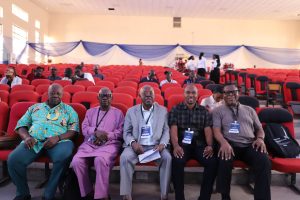
Jibrin Ibrahim, Jinadu, Nzongola Ntalaja, an African student and Okwudiba Nnoli
There was a gauntlet in Jinadu’s key contention that a triumphalist neoliberalism, provoked by right wing populist imperial-capitalist ideology blocked ‘the Third Way’ or the via media between Keynesianism and classical Adam Smith not only in the West but in Africa too where it rubbished the Afrocentric/Pan-African consensus on how to transform the continent. That, according to him, accounts for Africa’s ‘one step forward, ten steps backward’ in the matter of the continent’s exit from a unique level of underdevelopment as soon as the African consensus over governance policy measures to reverse its recolonization and transform the African State into a democratic developmental one were nominalised. He lists the African codes, standards and elements of the consensus to include the following: the Lagos Plan of Action, the African Charter of Human and People’s Rights, Africa’s Priority Programme for Economic Recovery (APPER), the African Alternative Framework to Structural Adjustment Programmes for Socio-Economic Recovery and Transformation(AAF-SAP), the African Charter on Transformation and Popular Participation in Development, the African Peer Review Mechanism (APRM), the Sirte Declaration, and AU Agenda 2063.
In Africa where “the African state lies immobilized, impoverished, underdeveloped by the embrace of neoliberal policies imposed by the Bretton Woods institutions and Western donor countries on African governments”, the fight back against neoliberalism and its reactionary and anti-people direction has, in Jinadu’s view, been anything but feeble. But Jinadu is still in a fighting mood. Although he concedes that the typical African ruling elite lacks the political will to build the African state into the democratic developmental state as laid out in the various home-grown, people-centered African codes, conventions and standards envisioned in resurgent Pan-Africanism, he is still asserting the case for reinvention and popularization of an African-centered response to neoliberalism. Of course, he is not oblivious that the codes and standards inspired by, and reflecting the vision and mission of the resurgent Pan-Africanism are now lying prostrate, denied and rejected by African governments that have acceded to and ratified many of them.
Resurgent Pan-Africanism is a concept dear to the Fanon Centenary keynote speaker. He credits Frantz Fanon, alongside Nnamdi Azikiwe, Amilcar Cabral, Pauline Hountondji, Patrice Lumumba, Gamal Abdel Nasser, Kwame Nkrumah, Julius Nyerere, Walter Rodney, among others, as the text producers of resurgent Pan-Africanism. And they did so “by using dialectical reasoning to counter the underlying epistemological and related teleological and philosophical assumptions, rationalizations, and the consequential institutional governance prescriptions and arrangements of colonialism and imperialism for dominated non-white colonized peoples, especially black and African peoples in and outside Africa”. For the above reason, Jinadu takes exception to the Jean-Paul Sartres of this world seeking to debase the redemptive, cosmopolitan undercurrent of resurgent Pan-Africanism by referring to it variously as an “anti-racist racism,” a “mad fury…bitterness and spleen…desire to kill us…Hatred, blind hatred …”

Prof Victor Adetula presiding over a session
For Jinadu, the concern in the keynote address was not so much about the enduring legacy of Fanon as they are about Fanon’s significant contribution to the resurgent Pan-Africanism, and to the development of an Afrocentric social science between the mid-1960s and 1990s. To this theme he devoted the second half of the nearly 6000 words text which we hope to read in full whenever the organisers of the centenary obliges us by way of the proceedings of the event.
The beauty of this sort of intervention is its attention to the transcendental by going beyond what happened (to Africa) to the condition of possibility for what happened. That may not necessarily privilege Jinadu’s primacy to neoliberal attack on the African consensus from critique, particularly by those who may say that Jinadu risks complicity in mystifying neoliberalism into the unconquerable ‘big Other’ as understood in Lacanian analysis. But contesting Jinadu and the light such a contestation will throw on the making, unmaking and remaking of the ‘African Condition’ is what will keep the conversation on Fanon in Jos going on timelessly and thus an achievement in itself. It is safe to speculate that activists, academics, trade unionists, gender warriors and students who converged on Jos, the Plateau State capital in central Nigeria have ‘carried over’ that contestation to when the texts of the centenary are published.
Beyond the opening ceremony and the exciting standpoint of the keynote address, the next most entangling session must be the Inter-generational Conversation. The session took place quite alright but it is debatable if it took the form which justified it. It was the means by which the centenary was to gain insights from some of Africa’s most established scholars on how to resolve the observable crisis of knowledge production in Africa. As most elaborately advanced by Prof Jinadu at the planning committee level, this would happen when current students and younger academics, especially the PhD students tell their stories. Voices from these categories were, indeed, heard but not in terms of their stories as such. A few of them spoke but much of it came in the form of opinion rather than encounters with the crisis of quality on African campuses. It meant that current students’ acquaintance and understanding of the situation today whereby record breaking scholarly outputs is permanently and almost exclusively the monopoly of those nurtured in Western universities largely eluded the centenary. Yet, that is the evidence needed vis-à-vis how today contrasts with yesterday when immediate post-independence African scholars wrote classics, challenged received methodological techniques and contested the global space with their Others, irrespective of whether they were produced from home universities or from Western academies.
The foregoing is not to suggest that the session was lost. After all, it was the session Prof Okwudiba Nnoli chaired and ahead of which he made his remarkable opening remarks. For Nnoli, the problem is that there has been a social science surrender to its Others in terms of the power of interpretation over facts and thus control of discourses or the public sphere. For him, that is a problem because it means all the years social scientists spent in the faculty amounting to nothing if the guy in Medicine could be as good in the frame game as the social scientist. As he sees it, the problem is that the non-social scientists lack historicism in the way they engage with facts. But facts have to be embedded in their historical context or they cannot produce theory. Yet, it is theory which produces understanding and the power associated with that.

Ex-BUK political scientist, Mallam Ibrahim Muazzam; Mallam Y Z Yáu of CITAD and the author on Day 1
Nnoli sees the consequences in what someone else called disjointed empiricism some years back, especially in the way we compare events and situations in Nigeria with events and situations in Britain and other places. It has reached a point in Nnoli’s estimation where Nigerian leaders hardly make two statements without reference to the United States or somewhere like that, a practice he employs the concept of ‘copy and paste’ to describe.
This pattern of analysis is dominant because, in his view, the petit-bourgeoisie is incapable of creativity. In like fashion, our companies do not consider R and D (Research and Development) a priority. So, the hoes our fore fathers used are still in the form and structure they were then. Even the discussion on Fanon was, in his view, taking place in a vacuum because the sessions on Day One hadn’t paid attention to what the mission every generation is supposed to discover out of relative obscurity as Fanon put it. He puts that to our hook – up with philosophical idealism as opposed to philosophical materialism. In the absence of confronting the contradictions that oozes from matter in motion and which philosophical materialism enables its discovery, we turn mostly to ethnicity and religious divides because we are not able to apply science and technology to our economic and social process and create anything else to turn attention to. In particular, we are unable to transcend the import-export economy that the British left behind.
Prof Nnoli’s intervention was both a powerful but also a disempowering intervention. Instead of the Inter-generational Conversation which his intervention was a preface, the session turned out into a generational monologue in favour of the elders. It was a product of wrong briefing. As already indicated, that was not the plan. There is a sense in which Nigeria’s Prof Jibrin Ibrahim saved the situation by bringing out a list of the manifestations of the crisis of quality. Although the information came from the wrong quarter since Ibrahim is a Professor of Political Science rather than a graduate student, he offered a list that speaks more to the situation than anyone else. His list spans his thesis of massification of university access and the pressure on facilities; corruption following the decline in the peer process in academic culture; ethical dimension of the crisis involving the exploitation of female students in particular by academics; complications brought about by developments in technology such that some highly porous academics somewhere in Africa could easily produce and circulate books or similar stuff which successfully escaped any quality control processes in academia and, lastly, the triumph of fake news in the era of post-truth in relation to the academy. There is no knowing what must have been going on in Prof Jinadu’s mind during the session because, as collective as the approval of the Inter-generational Conversation by the Fanon Centenary Planning Committee, it still bears the Jinadu framing stamp.

Hearing it from a female graduate student
It matters that the session didn’t take the form it was intended to because, as the legendary Stuart Hall was used to saying, the way a people is ‘known’ is likely to be the way they are or will be governed. The crisis of quality that was to be undressed in the Inter-generational Session constitute the biggest threat to the capacity of Africans to frame Africa so that the subaltern not only speaks but could also hegemonise a contrary notion of Africa and Africans quickly enough before the currently unfolding world stabilises. Otherwise, the world ahead will be a replication of Conrad’s notion of Africa as ‘the heart of darkness’.
Missing from Jibrin Ibrahim’s list of the manifestations of the crisis of quality are two vital dimensions that are particularly disenabling of African self-writing. One is the formal and informal gang up against teaching of theories in much of Africa. And the anchoring of the theories on cultural resources external to Africa. So, the engagement with theories are not only very limited or dated, the theories are products of what Prof Sam Oyovbaire called import-substitution academia in the debate between him and Bala Usman at Nigeria’s Ahmadu Bello University, Zaria in the early 1980s. The second is the antagonism against updating the methodology syllabus. It is probably not the case across Africa but these two aspects are certainly the case in Nigeria today. The decoloniality train in academia is, no doubt, in motion throughout Africa. Unfortunately, the big question in Africa more than in (East) Asia and Latin America is what decoloniality should eject or retain in its unfolding. The debate in the early 1980s I just referred to was the earliest engagement with this question. Now, the debate is fully back in nearly exactly the form it took then. Oyovbaire’s animus against his notion of import-substitution theorising is still at the heart of the matter. A major illustration of the resulting crisis of quality is the puzzling loyalty and infatuation for Realism and Positivism generally and for orthodox Marxism as the theoretical center of gravity in majority of the universities and activist circles. Associated with that is the adulation for positivist proof in methodology. To make matters worse, both are so poorly done, with a rising overinvestment in orthodox Marxism that does no one, including Marx, any good.
Having accomplished a landmark text on ethnic politics in Nigeria from a Marxist analytical hammer, Prof Nnoli’s ranking of philosophical materialism over philosophical idealism may not be that surprising in this regard. But what of the hyperactive excitement over reported reintroduction of History as a school subject in Nigeria by active academics? Is there anything inherently emancipatory in History in itself outside of the historiographical lens by which the facts of History are conveyed to warrant that excitement? One would have thought that E H. Carr had settled this point in the section of his ‘What is History’ where he tackled ‘The Historian and His Facts’ long before anyone heard postmodernist restatement of him. That is besides the position of Hayden White who was once expelled from the discipline of History by disciplinary guardians of orthodoxy for refusing to exempt any historical events from his History-as-emplotment paradigm. White is well known for arguing that there is nothing like History because, for him, only historiography is possible. Even those who do not agree with a claim such as this must, to the extent that they are associated with knowledge production, make efforts to reflect on its plausibility.

Another graduate student cum teacher who is happy that he was in Jos
And when Prof Jinadu was isolating the disruptive force of neoliberalism on the potentials of the Afrocentric consensus, he never linked his position to the argument that the worlding impact of neoliberalism was one of the most important provocations for poststructuralist discourse theory, also known as ‘post-Marxism’ mainly by its opponents. Yet, Jinadu’s position is exactly where post-Marxists stand, a position they exemplified with Margreat Thatcher triggering the creation of a whole new neoliberal world by invoking and reinterpreting defining concepts of the social. Even after writing so many books, British Marxist geographer, David Harvey, is still so puzzled with where neoliberalism came from to remake the world in its own image. The constitutive outcome was that powerful to make post-Marxists and more reflexivist Marxists conclude that the Marxist ontology is not sustainable in terms of understanding the worlding power of discourse. It was then poststructuralist discourse theory was born.
There is no debate about it that Marx was a brilliant researcher and activist of emancipation but he rode into the arena on an epistemologically injured horse. Denial of the injuries lead to pretending that Marxism can sustain change even if a revolution in the cataclysmic sense Marx sees it were to occur. Awareness of the magnitude of the epistemological injuries of the Marxist horse leads to the possibility of transcending the injuries which have roots in Western metaphysics. This transition has been a problem for those whose era in academia, activism or practical politics was substantially structured by soul-stirring soundbites from Marxist literature and who are tempted to call those harping on the epistemological weaknesses of orthodox Marxism as purveyors of postmodernism. The tragedy in this disposition is the inability of those in this realm to answer the question of what may be so unacceptable about postmodernism, with particular reference to the challenge of remaking Africa. It is simply difficult to understand the basis of their objections, given the history of internal criticisms in Marxism, even if we just abstract the positions advanced by Lenin, the Frankfurt School critics (which has morphed into Critical Theory as opposed to critical theory with small ‘C’) and, lately, the post-Marxists.
So, the struggle for the remaking of Africa today has a fundamentally ‘academic’ (or is it the theoretical?) dimension to it before its political cum organisational challenges. I do not mean to create a binary wall between theory and practice beyond drawing attention to the primacy of theoretical repositioning of the drivers of the struggle for this change in its different forms and spaces. I would say, therefore, that I am merely agreeing with Lenin that a revolutionary theory is a condition of possibility for a revolution, however we conceptualise the revolution today. Without taking a more systematic view of this challenge, it could remain a case of doing so much but achieving so little in relation to the developmental breakthrough we crave and for which no one owes anybody any apologies.

What would he have said if given the chance?
Even as degraded as they are, the universities still occupy the primary space for resolving the poverty of engagement with ontology and epistemology in Africa. Right now, there is more concern with these issue areas in Western universities, civil society and the media than within Africa, whether at the level of the theoretical, organisational and actual campaigning. From whichever angles seen, these activities in the West do have disruptive consequences for hegemonic scripts and which we should take serious note of.
The last source of insight for this review is the parallel sessions which featured diverse spaces in which Fanon is encountered. Among them, according to the Centenary brochure are ‘Encountering Fanon’; ‘Fanon and the ‘Colonial Present’; ‘The Fanonist gaze and Popular Culture’; ‘Protest and Resistance in the Image of Fanon’; ‘Fanon and Pan – Africanism’ and ‘Fanon: Innovations and Outcomes in Strategy’. Each of these sessions ran in three cycles.
Arranged in parallel sessions, the number of sessions any individual could cover was highly limited. There were papers that embodied so much promise at the level of the titles. Mentioning a few may be apt: ‘Fanon’s Psychoanalysis of the African Subject in ‘Black Skin, White Masks’; ‘Routinised Violence, and Police Training: Colonial, Military Legacies and Fanonian Lessons; Youth Political Consciousness, Digital Activism, and the Making of Decolonial Protest Movements in Africa; Re-Harvesting Heritage in the Digital Age: Analyzing Online Coverage Patterns of Festivals and Cultural Memory in the Punch and Vanguard Newspapers; Decolonizing the Hashtag: Fanon, Digital Activism, and Youth Political Consciousness in Africa; Performing Decolonial Identity: A Fanonian reading of Asake soundscape in contemporary Africa; Nollywood, Frantz Fanon and the Aesthetics of Protest: Violence, Coloniality, and the Quest for a New Humanism; First Things First: The Tragedy of Postcolonial African History and the Quest for Neo-Pan-Africanism; Fanon, Alienation and the Sonic Imagination: Reconstructing African Identity through Lucky Dube’s Reggae and Fela Kuti’s Afrobeat; The pitfalls of national consciousness and the recurrent crisis of legitimacy in post-colonial Uganda. Fanon’s Hypotheses and the Present State of Trade Unions in Africa.

Dr Dauda Garuba, Director, CDD-West Africa in media engagements ahead of the conversation
Again, the content of these papers would remain in speculation till there is a publication on the centenary. But there is Independent researcher, Dr. Ike Okonta’s presentation which generated its own small debate at one of the sessions. Dr. Okonta is part of the originating source of the Fanon Centenary idea. He presented the paper titled “Frantz Fanon and Nigeria’s Anti-Development Ruling Class”. The title says much about the content of the flawless paper. However, there was a particular query for it. It is the possibility of a sustainable homogenisation of the diverse fractions of what can be called the ruling class in Nigeria into an anti-developmental cohort. Could the post-independent generation of Nigerian leaders be put in the same cubicle with the subsequent sets in terms of understanding and supervision of development? Could the Oxford trained ‘Super Permanent Secretaries’ who drew up Nigeria’s Third National Development Plan (1975 – 1980) be classified together with the subsequent sets of the technocratic bourgeoisie, especially from 1986 – 1993? Could the set of military leaders between 1994 and 1998 be put together along with the neoliberal buccaneers from 1999 to 2007 and 2015 to 2023? These were some of the questions Dr. Okonta went home to reflect upon on his presentation. It would be interesting to know what questions each presenters in the many other sessions went home with.
The parallel character of the sessions also made it impossible to know the nature and direction of the debate on, among others, the disagreement(s) between Fanon and Marxism; Fanon’s vote for violence and what violence in his usage might mean in the context of relational epistemology today; Fanon’s endorsement of the people as the propelling force of change rather than the classical working class and the question of geopolitical outcomes of Frantz Fanon’s visualisation of global space in his ‘New Humanism’
The November 27th and 28th, 2025 Centenary of Fanon could have been a much more engaging event, considering the ‘Fanon and the ‘African condition’ thematisation, the magnitude of the crisis in Africa today and the prophetic precision observable in Fanon’s works. It didn’t attain that level of systematic linking of the variables, especially between Fanon and the ‘African Condition’ but it has left behind its own storms for the organisers to reflect and build upon. It would not be mischievous to say that by the time CDD-West Africa Director, Dr Dauda Garuba, was bidding everyone farewell, nearly all the speakers at the event were indirectly looking in the direction of the Council for the Development of Social Science Research in Africa (CODESRIA); the CDD-West Africa; the Nigeria-based Centre for Information Technology and Development (CITAD) and the ASUU to do something more innovative about the knowledge production crisis on the continent. In terms of ample resources, the relative autonomy and the sense of urgency, these organisations have advantage in doing something more innovative about the messy collapse of knowledge production on the continent although the collapse is more total in some parts of Africa than others. The assumption is that, individually and/or jointly, these institutions can figure out the means and the resource persons to transcend the largely dated engagement with knowledge, the production of same and the essence for a continent in the ‘African Condition’.
The author is a researcher at Wits
















 Conversation on Fanon And the ‘African Condition’ at the Centenary of the Philosopher)