The first time the world heard from Mount Saint Michael’s Secondary School, Aliade in the then Benue Province was in the immediate post-independence era. That was when one of its students by name John Onaiyekan scored a whooping number of A in his West African School Certificate Examination (WASCE). The result was so stunning that Sir Ahmadu Bello, the Premier of the then Northern Nigeria, had to engage with it because it had become a regional statement on merit, thereby putting the region on the map. The then young man at the center of ‘the solid personal achievement’, apologies to Achebe, got for himself the Premier’s offer of scholarship to wherever he would wish. He would most likely have been a global voice from Harvard or somewhere so if he had not already made up his mind quite early in favour of priesthood. God guided him right in his choice. Evidence: today, he is one of the very, very few voices that can call Nigeria to order based essentially on the strength of his moral authority.
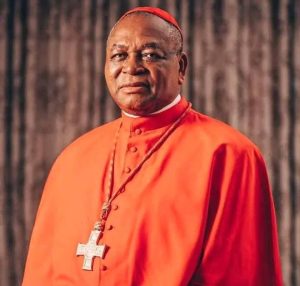
His Eminence, Archbishop Emeritus of Abuja, John Cardinal Onaiyekan, the most iconic of the Michaelite
That is the classic performance by which Mt St Michaels let it be known it was out for business in terms of providing secondary school education. By that result, it was saying it deserved a seat on the front row along with schools such as Barewa Colleges in Zaria or King’s College, Lagos and all the other finishing schools that preceded it.
Then the decline set in as the federal authorities experimented with one policy or another on ownership and control of secondary schools, especially under military rule. Intervention understands that, at the recent Special National Convention on September 29th, 2026, Rev. Father Moses Orti, who is currently the Principal, regaled the audience with tales of woes, particularly the state of infrastructure of the school.
His is a piece of information with wider meaning since the Catholic Church own and run most of better organised secondary schools in the old Benue Province, from Mount Saint Gabriel’s in Makurdi to St John’s, Amoke; John Bosco in Lafia; St Anne’s in Otukpo; Holy Rosary College, Adoka; Emmanuel Secondary School, Ugbokolo; St Francis College in Otukpo and several newer others. If Aliade which came earlier in 1953 (except St Francis, Otukpo) could be in miserable infrastructural state, then it is most likely to be the case in most of the over a dozen schools which nearly all the big names from the province today attended. In the days gone by, these schools, with their mostly Irish priest principals, were as good as any other across the provinces and regions throughout Nigeria. No further proof was needed beyond the message of the first paragraph of this piece for that.
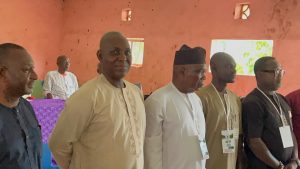
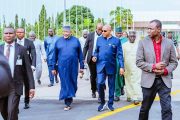
A line up of Old Boys (now men, no longer boys)
Naturally, the Aliade Old Boys Association (AOBA) has been concerned. Fired by a sense of a legacy to protect and advance, it got to work. As is always the case, leadership matters. Or, so it seems to the elders, ideologues and tacticians of AOBA which obviously concluded that good intentions alone may not guarantee success if there is no meeting point between AOBA leadership and the moment. What Intervention has learnt from speaking to a few Old Boys is that that problem was solved by picking on Comrade John Odah, a former General Secretary of the Nigeria Labour Congress (NLC). What criteria decided the choice in favour of Odah are, for now, exclusive to the ‘they’ who did the deciding. But that was just scene one of the script. Scene two was still ahead.
After having found Cde John to emerge as National President material, the revivalist AOBA machine did not want any competitive democracy for the taskmaster’s job of AOBA President this time. In other words, none of the dog fights, cat fights, donkey fights or fish fights for power across Nigeria today as far as AOBA is concerned. It is not a case of being against democracy. It was rather a warning that a plastic understanding of democracy which equates it with competitive struggle for every office in spite of the demands of space and time is anti-democratic and dysfunctional.
That is where the ‘does it again’ phrase in the title of this story on the making of the AOBA presidency is coming from. AOBA can and ought to be read as sending a message beyond itself to the wider society that it is anti-democratic to not dispense with costly and bad blood generating electoralism at a time of the kind of emergency it confronts. And hence the challenge of mobilising resources to revive their alma mata. Aliade does it again by passing a message of consensus at a time consensus is the scarcest commodity in Nigerian politics. As everyone can see, without elite consensus, Nigeria is gradually evaporating beyond recovery.
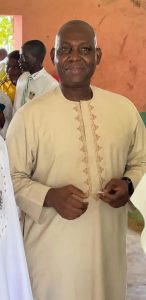
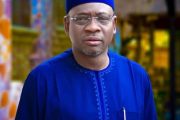
National President by consensus, Cde John Odah
How Cde Odah wangles his way in fulfilling the expectations of his fellow Michaelites is a different headache. Such ought not to be unachievable for a veteran of the old labour establishment and the activist movement in Nigeria who is not strange to collectivism. There is actually what one could call the AOBA war cabinet:
- Comrade John Odah mni – President
- Mr. Michael Awange – Vice President
- Mr. Samuel Yina – National Secretary
- Mr. Michael K. Ogwuche – Assistant National Secretary
- Mr. Anthony I. Oyih – National Treasurer
- Mr. Ito Andrew – National Financial Secretary
- Mr. Elijah Agaku – National Publicity Secretary
- Mr. Ogo M. Otegwu – National Social Secretary
- Pastor Guda J. Mishi – National Auditor
- Mr. Mark G. Ibiem Esq – National Legal Adviser
- Dr. Emmanuel T. Amon – National Provost
Certainly, this is not a smaller challenge for Odah than his previous ones given the many other signifiers that AOBA inherently summons whenever in use: the Catholic Church, the Benue State Government, other Old Boys/Girls associations across the country, religion-education, merit, role performance, AOBA members, to mention a few of such unending chain. It is probably his biggest challenge so far, considering the symbolic gesture in the consensus message as well as the magnitude of the collapse of education in Nigeria. Whatever AOBA achieves in this regard could become a model for others.