The idea of State Police in Nigeria has come under fire again. Tampering with historical structures of which the Nigeria Police is an example without proper understanding could be detrimental to society, says Chijioke Uwasomba, Obafemi Awolowo University Professor of Literary Theory and Culture.
Prof Uwasomba who spoke at the public presentation of Crime Beat Reporting in Nigeria written by a veteran crime journalist, Mr. Frank Oshanugor warned against undermining history as doing so, according to him, erodes identity and weakens institutions, including the Nigerian Police.
Prof Uwasomba Dr. Davidson Akhimien who chaired the event
Locating the challenges which have undermined the Nigerian Police in years of military interference, inadequate funding, and the emergence of parallel security outfits, Prof Uwasomba argued that introducing State Police without addressing these systemic issues could further destabilise the policing structure in Nigeria.
The State Police option, said the Professor of Culture, is worth cautioning against and worth advising serious police officer against supporting without careful consideration.
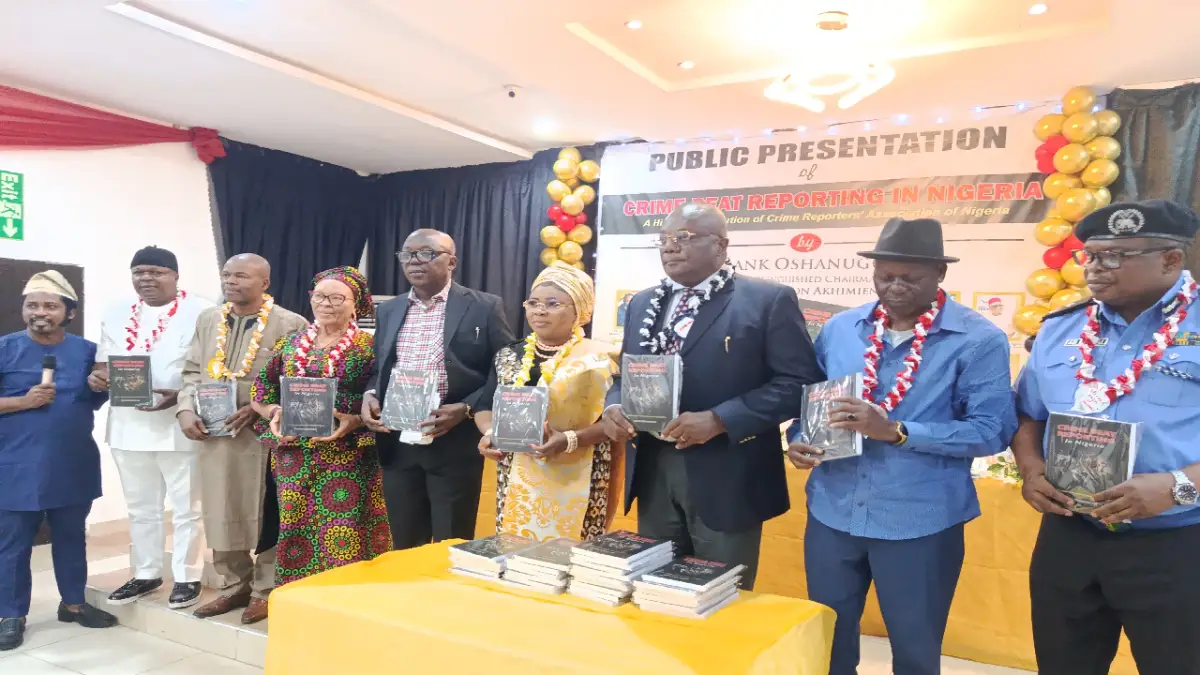
Prof Uwasomba spoke at the event which drew stakeholders from the media, security sector and other institutions and at which Adeshina Bamidele Lawal, a Deputy Commissioner of Police, represented the Inspector General of Police, IGP Olatunji Disu. Lawal highlighted the long-standing partnership between the police and crime reporters.
Commending the author for documenting the evolution of crime reporting, Prof Uwasomba noted that such efforts help preserve history and educate future generations, adding how extremely important is journalism in that regard.

A cross-section of the audience. Courtesy: Case File
Oshanugor’s book is a 335-page text inspired, in his own words, by his decades of field experience and aimed at supporting journalism education. He locates the book in field reporter’s over 30 years’ experience rather than written as a classroom teacher’s outing. He is sure it would serve as a resource for students and lecturers alike.
State controlled policing as a component of the national security architecture has remained a controversial topic in Nigeria. Those who support it say it is a panacea for recent security challenges such as kidnapping and banditry. Others in this category point out how state governors have been the ones funding state commands of the Nigeria Police, meaning that it is now only federal police in name.
Opponents of State Police also have their own arguments. Most argue it will be no more than the terror instrument of state governors who are perceived to lack the sense of restraint and civility towards opponents. It is also argued that it is delusional to expects states which have had nothing exceptional to show to suddenly be able to run the policing outfit with any credibility, particularly funding and training.
There is the unspoken fear too that State Police could be turned into militia for separatist agenda. Until it operates, it would be difficult to know which side is getting it right or otherwise.
President Bola Tinubu has already given approval for the idea and the legislative process which will operationalise State Police has started. It remains to be seen how quickly State Police becomes real in Nigeria and what difference that will make to the degree of safety that brings about.