When Intervention had to post a quick story on Comrade Abubakar Sokoto Mohammed on December 12th, 2025, it was assumed that it would be the last story on death for 2025. Actually, the idea of removing news of deaths came back powerfully.
There was no knowing we would be compelled to return to writing about another death a day after: Prof Adamu Baike. Death has its own paradoxical mystique: it leaves the living with little or no choice about announcing its every strike even as disorganising as doing so could be. In much of Africa, the time a person dies is about the only time there is a consensus on him or her. Since there is nothing more than consensus in the making of the real, death remains permanently the moment. Of course, that doesn’t mean that the consensus cannot be reactivated subsequently. We see that everyday in relation to General Sani Abacha. Today, he is the archetype bad guy, the next day, he is the patriot who did not bow to imperialist SAP.
In the case of those like Prof Adamu Baike who reached the ripe age of 92, it is the wealth of knowledge they are departing with that is the issue of concern. The primacy of understanding over explanation measures the magnitude of loss in own case.
Understanding means that people like him are irreplaceable, no matter the amount of biographical works on them. It goes down to the notion that no one sees the world from the way the world is. Rather, we only see the world through how we are, meaning that no two people see the world through the same lens, whatever the similarities.
So, the death of the first professor of Education in northern Nigeria, former Vice-Chancellor of the University of Benin and of the National University of Lesotho, a Christian Hausa-Fulani with roots in Zaria and Kano aristocracy is simply the close of an era.
In death, an Adamu Baike leaves a huge challenge for interpreters of the social- philosophers, Historians, the literati and so on. The challenge is a sufficiently critical re-interpretation of people like him with particular reference to identity and the remaking of Nigeria.
At the moment, there’s too much wholly and hermetic sense of identity in Nigerian politics. It is not that identity is not important in our lives. It is that identity is not as frigid as conscious and unconscious conflict merchants cheaply portray it. And a country of relative complexity as Nigeria must get away from such positivist views of identity. One way of doing so is in a far more situated reading of the Prof Adamu Baikes of this world and then holding them up as one of our ultimate models in that regard.
My memory of the encounter is weak now but Daily Trust certainly sent me to interview him in 1998. An earlier reference to the interview is in the story reproduced below. I cannot forget meeting him in a rather hidden office at the Institute of Education on the main campus.
My respect for him deepened from one of the stories he told me during the interview. It was how he handled a storm that was brewing at the National University of Lesotho under his Vice-Chancellorship. It was the sort of standoff that were resulting in invitation of the Police to the campus back home in Nigeria. But not for him any invitation to the Police. He diffused the situation by making the student leaders members of the University Senate. That way, they would not be ignorant of what resources were available, how they were being allocated and the values determining such allocations. So, should anyone get to the National University of Lesotho today and find that student membership of the university governance structures is intact, it is to Adamu Baike that it must be traced. It wasn’t there before. If and when a far more situated reading of him is possible, then innovations in university governance might be a good starting point.
He is one of those who owe God gratitude for having lived a great life. Reproduced below for whatever it is worth is Intervention’s April 21st, 2021 followed by another one April 22nd, 2021 on Baike and the late Chief Akochi Jonathan Adeka, his peer at the University of Indiana in Bloomington, USA where they undertook their graduate degree before returning to Nigeria. Adeka who left academia for government appointment in the old Benue Plateau State ended up as Mayor of Otukpo in Benue State before his death in 2017.
… Adamu Baikie As a Flashback to History
It is doubtful if nearly anyone in Nigeria today can afford to be indifferent to the cascade of news of violence, of threats of violence, of anger, frustration, of unchecked use and misuse of power and of humiliation of the Other person or groups, if not the total anarchy of traffic on Nigerian roads. No level of clarity immunizes anyone from the momentary madness all these can generate in each and every one of us. But, there was a time it wasn’t like this. There was the time when the society was working, whatever the imperfections. It must have its own healing touch to refresh memories about such times through its most unarguable signifier – Professor Adamu Baike.
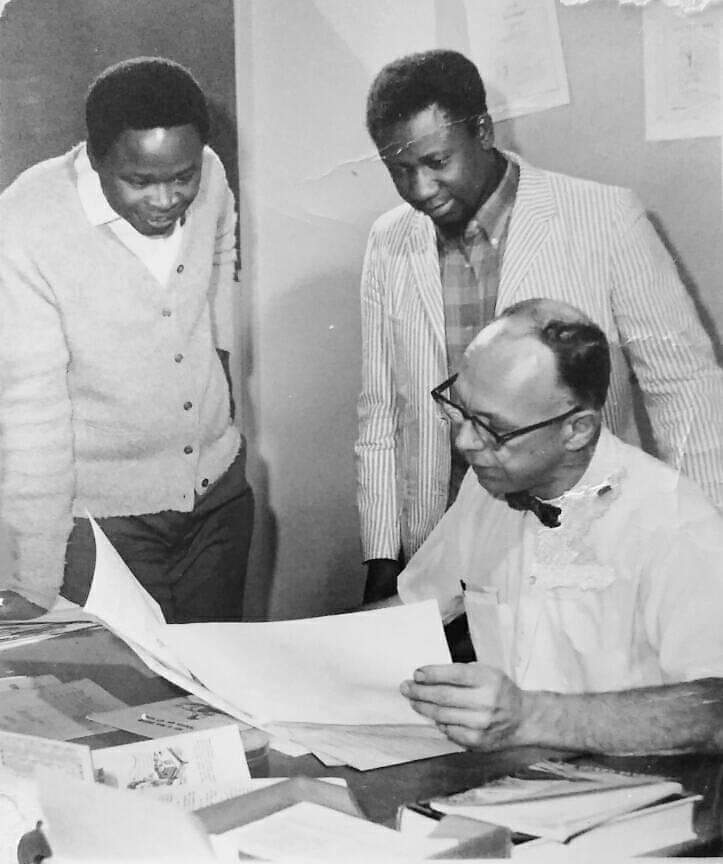
This is a flashback to history triggered by the cover picture of this story sent to Intervention by a restless internet crawler. In itself, the picture is that of a technocrat simply known as Mr A. J Adeka and Adamu Baikie with their Academic Adviser during their Masters programme at the University of Indiana, Bloomington in Indiana, USA in the late 60s. The accompanying lengthy caption goes on to tell how, upon their return from their studies in the USA, they both became lecturers at ABU Zaria before Adeka became a Commissioner in his home State, then Benue-Plateau State. The narrative is that Prof. Ishaya Audu who had become the Vice-Chancellor of ABU urged him to return to base at the end of his commissionership but only for him to decline.
On the other hand, Prof Baikie was to become a Prof. of Education (first in northern Nigeria) and later two-term VC of UNIBEN (1978 to 1986), VC at the University of Lesotho, and later founding VC of Nasarawa State University. One person serving as VC in three different universities is not a common place accomplishment. But that is still a tip of the iceberg: in all cases, he was ignorant of his appointment until it became public. That meant he never had to visit anybody in the night, rally round townspeople or blackmail anybody to get the job. Above all, he came out unscathed in all three.
One of those featured in the lengthy interview series which made Weekly Trust popular in its early days is Adamu Baike. The interview was arranged by Mallam Kabir Yusuf, a fellow sojourner in Southern Africa during Baike’s VCship in Lesotho but who had transformed into Media Trust publisher by then. Baike told the story of his experiment with democratic governance of a university that must be told sometime soon.
For now, the companion to the flashback is rather a different and more recent interview with Adamu Baike by Daily Trust on Sunday, (February 17th, 2017) which is accessible through that link. So, why should we read an old instead of a new interview? Simply because it is the story of one, unusual person as told by himself. It is also an insider’s account of the days gone by!. Lastly, there is no way of summarizing it without losing sight of the tension that every interview embodies.