By Prof. Chris Kwaja
Introduction
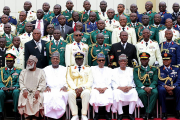
The All Progressives Congress (APC) held its National Strategic Retreat in Maiduguri, Borno State, from September 24 to 26, 2026. The three-day national strategic retreat brought together the NWC, state chairmen and other party stakeholders under the theme “Strengthening Party Organisation, Unity and Electoral Readiness Towards 2027.”
The three-day retreat in Borno State, which brought together the National Working Committee, state chairmen and other key stakeholders, was explicitly focused on strengthening party organisation, unity and electoral readiness ahead of 2027. The NWC subsequently said it had reviewed party structures from the national level through the states, local governments and wards to polling units. This provides a useful foundation for a stronger argument: the APC’s repositioning under Prof. Nentawe Yilwatda should be understood not merely as an electoral mobilisation exercise, but as an effort to turn the party’s national structure into a more coherent, reconciliatory and grassroots-oriented political organisation.
The significance of the All Progressives Congress National Strategic Retreat in Maiduguri goes beyond the meetings held, the communiqués issued or the familiar language of electoral preparedness. Something more fundamental is at stake: the repositioning of the APC as a political organisation capable of converting national structure into grassroots strength, internal unity and sustained political engagement.
A modern political party cannot be sustained by election-season mobilisation alone. It must be present between elections. It must listen to its members, manage disagreements, communicate its ideas, develop credible grassroots structures and maintain a relationship with citizens beyond rallies and campaign periods. That is where the Borno retreat assumes particular importance.
From Electoral Machinery to Organised Political Movement:
Under Prof. Nentawe, the APC has an opportunity to move the conversation from simply “winning elections” to building an organisation capable of sustaining political loyalty through effective internal organisation and continuous engagement.
The distinction matters. Electoral victories are ultimately the product of political organisation. Organisation requires functioning wards, active local government structures, responsive state chapters, disciplined communication and leadership that understands the concerns of ordinary members.
The NWC’s decision to intensify reconciliation at the state, local government and ward levels therefore deserves particular attention. The party has encouraged state chapters that have not yet established reconciliation committees to do so.
This is potentially one of the most consequential aspects of the Nentawe approach. A party that knows how to reconcile is a party that knows how to preserve strength. Political organisations naturally generate disagreements. Aspirants compete. Leaders disagree. Supporters become aggrieved. Political interests shift. The question is not whether disagreements will occur; it is whether the party possesses credible mechanisms for managing them before they become organisational fractures. In this context, reconciliation, therefore, should not be treated as an emergency response to crises. It should become part of the APC’s permanent political architecture.
The State Chairmen must become Engines of Repositioning:
The participation of state chairmen in the Borno retreat is particularly significant because national directives only become political reality when they are translated into action at the state and grassroots levels. The state chairmen should not merely be administrators of party structures. They should become strategic political managers. Their responsibility should include knowing where the party is strong, where it is weak, where members are dissatisfied, where reconciliation is required and where grassroots structures need rebuilding.
The ward should no longer be treated as an address on a party register. The local government should no longer become politically visible only during elections. And the state chapter should not function principally as a transmission belt for instructions from Abuja. That is how a national party becomes responsive.
The repositioned APC must work in the opposite direction as well: information, grievances, ideas and political intelligence must travel from the grassroots upward.
Nentawe’s Opportunity:
Prof. Nentawe now has an opportunity to give the APC a distinctly organisational character. The documented outcome of the retreat already points in that direction: structural review, reconciliation, stronger state-level engagement and a more active role for the NWC in communicating government policies and programmes.
The next test is implementation. The APC does not need another layer of slogans. It needs measurable organisational consequences. If reconciliation committees are created, they must work. If structures have been reviewed, weaknesses identified through that review should be addressed.
If ward organisations are to become stronger, they need regular political activity. If state chairmen are to drive the new phase, they require clear responsibilities and mechanisms for measuring organisational performance. And if the party intends to communicate the policies and programmes of the Tinubu administration more effectively, that communication must be translated into language that ordinary Nigerians understand and can interrogate.
Beyond 2027:
There is also a larger question. Is the APC building only for the next election, or is it building an institution that can survive electoral cycles? The answer will determine the historical significance of the present leadership.
The Borno retreat was themed around 2027, but its most important legacy should not be exhausted by the 2027 campaign. A genuinely repositioned APC should emerge with stronger internal systems, better grassroots connectivity, more effective conflict-resolution mechanisms and a clearer relationship between its national leadership and its state structures.
Borno has therefore given the APC leadership a point of departure. The NWC has declared the party structurally prepared and has announced a renewed emphasis on reconciliation and engagement.
The real measure of the Nentawe leadership will be whether the ideas discussed in Maiduguri become visible in the wards; whether reconciliation becomes tangible to aggrieved members; whether state chairmen become more effective organisers; whether local structures become more active; and whether the party develops a culture of continuous engagement rather than periodic mobilisation.
And if the Borno retreat is to be remembered as a turning point, its enduring significance will lie not in the resolutions announced in Maiduguri, but in the organisational culture those resolutions produce across Nigeria.
Conclusion
Prof. Nentawe has the platform. The state chairmen have the structures. The challenge now is to turn both into a functioning political machine—one that is organised at the centre, connected at the grassroots, capable of reconciling its own people and disciplined enough to translate national strategy into local political action.
Maiduguri should not be the conclusion of the conversation about APC repositioning. It should be the beginning.
The author is a Professor of International Relations at the Modibbo Adama University, Yola