By Chris Kwaja
Introduction
The global health order is undergoing a profound transformation. The post-Cold War assumption that economic integration, multilateral cooperation and development assistance would gradually produce a more stable and equitable international system has been challenged by geopolitical rivalry, trade fragmentation, sovereign debt pressures, climate shocks, supply-chain disruptions and declining development assistance. For Africa, these transformations have exposed an uncomfortable structural reality: the continent bears a disproportionate share of the global disease burden while possessing limited control over the financing, production, technologies and institutions upon which its health security depends.
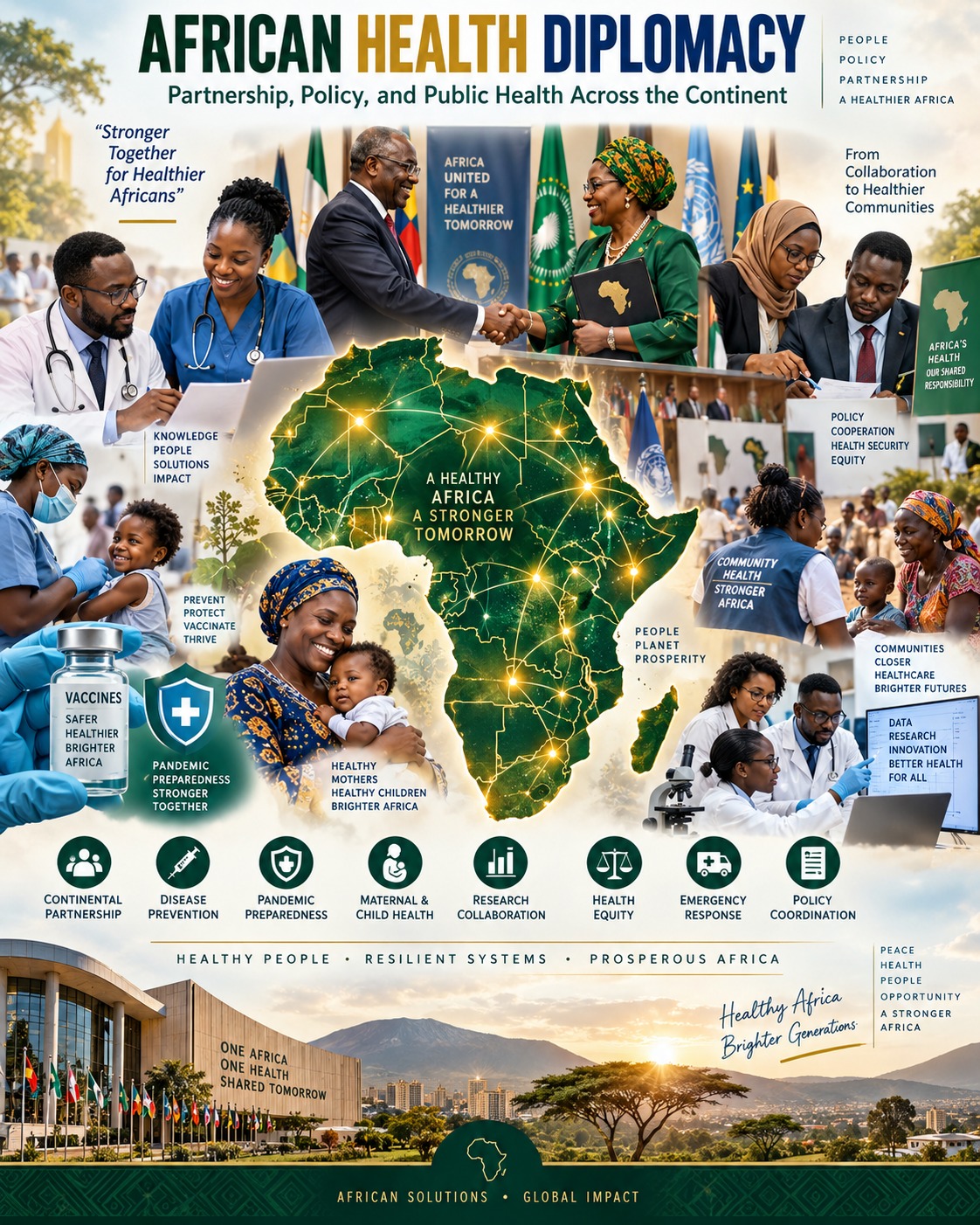
This piece argues that the Africa Centres for Disease Control and Prevention (Africa CDC) has consequently evolved from being primarily a continental public-health coordination institution into an increasingly important instrument of African health diplomacy. Its significance lies not only in outbreak surveillance and emergency response, but in its attempt to alter the political economy of health: who finances African health systems, who produces essential medical commodities, who controls health data, who sets global health rules, and whose interests are represented in international institutions. Africa CDC’s transition from the New Public Health Order to the Africa Health Security and Sovereignty (AHSS) Agenda reflects this wider transformation.
There is a sense in which health sovereignty should not be interpreted as African isolationism. Rather, it represents a diplomatic strategy for negotiating interdependence from a position of greater institutional, productive and financial capacity. The central challenge is whether African states can translate continental political commitments into sustained domestic financing, collective bargaining power and credible implementation.
Health in an Age of Global Rupture:
For much of the late twentieth and early twenty-first centuries, health diplomacy was generally understood within the framework of international cooperation. Governments, international organisations, donors, pharmaceutical companies and civil society organisations negotiated around the containment of infectious diseases, the financing of health programmes and the provision of essential medicines. For African states, this system generated important gains. International financing contributed to the expansion of HIV/AIDS, malaria, tuberculosis, maternal-health and immunisation programmes, while institutions such as the World Health Organization (WHO), the World Bank and global health partnerships became central actors in health governance.
Africa occupies a particularly vulnerable position within this transformation. Africa CDC estimates that the continent accounts for approximately 22 percent of the global disease burden while representing only about 1 percent of global health expenditure. Its 2026 health-financing analysis further identifies declining external assistance, rising debt, population growth and changing disease patterns as mutually reinforcing pressures on African health systems.
The question, therefore, is no longer simply whether Africa can obtain more assistance from the international community. A more fundamental question has emerged: Can Africa acquire sufficient political, financial, productive and institutional capacity to negotiate its place in the global health order rather than merely adapt to decisions made elsewhere?
The above question places Africa CDC at the centre of contemporary African diplomacy. Established by the African Union following the devastating experience of the Ebola epidemic, Africa CDC has gradually moved beyond the conventional role of a technical disease-control institution. During COVID-19, it helped coordinate continental responses, vaccine acquisition, testing, medical supplies and genomic surveillance. The experience also demonstrated the limits of the existing global system. Africa CDC itself acknowledged that only about 1 percent of Africa’s vaccine needs were manufactured domestically during the pandemic.
The institutional response has been the development of what was initially called the New Public Health Order for Africa, and more recently the Africa Health Security and Sovereignty Agenda. The latter explicitly seeks to reduce African dependence on external financing, manufacturing, procurement, supply chains and technological systems.
From Public Health Cooperation to Health Geopolitics:
Traditional health diplomacy tends to emphasise cooperation: states negotiate treaties, share surveillance information, coordinate outbreak responses and mobilise international assistance. Such cooperation remains indispensable. But contemporary health politics increasingly demonstrates that cooperation is inseparable from power.
The COVID-19 experience illustrated this vividly. When vaccines became available, access was determined not simply by epidemiological need but by purchasing power, manufacturing capacity, intellectual property arrangements, export controls, bilateral agreements and the ability of governments to negotiate directly with producers. Africa’s vulnerability was consequently not merely a health-system problem. It was a structural power problem.
The same principle applies to diagnostics, therapeutics, laboratory equipment, medical oxygen, personal protective equipment and digital technologies. A country that cannot produce or reliably procure essential medical commodities has limited strategic autonomy during a crisis. A country dependent upon external financing may find that its health priorities are shaped by the preferences of donors. A country without control over health data and technological infrastructure may find its ability to anticipate and manage epidemics constrained by external systems.
Health security therefore becomes inseparable from economic security. This is the intellectual foundation of Africa CDC’s changing role. Its earlier New Public Health Order rested on five broad priorities: strong public-health institutions, a stronger health workforce, expanded African manufacturing of vaccines, diagnostics and therapeutics, increased domestic resources, and more respectful and action-oriented partnerships.
Africa CDC as an Instrument of African Health Diplomacy:
Africa CDC should be understood as part of the institutional architecture through which the African Union converts continental political interests into technical and diplomatic capacity. Its role operates on at least four interconnected levels:
(i) Continental Coordination: Africa’s political fragmentation has historically weakened its bargaining position. Fifty-five states cannot always negotiate as effectively as a coordinated continental bloc. Africa CDC provides an institutional mechanism through which governments can coordinate positions, share epidemiological intelligence and develop common responses.
- Agenda Setting: Diplomacy is not only about negotiating outcomes; it is also about determining which issues become politically important. Africa CDC has helped move African health policy from the language of emergency response towards the language of sovereignty, resilience and self-reliance. This represents an important conceptual shift that is framed on the assumption that health is no longer framed simply as a welfare sector. It increasingly appears as an element of national security, economic resilience and geopolitical agency.
- Collective Bargaining: The diplomatic value of continental coordination becomes especially apparent in negotiations concerning vaccines, medicines, financing and global health rules. Africa’s fragmented purchasing power has historically weakened its position vis-à-vis pharmaceutical manufacturers and other suppliers. A unified African position in negotiations concerning pandemic preparedness and global health financing can provide greater leverage than dozens of disconnected national positions.
- Representation in Global Governance: Africa CDC is increasingly concerned with who writes the rules of global health. In April 2026, Africa CDC launched an African High-Level Ministerial Committee on Global Health Architecture Reform, bringing together African health and finance ministers to consolidate continental positions across these processes. This is health diplomacy in its most political form: not simply implementing global rules, but attempting to influence their construction.
Conclusion:
The language of sovereignty can generate misunderstanding. In an interconnected world, complete health self-sufficiency is neither realistic nor necessarily desirable. No African country can manufacture every vaccine, medicine, laboratory instrument, machine or technological system it needs.
The significance of Africa CDC ultimately lies beyond epidemic response. It lies in the question of agency. The rupture of the global economic and geopolitical environment has exposed the limits of a model in which Africa’s health security depends substantially upon external finance, imported medical commodities and institutions whose rules are often designed elsewhere. Africa CDC’s transition from the New Public Health Order to the Africa Health Security and Sovereignty Agenda represents an attempt to respond to this structural transformation.
Africa CDC is therefore emerging as something more consequential than a continental disease-control agency. It is becoming an instrument through which the African Union can connect health, diplomacy, industrial policy, finance and sovereignty. The future of African health diplomacy will ultimately be determined by this transition. In a rupturing global economy, that transition is no longer merely desirable. It is becoming a condition of African security, prosperity and geopolitical relevance.
Chris Kwaja is a Professor of International Relations and Strategic Studies at the Centre for Peace and Security Studies, Modibbo Adama University, Yola, Nigeria.