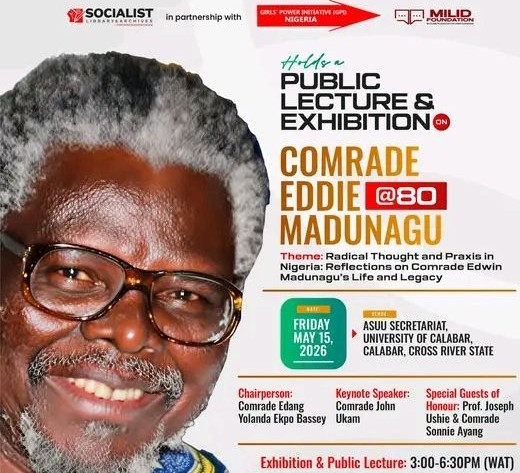
Dr. Edwin Madunagu, notable Nigerian protagonist of socialism, is clocking 80 years of life on earth and the birthday bells are ringing ceaselessly. A statement made available to Intervention on behalf of the multiple organisers of the event -the Socialist Library and Archives; Girl Power Initiative (Nigeria) and MILD Foundation – indicates that the birthday anniversary will climax with an exhibition and a public lecture. All these are unfolding on May 15th, 2026.
The temporal strength and Dr Madunagu’s uncommon consistency to an elevated value framework such as socialism in a society such as Nigeria makes the event a text and, like every other text, susceptible to the dictatorship of iterability. One such interpretive temptation for both those who are persuaded as well as those who are not that there’s nothing outside the text is to contend beautifully that this birthday is, automatically locked into its three inter-connected contexts: the global disarray, the much of the disarray which have reflected in the domestic (Nigerian) space and the ideological.
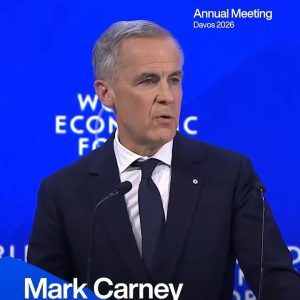
Canadian Prime Minister, Mark Carney
While it is true that corporate propaganda has, for now, successfully intimidated the world to look at socialism as a failed project, everyone knows the alternatives are just not working and the build-up for a less creatively destructive social order than neoliberalism is unmistakable. Long before Canadian prime minister Mark Carney – a sophisticated manager of the existing global order – went to Davos earlier in the year to declare that the order has crashed, Jacques Derrida had reminded the world of the ‘spectres of Marx (ism)’ in the context of the manifestations of key markers of the current order such as the migration crisis, indebtedness, intra-capitalist in-fighting, the arms race, unemployment and insular identity populism, amongst others.
Just like when he stole global attention in 1966 when he dismantled structuralism and put poststructuralism in its place at John Hopkins University, Derrida’s ‘Spectres of Marx’ intervention also took place in the United States, this time at the University of California at Riverside where he used to teach. It remains about the most thorough going insight into analysis of history in his ruthless deconstruction of Hegel and his reincarnation then – Francis Fukuyama. Derrida was not enacting an about-turn to classical Marxism from his own deconstructive perch but was endorsing the key markers of the system Marx pointed out and the unsustainability of the existing order those markers point at. That is his point about Marx being a spectre haunting the system.
What has become clear, especially in the aftermath of the 2008 financial crisis is that informed managers of the system such as prime minster Carney understood the deeper meaning of a system haunted by spectres, ghosts, apparitions or spirits, hauntological metaphors all for crisis upon crisis. This is because, as he told The Economist thereafter, the major crises of the system would still have been there irrespective of whether a Trump were in or out of power. This is what the Davos conclave also believes when they talk of reset, all of which point to an agreement that the world is experiencing a dislocation: the moment when old answers are no longer adequate for new questions.
As meaning also changes every time there is a dislocation because new frontiers of antagonism emerge, the propaganda against socialism may have also crashed if the above background is anything to go by. In other words, socialism is the ever present order when the unsustainability of what exists is pungently remarked about by its managers. All such hints serve as additional inputs in terms of the significance of events such as the 80th birthday of one of the flag bearers of the socialist idea in Africa’s most populous country.

Typically dense Derrida but cutting edge grasp of the contradictions of late capitalism in the Marxian image
Critics, observes Intervention, argue that all these make the ideological the issue – area for reflection at this event, especially as regards how the ideological ties to itself the domestic manifestations of the global disarray. The Socialist project is in a deep crisis. Unlike capitalism for which crisis measures its vitality, the crisis in the socialist project is theoretical as well as strategic. But the crisis is not peculiar to Nigeria. The world is still recovering from what started with the failed students’ revolt in France in 1968, the conduct of the Communist Party in both France and Soviet Union in the aftermath, the anti-Marxist (or was anti-Saussure?) fury of ‘the French 7’, their epochal reception in the United States, compounded by the way the vicars of neoliberalism such as Margaret Thatcher outsmarted socialists by articulating the capitalist crises in terms of non-class variables of de-statisation, nationalism and race and so on to the chagrin of Leftists, Marxists in particular. By the time USSR fell, again to rearticulation of socialism from within rather than a shot from anywhere outside of it, both Marxism and Socialism had been badly disrupted, made worse by one sided corporatist propaganda already referred to.
The resulting loss of confidence and associated incoherence was experienced across the world, serving in most cases, especially in Europe, Asia and Latin America to energise faith in nationalism and populism, radical populism in most of Latin America but right wing insularity in other parts. That’s the variant Nigeria inherited, making ethnicity and insular demagoguery a heroic unfolding.
Illiberal or insular populism has been such that they, consciously and otherwise, act as conveyor belt for mono-causal narratives originating mostly from outside but aimed at dominating the field of meaning as to what, why and how Nigeria is in such a disarray. They have become extremely difficult to counter or contain, even by the Nigerian State which has now been turned into a sheepish onlooker at its own funeral, impotently watching as articulations of insular populism and the extremes of violence take-over. Suddenly, the Nigerian military which recorded battle wonders in the forests of Liberia and Sierra Leone no longer has the capability to dislodge a far less determined or entrenched insurgents. In fact, things got so bad that their former organic commander, General T Y Danjuma threw allegations of collusion with insurgents at them, implying state complicity.
Yet, people don’t seem to see through the game. It is not only the Nigerian State that has manifested an intriguing behaviour pattern in its obliging silence over narratives of fragmentation. Not even the Left has found its voice against that nor has the media, in spite of its heritage of adversarial journalism. Leading academics too have also gone quiet as much as the civil society. Without vociferous interventions from such quarters, majority of the citizens are consuming the ethno-religious and insular populist narrativisation of crisis uncritically, unable to go beyond what meets the eye, especially as they encounter existential threat on the farms, on the roads, in their ancestral communities and even in the urban centres. In themselves, the propaganda stuff may just aim at intimidation but, like every other narratives, those of fragmentation can sediment into self-evident truth and become performative of the images they invoke. That is where the danger lies.
That danger is precisely why Dr Madunagu’s 80th birthday is not only for those committed to socialism but also for the Nigerian establishment which must, by now, appreciate the dangers of one-dimensional view of reality. Self-interrogation is very much called for all centres of power as well as individual actors in the Nigerian polity. It is though higher for socialists of all tendencies since socialist democracy can never be a unitary project. And Dr Madunagu’s 80th birthday provides an adequate symbolic cover for thinking through all that have happened and are still happening, what the most critical voices have said and what we ourselves can now say!
“Radical Thought and Praxis in Nigeria: Reflections on Comrade Edwin Madunagu’s Life and Legacy”, the title of the public lecture is broad and inviting enough to provide the synopsis for the big questions!