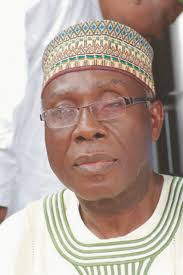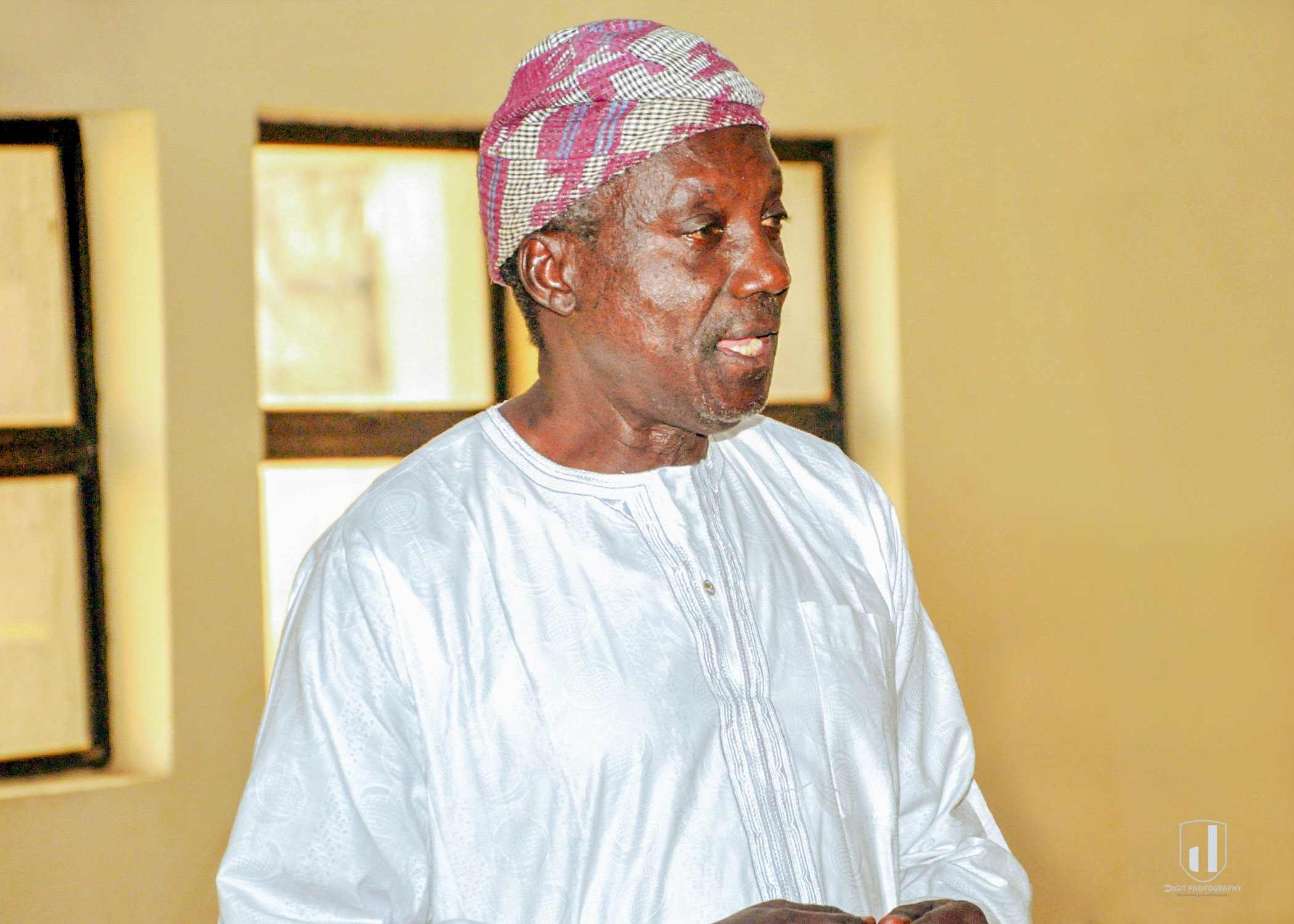
It was called an ‘Evening of Tributes’ and sobering tributes poured in from Washington DC, Nairobi, Switzerland, Kampala in Uganda, Dakar in Senegal and, of course, those who were on the ground at the Ahmadu Bello University, Zaria where Okello Oculi landed in Nigeria to begin a productive academic career after a PhD in Political Science from a front rank American university – the University of Wisconsin in Madison.
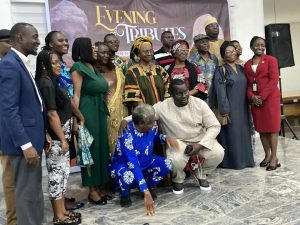
One set of in-person attendees
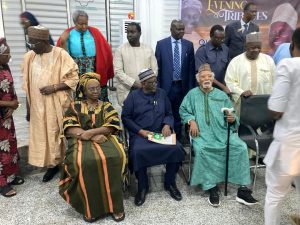
Mrs Debra Ogazuma (Prof Okello’s wife), Prof Gambari in black, Lindsay Barret in green, Dr Bala Jibrin in brown babanriga on the left and so on
An online event which must already have been streamed and available to millions, only a few takes are necessary in this report. It can hardly be otherwise since, except those who participated online, it was impossible to hear what the in-person participants were saying.
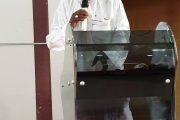
It would have been interesting to hear what Prof Jibrin Ibrahim was saying as Chairman of the Planning Committee. He was in Zaria in those days. Nothing of his very short speech before he called Prof Ibrahim Gambari to the podium. Prof Gambari was not just in Zaria when Oculi arrived Nigeria, he was most likely the HoD of Political Science who took Oculi in. While this is subject to confirmation, he could be heard saying something like Oculi being one of the stars who made the defunct Faculty of Arts and Social Science (FASS) the envy of other faculties (and universities too?) as for such enemies to rename FASS into FARCE. Heard or not heard, Prof Gambari’s presence gave additional symbolic seriousness to the ‘Evening of Tributes’.
Dr Emman Shehu, the literati and journalist friend of Prof Okello read the biography of the departed before another African intellectual ‘masquerade’ and Okello’s former school mate came online. He is Prof Peter Anyang’ Nyong’o, the governor of Kisumu County in Kenya. He was to have been in Nigeria for the ‘Evening of Tributes’ and the other rites of passage for Prof Okello before it has, somehow, not worked. Prof Jibrin Ibrahim was telling a story about one incident involving him and Anyang’ Nyong’o in Kenya but it was all so faint.
Anyang’ Nyong’o and Oculi were, by Nyongo’s account, tutorial fellows at Makerere University in Kampala and became very close friends. His first scoring of Oculi is the usability of his texts at all levels of education, from primary schools up, up. Schools use Oculi’s poetry books in much of East Africa, he said, before switching to how what the world of scholarship had come to understand as defining Oculi is Pan-Africanism. Before Oculi’s death, he was working on a book on Diallo Telli, the first Secretary-General of the defunct Organisation of African Unity (OAU). Telli died in suspicious circumstances thereafter back in his own country Guinea. And Oculi, driven by his gourd of Pan-Africanism, was bringing back that incidence in the first quarter of the 21st century.
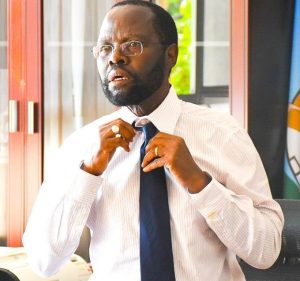
‘Kenyan political scientist, Prof Peter Anyang’ Nyongo
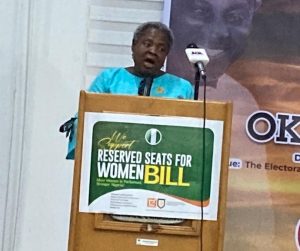
Nigerian gender activist, Ene Ede on the podium
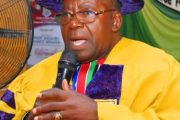
Prof Anyang’ Nyong’o would be happy to see that the book is completed in Oculi’s name, imploring the organisers of Oculi’s tributes to explore how they could be part of it. He lauded Oculi’s prioritisation of Pan-Africanism, that being why he headed for Nigeria and ended up spending nearly half a century in the country instead of staying back or returning to the United States. In words and in deed, Oculi was about Pan-Africanism, he said, expressing the hope that many more actors such the African Political Science Association (APSA); the Council for the Development of Social Science Research in Africa (CODESRIA) and a few more others could pursue what Oculi was pursuing at the point of death.
He gave the assurance that they in East Africa would take up the challenge, acknowledging that Nigeria had been Oculi’s home for such a long time that it could not be denied. We shall work together to give Okello what he deserved in the world of scholarship and Literature and that of the rural dwellers were his parting words.
The Ugandan High Commission in Nigeria was represented by Dr Omara Sam. All that one could hear him say was Oculi having transformed into a truly African son, an obvious reference to his finding a home in Nigeria. Prof Abdoulaye Bathily, the Senegalese Historian could not utilize his online call-up to speak. It must have been network crisis from either side.
Next to speak was Mr Lindsay Barret, the veteran’s veteran and the man with the fullest account of all the wars fought in West Africa shortly before and after the end of the Cold War. Himself and the Ghanaian journalist, Ben Asante reported those wars like no others and might even have more details about the wars than troops. Asante, his friend and a long time dweller fell ill some years back and no one has heard of him in the past few years. It is not clear if Barret has made progress with his autobiography. Whether he has or hasn’t, Barret is the one to be celebrated in his life time, not after his demise. He is a one-man library of an important dimension of the crisis in (West) Africa. He was certainly very close to Okello Oculi, both share many features together, particularly relocating to Nigeria and marrying from the country. Like all others today, no one online heard what he was saying as an in-person participant.
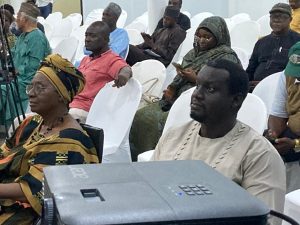
Son and widow
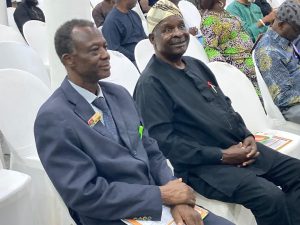
Prof Gani Yoroms and Prof I. Zabadi from Bingham University, Karu, near Abuja
The lot fell on Dr Yusuf Bangura whose office at the old FASS was next to Okello’s. They used to hang out a lot as academics even though there were certain things they didn’t agree on. But Bangura told his audience how Okello had a way of bringing one to his side, especially the skillful way Okello told his stories. Prof Okello’s entire world view, said Bangura, is structured by African quest for dignity, power and independence. That, he also said, was amazingly popular with the campus even as some of them, as Okello’s colleagues, disagreed with some aspects. For Bangura, interaction with Okello in Zaria of then was a case of hundred flowers blooming.
And that interaction assumed a thicker level this year as both Bangura and Okello chatted every week till Bangura suddenly heard of his death July 26th, 2025. He got to know from Okello about a book work on Diallo Telli just as Anyang’ Nyongo mentioned earlier. Bangura was not going to write a chapter in the book but offered to interview a relation of Diallo Telli who had been a diplomat. The interview didn’t work out in the end because the man went to France instead of Switzerland where Bangura was. But the book was/is one of the three -pronged approach Okello was deploying on the Diallo Telli project. He was connecting with progressive lawyers who could unravel and fully account for the way Diallo Telli was obviously killed. The third plank was instituting a Diallo Telli Prize. Bangura concluded by disclosing how he had immersed himself in Okello’s literary outputs, particularly Banana Man which he described as a text, amongst others, on the denigration of Africa and the failure of modernisation, recommending to all to who love literature to read it. He obliged the audience a number of proverbs he described as mind – blowing in it praying for Oculi thus: may he enjoy the full embrace of his ancestors.
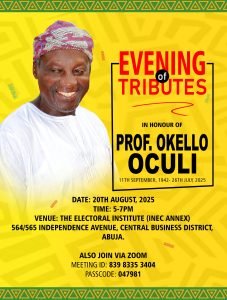
The Okello Oculi moment!
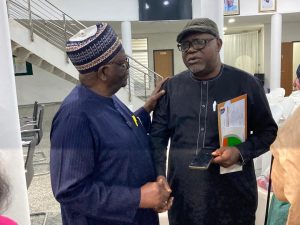
Prof Ibrahim Gambari and Cde Chris Uyot (ex-NLC staff)
Prof Mbye Cham, a relation of Prof Nzongola Ntalaja spoke from Washington DC. The two of them met in 1973 at the University of Wisconsin, becoming roommates till 1976. Those were transformational years for the entire Pan-Africanist activists at the time, with Okello at the centre of it all. They had an apartment where they cooked and unfolded Pan-Africanist initiatives, especially the ‘Monday Night Live’ praxis. That was when and where they gathered mainly graduate students and invited knowledgeable and expert Pan-Africanists to take the central questions of the moment.
Referencing Bangura, Prof Cham talked of things one may not agree with Okello but which he had his own way of making one see it differently. Both he and Bangura were striking at a key aspect of the Okello Pan-Africanist praxis. Till he breathed his last, he encountered criticisms of his innovations in Pan-Africanism. One of it was how getting young people to act out the many corrupt agents of imperialism in the OAU during the Cold War was Pan-Africanist. In fairness to him, he never said that. In many cases, he was the first to recognise that tension. But he had other pedagogical reasons behind the Mock – OAU/AU Summit. Among those ideas were training young people to acquire competence in conducting background research about African countries, be so knowledgeable about Africa and to begin to imagine themselves as leaders rather than streetwise thinking citizens. To that extent, Africa hasn’t heard the last of Okello until some of the beneficiaries of his superintendence blossom.
Prof Cham spoke about a joke about Okello which was calling him an ‘impostor’. Those who gave him the nickname meant that he was hiding in Political Science when he belonged more to the world of literature, having already written renowned literary works. The paradox was that Okello was working under the supervision of a big name in Political Science, Prof Crawford Young, the author of the classic of diversity in emergent states in Africa and Asia titled ‘The Politics of Cultural Pluralism’. In Cham’s words, Young took Okello “on his wings” and rated Okello one of his great students. The professor is happy he had the privilege of hosting Oculi’s wife, Debra Ogazuma in DC sometimes back and he will keep praying for the family.
Sembene, Oculi’s first son was called to the podium. Intervention didn’t hear what he was saying but he was moving his hands while reading from a text. It may not be out of sync to read the movement of his hands as saying, ‘Dad may be gone but I am here’. It was the encouraging moment.
Prof Istifanus Zabadi, a member of the Planning Committee spoke. He wore three caps at the event – a former student of Okello, an academic at Bingham University, Karu in Abuja where Okello put together what must have been his last new Mock-OAU/AU Summit before death and, three, membership of the Planning Committee. Wole Olaoye, another friend of Oculi and a member of the Planning Committee brought the event to a close with ‘thanks’ to everyone.
It was a valedictory session befitting a many-sided persona who has been around in Nigeria for nearly 50 years. Not only was he an academic, he was also in the civil society and even in government, serving as an adviser to a Minister for Agriculture. Such a person was bound to reap homage from circles as wide as he straddled.
The rites of passage now moves to The Service of Songs and the Requiem Mass before his internment Friday, August 22nd, 2025. After that, the puzzle moves to who are succeeding the Mudimbes, Ngugis and Okello Oculis as Africa’s spokesmen and women in a world of voices!