By Prof Chris Kwaja
Introduction
Every generation produces men and women whose stories remind us that greatness is not an accident, but the reward of vision, discipline, resilience, and unwavering faith. Professor Nentawe Goshwe Yilwatda stands as one of those remarkable Nigerians whose journey reflects the triumph of character over circumstance and purpose over privilege.
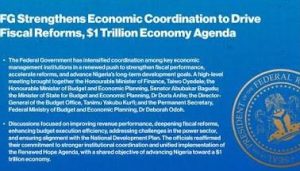
The 1 trillion Naira economy narrative
The story of Nentawe Yilwatda is therefore not simply about political office or professional achievement. It is the story of a young man from Plateau State who embraced education as a ladder, integrity as a lifestyle, and service as a calling. His journey reminds every young Nigerian that circumstances at birth do not determine destiny. What matters is the courage to learn, the discipline to persevere, and the conviction to remain faithful to one’s purpose.
His life teaches that success is not merely reaching high office; it is building competence before seeking influence, serving before leading, and remaining steadfast through seasons of challenge. From the classrooms of academia to the corridors of national leadership, Professor Nentawe Goshwe Yilwatda’s journey is a testament that grace often meets those who have labored faithfully.
From Humble Beginnings to a Life of Purpose
Born on August 8, 1968, in Dungung, Kanke Local Government Area of Plateau State, Yilwatda was raised in a family where faith, discipline, and service formed the foundation of life. Those early values became the compass that guided him through every stage of his remarkable journey.
His path was never defined by shortcuts. Instead, it was built through education, diligence, and an unquenchable thirst for knowledge. From the Boys’ Secondary School, Gindiri, to earning degrees in Electrical and Electronic Engineering, including a doctorate in Digital Systems Engineering, he consistently proved that excellence is achieved through hard work and persistence rather than mere talent.
As an academic, he dedicated years to teaching, mentoring, and advancing technology in Nigeria. At the Federal University of Agriculture, Makurdi, he became known not only as a professor but also as an innovator who championed digital transformation and institutional development. His career demonstrated that leadership begins with solving problems and empowering others.
His transition into public service revealed another dimension of his character. Serving as Resident Electoral Commissioner in Benue State, he became associated with efforts to improve electoral administration, including initiatives aimed at expanding participation for internally displaced persons and people with disabilities.
Like many leaders, Yilwatda encountered disappointment. He contested the 2023 Plateau State governorship election but did not emerge victorious. Yet defeat did not define him. Rather than retreat from public life, he accepted the judicial outcome and continued serving the nation, illustrating that true leadership is measured not only by victory but also by dignity in adversity.
His dedication and experience eventually earned him appointment as Nigeria’s Minister of Humanitarian Affairs before he later became the National Chairman of the All Progressives Congress (APC). These appointments reflected years of preparation rather than overnight success, showing that consistent service often opens doors that ambition alone cannot.

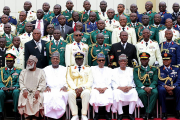
Faces at ruling party chairperson’s 58th birthday
Prof. Yilwatda in the Shadow of Nigeria’s Journey to a $1 Trillion Economy
As Nigeria pursues the ambitious goal of building a $1 trillion economy, the conversation increasingly extends beyond fiscal policy and macroeconomic reforms to the quality of leadership capable of translating vision into measurable progress. In that context, Nentawe’s career offers an interesting study in the growing relevance of technocratic leadership within Nigeria’s political landscape.
An engineer by training, an academic by profession, and a public administrator by experience, Nentawe has built a career that spans university administration, electoral management, humanitarian governance, and party leadership. He served for more than two decades at the Federal University of Agriculture, Makurdi, where he led ICT reforms before becoming Resident Electoral Commissioner in Benue State. He later contested the Plateau State governorship election, served as Minister of Humanitarian Affairs and Poverty Reduction, and in July 2025 became the National Chairman of the All Progressives Congress (APC).
Nigeria’s aspiration to become a $1 trillion economy is not merely about expanding GDP. It requires raising productivity, improving infrastructure, deepening digital transformation, strengthening institutions, expanding industrial capacity, and creating an environment where innovation can flourish. Achieving such a target demands consistency in policy implementation as much as bold economic ideas.
This is where leaders with technical backgrounds potentially add value. Engineers are trained to solve problems systematically. Academics are conditioned to rely on evidence. Technology professionals understand the importance of systems, data, and efficiency. These attributes become increasingly relevant in a country where institutional performance often determines whether policy succeeds or fails.
Nentawe’s professional history reflects these themes. During his years in university administration, he was associated with digital transformation initiatives that modernized institutional processes. His work also extended to technology consulting for development partners, reinforcing an interest in applying digital solutions to public-sector challenges.
Today, as National Chairman of Nigeria’s governing party, Nentawe occupies a different kind of strategic position. Political parties are often judged by their ability to maintain internal cohesion, develop credible policy platforms, and support governments in implementing long-term reforms. If Nigeria is to sustain a growth trajectory capable of approaching a trillion-dollar economy, political stability and institutional continuity will matter alongside economic policy. Yet the path remains complex.
Nigeria continues to grapple with inflationary pressures, infrastructure deficits, energy constraints, unemployment, foreign exchange challenges, and uneven productivity growth. None of these problems can be solved by political rhetoric alone. They require coordinated action across government institutions, the private sector, and civil society.
This is perhaps where the significance of figures like Nentawe lies—not as singular architects of national transformation, but as representatives of a broader movement toward evidence-based governance. His background suggests familiarity with systems thinking, digital innovation, and institutional management, qualities that many analysts argue are increasingly necessary for complex public administration.
Of course, credentials alone do not guarantee outcomes. Nigeria’s history is filled with highly qualified public officials whose ambitions were constrained by political realities, institutional limitations, or implementation gaps. Ultimately, leadership is measured less by academic titles than by the ability to deliver tangible improvements in citizens’ lives.
Conclusion
The journey to a $1 trillion economy will therefore depend on more than economic targets. It will require credible institutions, disciplined execution, policy continuity, and leaders capable of building public trust while managing difficult reforms.
Whether viewed as an engineer, professor, politician, or administrator, Professor Nentawe Yilwatda represents one dimension of that evolving leadership conversation. His career mirrors Nigeria’s own transition—from analogue governance toward digital systems, from personality-driven politics toward institutional performance, and from managing crises to aspiring toward long-term economic transformation.
As Nigeria continues its pursuit of greater economic scale and global competitiveness, the country’s success will rest not only on ambitious projections but also on the quality of leadership guiding the institutions that turn those ambitions into reality.