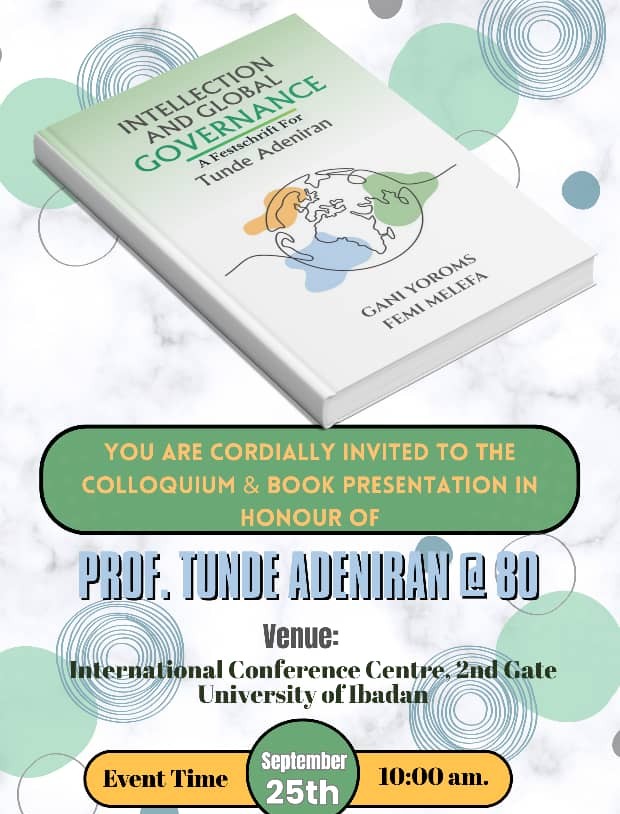
Gani Yoroms & Femi Melefa. 2025. Intellection and Global Governance: A Festschrift for Tunde Adeniran. Ibadan: Kraft Books Limited. 561 pages, price: $45
The intellectual ritual of celebrating the contributions of a scholar through the production of knowledge around the ideals and substance of his scholarship which began in Germany in 1871 seems to have become a very prominent and established academic tradition in Nigeria. Festschrift is a German compound word made up “Fest” which stands for “celebration”, and Schrift” which means “writings”. In Nigeria today, highly distinguished scholars are celebrated when they mark their milestones with well-published festschrifts expounding their intellectual discourses in collections of writings by their colleagues and protégés with whom they had had very extensive and intimate intellectual intercourse.
The book under review is a festschrift on Professor Tunde Adeniran, a renowned theorist of international relations, a very distinguished teacher of the broader discipline of Political Science, a literary scholar with impeccable command in English language, a public administrator, an accomplished diplomat and a politician with good conscience. Arising therefore from the very impressive public record of the subject of this publication, it is certain that this festschrift is a fitting tribute to the excellence he displayed to the world at the different levels of his public Service engagements.
The editors of this book are intellectuals who had benefited from Professor Adeniran’s wellspring of knowledge at Nigeria’s premier University-University of Ibadan-which has produced impactful scholars in several areas of scholarship ,but most significantly, in the Social Sciences. It was in this citadel of learning that Professor Adeniran engaged the world with his brilliance and pragmatic intellectual discourses, especially in the field of international relations.
This book begins with a Foreword by Elochukwu Amucheazi, a distinguished Professor of Political Science and a long-time friend and associate of Professor Adeniran, who affirmed Adeniran’s consistent belief and pursuit of idealism in politics anchored on due process, accountability and rule of law. In the introductory note, Professor Gani Yoroms and Femi Melefa, the editors of the book, highlight the essence and justifications for the book, and the synopses of the twenty-two chapters of contributors which are carefully arranged into four sections.
Obviously, in this book, there are many good renditions on the theoretical import of Nigeria’s global encounters and the broader impact of contemporary challenges in the global system on Africa as well as Nigeria, which were based on Professor Adeniran’s perspectives, and indeed, to some extent, seek to advance the frontiers of knowledge production. But the challenge is that for a review of this nature, it is absolutely impossible to present an exegetical analysis of each of the twenty-two chapters of the book. It is, however, important to at least examine some of the contributions in order to get a sense of the value addition of this book to scholarship. Kayode Fayemi’s piece gives a panoramic view of the immense value of Adeniran’s scholarship and the courage of his foray into politics and diplomatic adventures, which are considered exemplary and commendable (pp. 9- 22). The chapter by Ayo Fadahunsi presents the intellectual-cum –socio-political activism of Professor Adeniran as one that suits the Platonian concept of a philosopher-king, noting that he belongs to the class of such great minds with socio-political visions of emancipating Nigerians like Obafemi Awolowo, Nnamdi Azikiwe, Ahmadu Bello, Claude Ake, Peter Eke, Ken Saro-wiwa, Chinua Achebe, Wole Soyinka, among others. He commended Adeniran for demonstrating platonic zeal in his service to Nigeria throughout the period of his public service engagement (pp.23-39). The chapter by Bola Akinterinwa which is evidently detailed and well-researched, is an explicit review of the history of Africa’s international relations to the contemporary times, and an inquisition of what the future holds for the continent which is currently being cultivated by competing powers in an emerging era of new Cold War struggles (pp.40 – 125).
The nature, dimensions and levels of African security challenges , the local, regional and transnational criminal activities and efforts aimed at managing their socio-economic and political consequences as well as their implications for governance are well-rendered by A.G. Adedeji (pp.129- 47), Aderemi Ajibewa &Daniel Odunyingbo (pp.148-166), Isaac Olawale Albert(pp.226-247), Michael Agbo John, Anthony Gebiri Elizabeth &Ankeli Monica Alexander(pp.248-266), Gani Yoroms (pp.267- 295), and Tunji Olaopa (pp.296-308).
Issues bordering on Africa’s place in the global power calculus, the foreign policy imperatives, civil service administration reforms, intergovernmental relations for improved governance, advancement of democracy and enhancement of participatory politics are the concerns of Femi Omotosho & Olalekan Fatogun (pp.167-192),Oladapo Afolabi (pp.349-363), Olugbenga P. Faseluka (pp.364-388), Jerry Uhuo (pp.389-418), Olarinde Fidelis Olugbamiye (pp.419- 432) and Julius O. Ihonvbere (pp.508- 524).
The implications of the interdependence and connectivity within the extant global system when such transnational challenges as Covid-19 pandemic, climate change, and the resultant impact they could exert on countries of the world including the politics of information management of these challenges, as well as the place of the media in National discourses, engage the intellectual curiosity of John Ayotunde Isola Bewaji (pp.193-225), Kingsley U. Ekwere (pp. 433- 456), Oludaye Tade, Ridwan Abiola Kolawole & Adigun Agbaje (pp. 459- 480), and Tunde Olusunle (pp. 481- 506).
In the absence of a concluding chapter, Adebayo Olukoshi‘s chapter which is titled: “Nigeria: Character builds a Nation, Dignity transforms it”, fits the bill. The message of the chapter in question, has universal applicability, not just for Nigeria. He highlights Asia’s transformation from being considered underdeveloped to becoming a developed continent, a transition he argues could be attributed to the character and determination of its leaders. He emphasizes that with the right combination of factors, any nation can achieve greatness. The chapter stresses that character builds a nation, but dignity is what transforms it. It highlights the importance of discovering a public purpose that unites politics and policy, and citizens must be committed to this purpose, with a system of reciprocal accountability. The takeaways from this chapter include the following: i. Character and determination drive national transformation; ii. Dignity is essential for transforming a nation; iii. A shared public purpose is crucial for greatness; and iv. Reciprocal accountability is key to achieving national goals (pp.507-523).
A book of this magnitude could have inflicted some stress on the editorial team, which had to work under tight schedules to ensure the delivery of the publication and its presentation at the 80th birth anniversary of Professor Adeniran. The editors did a very good job by sectionalizing the chapters even though one might spot a misalignment in some cases, which the publisher should be able to rectify in subsequent editions of the book. In addition, most festschrifts in Nigeria including this one under review, collect and collate articles of contributors into a volume regardless of whether they have any reference to the intellectual worldview of the subject of the publication. Festschrift on a scholar that deserves such honour should be a platform for some critical reflections on the scholar’s perspectives on varying topical issues in his previous intellections.
Moreover, Professor Adeniran is not just a political scientist with specialization in international relations, he is a poet, an essayist, a novelist, politician, public administrator and a public intellectual. There ought to be sections on each of these areas of his scholastic expressions and activism. I believe with time, this intellectual ritual of festschriften will be improved upon, and hopefully, University publishing houses will gladly begin to invest in this worthy scholarly endeavour and output.
Overall, this festschrift on Professor Tunde Adeniran is a rich collection of writings with relevant and valid information and updates on varying topical issues in the world. This publication is a fitting tribute to this intellectual giant and a politician with good conscience. Most of the contributors to this book are accomplished scholars in their different fields of engagement, and their submissions are products of their experiential knowledge which they garnered over a long period of time. That is why I am confident that the publication will stand the test of time, being a worthy addition to the current stream of academic publications on Africa, focusing on the changing global power calculus which students and teachers of social sciences, public administration, international relations, diplomacy and politics will find very useful.
Dr. John Olushola Magbadelo is of the Ambassador Bulus Lolo Centre for Diplomacy, Conflict, Peace & Plural Studies at Bingham University, Karu, Nasarawa State of Nigeria and is reachable through ablc@binghamuni.edu.ng