
Justin Smith-Ruiu, the author, is introduced by THE as a professor of History and Philosophy of Science at Université Paris Cité as well as founder and president of the Hinternet Foundation, an educational nonprofit
- Administrators, ideologues, and yes — professors too — share the blame. But all is not lost
It is perhaps in the nature of academics to fret about declining standards, especially as these academics age and become ever less attuned to the always-evolving expressions of the innate ingenium of youth. But even an eternal complaint can be truer in some eras than in others. With each passing year since the economic crisis of 2008, the familiar response to complaints of decline — that we must not let our spirits flag, that we must not retreat into cynicism and defeatism — has come to sound, to those who have not lost their hearing, ever more “late Soviet.”
No one wants to be the first shock-worker on the assembly line to acknowledge that the factory is not meeting production quotas. But at some point enforced identification with what is obviously a collapsing system grows so strained as to become unbearable, and the change that had been coming slowly for a long time now comes all at once.

The verdict of the late Oxford scholar
The arrival of generative AI was, for many university-based humanists, the event that finally pushed us over the edge, and suddenly compelled us to begin naming the problem in lucid and uncompromising language. But AI was not so much a new threat to humanistic inquiry as it was the final, decisive blow dealt by a many-fisted menace that had been stalking us for years. A combination of technological, economic, political, and cultural forces, at work both within and without the university, had by the early 2020s effectively pummeled the tradition of universitarian humanism into unconsciousness.
Humanities professors could still “report for duty” in a narrow sense; like apparatchiks in the early days of post-Soviet confusion, they could still show up for work and collect their (greatly devalued) paychecks. What they could not do is fulfill their duty — they could no longer, that is, have any real hope of guiding their students from beacon to beacon of a millennia-long tradition of reflection and discovery that, once internalized, likely represents the greatest hope a person has in this hard world for achieving a condition of true freedom.
The collapse is amply confirmed in both data and anecdote. But it is already a symptom of the total domination of a nonhumanistic spirit in our contemporary world to suppose that data have some great power of persuasion that narrative description lacks. You can find the data elsewhere; let us instead consider here, unashamedly, some anecdotes.
These are stories that most humanities professors will already have heard in other variants, even if their full significance may not yet have sunk in. I have learned of an American student on a semester-abroad program in Florence — Florence — who, when told just a thing or two in passing about Michelangelo or Dante in the context of an introductory Italian class, complained to the program director that precious class time was being wasted simply to indulge the professor’s eccentric interests. From the student’s perspective, the entire purpose of learning Italian is exhausted by such things as ordering panini.
But why bother to go to Italy at all? This student’s “major,” of course, was one that did not exist before the present century, involving some ad-hoc concatenation of terms like “leadership,” “innovation,” and “sustainability.” On such a course of study students can easily end up in Florence rather than Barcelona, say (where they will in any case spend the weekend, thanks to EasyJet), as the result of a choice as hasty and unreflected as the one between “Innovation Mindset” on Mondays and Wednesdays, or “Team Building for Social Impact” on Tuesdays and Thursdays.
The simple truth is that the students have no idea why they’re in Italy; they barely know that they’re in Italy. There is some dim awareness that they should be there, eventually to put “Italian” among their “languages” on LinkedIn. But this “Italian” is an Italian entirely separated from history, literature, and culture; and this should is an imperative entirely imposed from outside, entirely unconnected to a student’s exercise of his or her own freedom. The student has no freedom. Freedom has to be cultivated.
One feels for the student, whom the system has so tragically betrayed; and one feels for the professor, who simply cannot, under the circumstances, make good on their true life-calling.
What about the humanities majors? If you check the data, you will see that there aren’t that many of them left. Have the humanities departments responded to their falling enrollment numbers by renewing their commitment to the great tradition, to helping their students wake up to the wonder of the human mind as manifest in its most enduring monuments? They have not. Instead, like the hoverflies that have found their little niche inside beehives through Batesian mimicry of the outer bodily morphology of their hymenopteran cohabitants, the humanities are undergoing a rapid process of what Tyler Austin Harper has called “business-schoolification.”

Popular culture and the humanist struggle!
The blame for all this is not to be heaped entirely on the professors. The real explanation of why it is happening has everything to do with top-down economics, with the decisions made by that class of administrators whose primary function is to raise money, a portion of which now comes from corporate partnerships. I heard from a California-based specialist in Medieval cosmology whose courses, which he spent decades gaining the expertise necessary to teach, have been replaced by courses on “video-game ethics.” He has been told he’s welcome to stay on, for now, and teach these if he wishes.
You can roughly guess, given the proximity of Silicon Valley, what sort of deal must have been made that would explain this change in curricular priorities. I have spoken with countless young Ph.D.s, who squeezed through with what can now only be seen as dissertation topics from an ancien régime — beautiful topics, universe-in-a-grain-of-sand topics, on Vedic ritual and Hildegard of Bingen and Ptolemy’s Almagest and Navajo verb tenses and Mexica calendars — who are now desperately bouncing from place to place, adjunct-teaching fake courses for paltry sums of money on topics fundamentally unworthy of their attention, like “Critical Thinking for Executive Leaders,” “Philosophy for Public Impact,” and all those other confabulated subjects that fall within the genus of what is ultimately and irremediably an oxymoron: “Business Ethics.”
One feels for all of these precaritized intellectuals, whom the system has so tragically betrayed. But the time has come to do more than feel for them. The time has come to see whether something might be done for them, not just to string them along in a system that is plainly no longer their natural home. The time has come to think seriously about how we might salvage their beautiful spirits and enable them to carry forward the things that really matter. It is plain, by now, that if this is going to happen, it will not be the result of an intra-university change of priorities. Universities are not going to reform themselves, at least not without significant external pressure.
Most academics who are not yet retired or dead are young enough to have spent their entire careers in a milieu dominated by some strain of “myth-busting” or other. The principal purpose of what has passed for humanities education has been to convince students that the humanistic tradition is not what they think it is. This is a peculiar pedagogical goal, to say the least, since typically at the outset students do not have any idea what the humanistic tradition is, or even that it exists at all. They are being rushed straight from ignorance to contempt, without any serious effort to familiarize them with their contempt’s object.
This is a tragedy in the literal Greek sense: It is a blindness as to the nature and consequences of the professoriat’s own choices that ultimately contributes to its downfall. Nothing has been more useful to the administrators seeking to transform the entire university into a business school than to hear from the humanists themselves that their tradition is really only the propaganda wing of white supremacy, patriarchy, and imperialism. Imagining themselves as occupying a site of resistance to capitalism, they end up among its most obedient lackeys.
I acknowledge that in the 1980s and ’90s many powerhouse intellectuals had a hand in promoting what Paul Ricoeur called the “hermeneutics of suspicion.” Even today you’re hardly much of an intellectual yourself if you feel no frisson in your encounter with what the cultural reactionaries classify generically and imprecisely as “postmodernism,” or even more imprecisely, “postmodern Marxism.” Much of the work these reactionaries ignorantly dismiss is indeed exciting stuff, and it has uncovered real truths about our reigning ideological order, in large part because all the leading figures of its first generation were extremely well-educated and knew the objects of their critique inside and out.
But revolutionary movements almost always degenerate into mediocrity once they pass into the institutions, where the succeeding generation preserves little memory of what the revolution had defined itself against. The particular flavor of our current mediocrity, in fact, results precisely from the collision between this now-institutionalized, half-educated spirit of contempt, on the one hand, and the vastly more powerful forces of financialization and hyperquantification on the other.
It is as products of this collision that we must understand the delirious proliferation of ostensibly peer-reviewed articles (if their reviewers read them, they will almost certainly be alone in having done so) on what are plainly topics that would best be investigated in the form of a personal or literary essay. Their authors fail to understand, or pretend not to understand, that what interests them is best pursued through cultivation of an individual expressive style rather than through a weak semblance of argument and a flimsy citational apparatus.
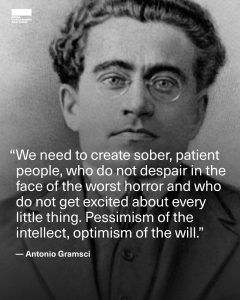
About the communist without blemish!
Thus we find young humanities professors maintaining a cargo-cult-like system for the publication of reflections on their personal motivations for adopting nonbinary avatars when playing video games (for example), shoehorning a question that really ought to be explored through the cultivation of a personal authorial voice into the ill-fitted, incongruous frame of abstracts, keywords, works cited, and so on. The results cannot fail to be laughable. If those who participate in this cargo cult are unable to see this, it is because they preserve no real memory of the existence of a humanistic tradition that, rather than allowing its practitioners to burrow further into themselves, instead brought its practitioners out of themselves and onto a horizon that was much, much larger than their gaming screens.
It is not at all my purpose to ridicule anyone in particular. I feel for those whom the system has so tragically betrayed. But that this current way of doing things is ridiculous, that this strange skeuomorphic vestige of the formerly flourishing Geisteswissenschaften needs to be abandoned by any serious person — of these conclusions there can be no question.
Those who have some stake in upholding this absurd system — the junior academics excited to add an editorial-board membership to their CVs, the graduate students eager to glean some likes on social media by sharing their first “accepted” email as a screenshot — can often be found criticizing their critics for having criticized them in ignorance of what is called “the literature.” But by this they invariably mean only the narrow productions of the particular academic community in which they’ve found a home. Upon investigation, these productions never turn out to exhaust the range of what might legitimately be said on a given topic.
What does it mean to tell someone they have not adequately consulted “the literature” on gender, for instance? That they have not read the Rig Veda? The Talmud? That they have not sufficiently familiarized themselves with the role of the Tungusic shamaness in mediating between the Upper World and the Middle World? That they don’t know enough about twin symbolism among the Congolese Lele? It would be surprising indeed if the infinitesimally small sliver of ideas that is influential in Anglophone academic humanities departments in the early 21st century were to happen to provide the final, definitive accounts of their subjects.
The most prominent alternative to this folly of humanistic research, populist identitarian nationalism has been on the rise over the past few years, especially in the United States. These proponents of “Western civilization” hope to move into the void created in large part by the obvious failures of the myth-busters now dominating the academic humanities. In certain states such as Florida, they have succeeded in this ambition. This does nothing to change the fact that they are themselves utterly ignorant of what humanistic tradition is and of what it is good for.
The people with Greek statues as their profile pics, like those they mock, know nothing of the concrete attainments of the “humanities as Wissenschaft” model that took shape in the Enlightenment and survived until around the end of the 20th century. They have never read Winckelmann; they don’t have a clue as to what in fact makes a Greek statue beautiful; and they are certainly in no position to spell out any real criteria in virtue of which the Greek statue might be judged “superior” to a Kwakiutl totem or a Benin bronze.
Even if we concede for the sake of argument that the Greek statue is superior, these people still have no account of how or why that superiority should be supposed to traduce down to them in particular. In most cases they descend from ancestors who in antiquity had been forest-dwelling barbarians. (There is of course nothing wrong with that. A properly capacious humanism is one that studies the lifeworld of the barbarians with no less generosity of spirit than we should expect of our specialists in Hellenistic aesthetics.) But they’re hoist on their own petard. For if you do wish to reduce tradition to blood ties, and the history of human ingenium to what has been produced only within complex hierarchical urban societies, well then sorry, but you probably aren’t going to make the cut.
It is of course natural for members of traditional societies, lacking a humanistic education, to conceive the history of humanity as having a teleological arc that leads to the emergence of their own kind of people. I have spoken with villagers in Anatolia who will proudly tell you that the pre-Socratic philosophers of Miletus were “Turks.” This is normal, endearing, and indeed a widespread cultural phenomenon worthy of study in its own right. But it is what you should expect to find in the absence of humanistic education. It cannot, obviously, be the purpose of a humanistic education to bring the student who undertakes it into exactly the condition that that education was supposed to lift him out of.
I am a defender of “the canon” for much the same reason I defend periodization (“antiquity,” “the Middle Ages,” etc.). It is not that our system of ordering is the final definitive one, but rather that you can make no sense at all of the monuments of human attainment if you don’t organize them around a set of commonly recognized beacons and transitions. Most of the works in the canon, most of the “Great Books,” are truly great. But their greatness accrues gradually over the course of their long reception-histories, often as a result of contingencies that could not have been predicted by any non-omniscient intellect at the time of their creation.

Philosopher and practitioner of emancipation!
Gilgamesh is great. It is a beacon of humanity’s common heritage and should be studied and loved by everyone. It is also a statistical composite of a common Mesopotamian narrative whose tablets happened to survive. Are the stories on the tablets that were stored in conditions less amenable to preservation less great? We will never know for sure, of course, but that seems unlikely. The Odyssey is great. We also know with certainty today that it was an oral tradition for centuries before anyone bothered to write it down. Is it “greater,” then, than the oral traditions of the highland Bosniak guslari, which feature many of the same epithets and alliterations and other mnemonic techniques, telling much the same sort of heroic tale, to the same aesthetic effect, serving the same purpose of social cohesion?
We are so far, today, from the sort of capacious, generous, liberal disposition that enables any true humanism to see essentially the same genius at work wherever human beings are doing their human thing. We are so far today from any real receptivity to human creativity as such, to culture as such; to craft traditions; to oral traditions; to folk tales, lullabies, ditties, byliny; to an awareness, such as G.W. Leibniz was already perspicacious enough to see in 1704, that once we have studied every word of every “Great Book” of every “civilization” in the world, the real task of humanistic inquiry will have only just begun, since at that point “languages would take the place of books, and they are the most ancient monuments of mankind.”
This conception of what humanistic inquiry is supposed to be doing had a long and productive history, extending as a slightly subaltern but still very influential thread in the work of several figures throughout modern history, from Leibniz through J.G. Herder and others of the so-called “counter-Enlightenment” and “Romantic” movements, issuing in the scholarly study of folklore and fables by the Brothers Grimm and G.E. Lessing, informing the anthropology of Franz Boas and the ethnomusicology of Alan Lomax (to run through just a few of the great beacons of the tradition), only to be definitively squelched by the end of the 20th century with the conjoint triumph of hyperfinancialization at the level of institutional organization and the hermeneutics of suspicion at the level of ideology.
And today, with practically no one around in our institutions to defend such a generous approach to the human past, the past itself is left undefended from the invading barbarians who imagine themselves as the brave upholders of civilization. There is no one around to articulate, to the likes of Christopher Rufo, the real reasons why the humanities cannot be subordinated to the purposes of national myth-making or patriotic indoctrination. And so the campuses fall to these ignorant marauders, like paper tigers, while true humanistic inquiry remains just as homeless as it had been under the reign of the administrators with their vision of the university as one giant business school; of the donors, with their demand for ever more programs in AI ethics and other oxymoronic schemes; and of the posthumanist faculty, with their self-indulgent me-search and their strained and anxious appeals to “the literature.”
It is only natural, in the midst of this omnishambles, that true humanists should start to think about building new homes for themselves. As recently as five years ago, the job-placement operations within humanities graduate programs still treated the so-called “alt-ac” path as a regrettable second-best, a consolation for runners-up. Today, the entering Ph.D. students I encounter, in various humanities programs at variously ranked colleges in several different countries, tell me openly that they have no expectation of ever having a traditional academic career. Ph.D. studies are pursued, now, out of a combination of genuine intellectual curiosity together with a strategy, when they are honest about it, of pushing the eventual obligation to find a job further down the road.
At the same time, something remarkable has been happening: Independent initiatives are springing up right and left, spearheaded by former academics, or academics working double-time (or triple-time), or otherwise academe-adjacent people for whom the traditional career pathway did not work out, or indeed who are waking up to the reality that that pathway will never deliver them the intellectual satisfaction for which they might earlier have hoped. Many of these initiatives are spearheaded by “dissenters” of various stripes, by cautiously critical insider-outsiders, or indeed, in some cases, by downright gadflies.
They have all, in different ways, woken up to the fact that they have a significant amount of power, delivered to them in part by our new technological infrastructure, to decide for themselves what the humanities are going to look like, rather than waiting for a dean or a provost or a board of trustees to decide. They are finding that the old objection, that their initiatives cannot deliver “course credits” to those who sign up for them, falls increasingly flat. There does not seem to be, at this point, much in the way of a link between such credits and any eventual material payoff, the new thinking goes, so we may as well just do what interests us. And who knows, really, what sort of payoff might come, down the road, from the accumulation of such uncreditable experiences?

Foremost philospher and practitioner of ‘New Humanism’
Among these initiatives we might include the Brooklyn Institute for Social Research, the Catherine Project, the Strother School of Radical Attention, the Matthew Strother Center for the Examined Life, and an organization I founded, the Hinternet Foundation. Magazines such as The Point are organizing summer workshops, and Substack is increasingly spinning out new experiments in continuing education. Some of these initiatives are inspired by the particular visions of the more traditional academic institutions they are born from, such as the University of Chicago or St. John’s College, themselves already somewhat “alternative” within the American university landscape. Some of these initiatives are grounded in a “back to basics” philosophy that eschews technological aides; others are eager to experiment. Many of them draw inspiration from historical antecedents, experimental initiatives that sprang up in the early-to-mid 20th century, such as Black Mountain College or the many working-class reading groups that flourished in close associations with trade unions in Britain, Europe, and North America, but that began to fade with the expansion of higher education after World War II.
Higher education is no longer expanding; it is contracting, or transforming to the point of total discontinuity with what it had once been. It is only natural that this transformation should bring with it a rediscovery of the historical fact that there is nothing intrinsically “elite” about reading Homer or Shakespeare. Yorkshire coal miners used to do it, together, with great joy and satisfaction. It was a lie and a betrayal on the part of the hermeneuticists of suspicion to have told their students — and their deans — that humanistic inquiry is, in its essence, anything but democratic.
The humanities are democratic precisely because they do not come down to us through blood ties but must be cultivated anew over the course of an individual life. As Seneca said: “If there is any good in philosophy, it is this — that it never looks into pedigrees. All men, if traced back to their original source, spring from the gods.”
The humanities are not a system for the production of positive “research results.” They are a practice of self-cultivation, or they are nothing. They proceed through the interiorization and mastery of great bodies of work that attest to the fundamental genius of human endeavor as expressed in culture. They understand culture as inescapably wrapped up with myth. But they see it as their purpose not to bust myth, nor to buttress it, but simply to wonder at it — to take it in and admire it in all its variety and depth.
Most of the work humanists study will necessarily be foreign to the world into which any individual humanist-in-training was born. This work will not, initially, be “relatable.” This is among the most compelling arguments for the humanities, not against them. Their purpose is nothing less than liberation: from the narrow horizons of our all-surrounding mass-culture, from the eternal vapidity of the present, from externally imposed and ill-comprehended imperatives, from a life of being told to go now here, now there, simply because that is what one does.
It will surely seem paradoxical to some to be told that the path to freedom lies in tradition. Today tradition is generally thought to limit self-realization, not to enhance it. Honestly, though, could anyone be less free than the young American who goes to “study” in Florence but resents having to hear any mention of Dante once there? The institutions that have allowed this to happen have failed us, plainly and simply.
It is time for committed humanists to get over the idea that these same institutions offer the only setting in which humanistic inquiry might be collectively pursued. This does not mean we want to replace them, or that we must, individually, abandon them. Many of us will remain insider-outsiders, perhaps for the rest of our careers. But it is time now, at least, to begin building parallel institutions that can exert some real pressure, that can let the universities know just how deeply they’ve failed, by modeling a truer and more beautiful alternative.